André DUCHESNE: “Cordes à danser… Suite Saguenayenne” ******


Recorded 2005-2006


André Duchesne is a giant of musique Québecoise.  His breezy, melodic compositions betray his guitar technique – buoyant, gleeful, ludic, even nonchalant.  But his penchant for rich, modern orchestration adds layers of hatched lines, pleasantly distracting the listener from the basic chord structure. 


Duchesne’s art is representational, but also emotional.  Yet for all their intensity, the emotions that his music exudes are never extreme – the melodic narrative is alternatively hurried (but not stressed), uplifting (but not ecstatic), somber (but not depressed), sorrowful (but not distressed), expectant (but not overly confident). 


He first gained fame for his intricate classical guitar interplays on Conventum’s LPs in late 1970s.  To this day, these recordings remain a classic of chamber rock.  Since 1984 onwards, thanks to Montreal’s legendary Ambiances Magnétiques label, Duchesne regularly revisits our unconscious with his ornate instrumentals and impromptu chansons. 


Saguenay Country Club

The track surfaces on a hard-driven, guitar-led jazz run.  The conventional expectations are dashed when Stéphane Allard’s violin sweeps in with fluent touches.  Allard’s tone is brighter than Leroy Jenkins’s and here lies the novelty of this juxtaposition.  We are then served with Duchesne’s trademark, high-pitched electric guitar.  Allard is joined by the rest of the string quartet (Mélanie Bélair, Jean René, Christine Giguère), which complicates things – the strings seem to be gliding across, rather than along the metric advance.  The band pauses shortly for some atonal pizzicato and isolated up-bow fragments.  A solo on a buzzy guitar follows, and a conversation with violin terminates this first invitation to “Cordes à danser”.


Mon pays c’est une shop

A mellow guitar line, supported by strings opens an indeterminate but rosy theme propelled by an agile bass-drum section.  A repetitive pattern sets in, building up tension through string quartet’n’drum interplay, thus allowing the guitar to improvise freely.  Pierre Tanguay will also throw in his precious 3 Canadian cents on skins solo.  The sanguine, tuneful theme then sees some evolution in synchronous lead by the guitar and le quatuor à cordes. 


Cowboy ahuri dans une forêt de cheminées

The high range guitar buzz splashes tenebrous daubings with appropriately contrived sustain.  Slowly, a crescendo rises, hammered up by monometric drum and bass.  The string quartet first contents itself with mere responses, but then Jean René’s viola makes wistful comments on its own.  Buzzing guitar and the violins instill some drama into murky thundering until sampled crackle’n’noise switches it off.


Jumper le train de Robervay Saguenay

The guitar maintains just enough sustain to live up to unison requirements posed by the strings.  Then they bifurcate: the strings slide to and fro and the guitar adopts a more pristine timbre with a sense of a train-like urgency.  One wonders if this is not a quotation from Duchesne’s own “Locomotive”, albeit augmented here by the nimble quatuor.  Once again the rhythm section of Patrick Hamilton and Pierre Tanguay is tight and disciplined.  The “train” progresses smoothly, leaving behind a light, lyrical touch.


Boues rouges (lacs de bauxite)

Enter wah-wah guitar and a harmonic bass.  The violins’ clear, E-string focus leaves the center range unoccupied, which makes the projection of the bubbly guitar so much more prominent.  Tanguay remains very discrete here, surreptitiously bolstered by another rhythm guitar track.  The wah-wah meanders, letting the quartet fall into a succession of serene glissandos. 


Ca serait plaisant si les quananiches étaient éternelles

Tabla and a more insistent quartet drag us into a decisive, forceful combination of repetitive, soft guitar mélange.  The track rides on unassumingly, based on multilayered guitars and violins’ springtime interventions. 


Autant de lunois que de linge sur la corde à linge

Changement du décor: orientalizing strings’ gabled notes wrap around Middle Eastern darabukke’s dry fingerprints.  The notes, bent and mangled are cut halfway through the meter.  The guitars merely add a gossamer web of harmonic perspective.  This the realm of Light Rain minus the frenzy of Levantine skin galore.  Overlaid guitar tracks make it however much more than a Paul Klee-like reminiscence of Maghrebian deserts.  A lustrous guitar alternates with the strings.  A scorching guitar whittles down. 


Des cheminées des cheminées des cheminées

All participants are pinned down by three sustained guitar notes, engraved repeatedly against the evanescent, wavelike string background.  A promissory drumset remind us of Duchesne’s vintage orchestral scores in the late 1980s.  The three-note tidbit echoes on and on, as if sampled.  The restrained, almost taciturn live guitar will test the limits of the format, with colorful, dramatic tones squeezed out from the instrument’s neck.  This research will eventually cede to a fast-picked guitar fragment that closes this track.


Kénogami grisaille

Jean René conducts the string section into a more mobile, tensile performance.  The violins are scored against the duo of viola and cello, or against cello solo (Christine Giguère).  The quatuor advances ably, wheeled on by Pierre Tanguay’s circularly shaped instruments and snappy bass.  A gargling guitar shortly chips in.  Then the drumming stops and the strings plunge into some very contemporary atonality.  It is all clipped much to soon.


Naître jonquière (un vendredi soir, après le souper)

At the beginning, the strings perform a purely rhythmic role, but with none of the manic attacks of early Art Zoyd.  Instead, a rebellious guitar tells a story.  When it begins to sizzle, the motif is instantly taken over by the first violin – hats off to the mixing engineer (the author himself) for synchronizing this effect with guitars recorded almost a year after the strings. 


Route 175 (à défaut de)

The final and longest composition on this record introduces us to a sustained high note from the strings and some muffled drum arrhythmia.  Two guitars – one mellow and narrative, and one incandescent and searing appear somewhat oblivious to each other.  The former will tell a us story, the latter will circulate around us like an annoying insect.  Another guitar track with Arabian overtones procures additional pigmentation to the pleasantly advancing cause.  Suddenly there are more guitar participants – a trembling “mandolin” among them.  It is up to Patrick Hamilton to keep the pace, as Tanguay occasionally forays into intra-meter hand figures on his skins.  The main guitar-led narrative alternates between childlike why-regress, through solitary ruminations to proud harangues.  The stately strings, as if cognizant of the imminent closure, surge like a chorus in a Greek drama, soaring with pathos. 


***


André Duchesne’s records fall into three categories – richly arranged instrumentals, pensive songbooks and solo guitar excursions.  He also formed a number of guitar formations, the most famous of which was Apocalypso Bar in the late 1980s.  Of his output, I particularly strongly recommend his first, poetic solo LP as well as the guitar quartets and the last two – albeit very different – collections from this decade.


André DUCHESNE: “Le temps de bombes” (1984)

Les QUATRE GUITARISTES DE l’APOCALYPSO BAR: “Tournée mondiale” (1987)

Les QUATRE GUITARISTES DE l’APOCALYPSO BAR: “Fin de siècle” (1989)

André DUCHESNE: “L’ou’l.  Concerto pour un compositeur solitaire” (1989)

André DUCHESNE: “Le royaume ou l’asile” (1988-1990)

LOCOMOTIVE: “Locomotive” (1992)

André DUCHESNE: “Réflexions” (1999)

André DUCHESNE: “Polaroïdes” (2000-2001)

André DUCHESNE: “Cordes à danser… suite Saguenayenne” (2005-2006)

André DUCHESNE: “Arrêter les machines” (2006)


Duchesne’s music can also be heard on a number of festival sets and compilations, such as: “Association pour la diffusion de musiques ouvertes Vol.1”, “Ré Records Quarterly Vol.1 No.4”, “Festival MIMI’87”, “Une théorie des ensembles”, “Ambiances magnétiques vol.3 Inédits”, “Ambiances magnétiques vol.5 Chante!”, “Super Boom”.  Few of these compositions can also be found on his solo records.

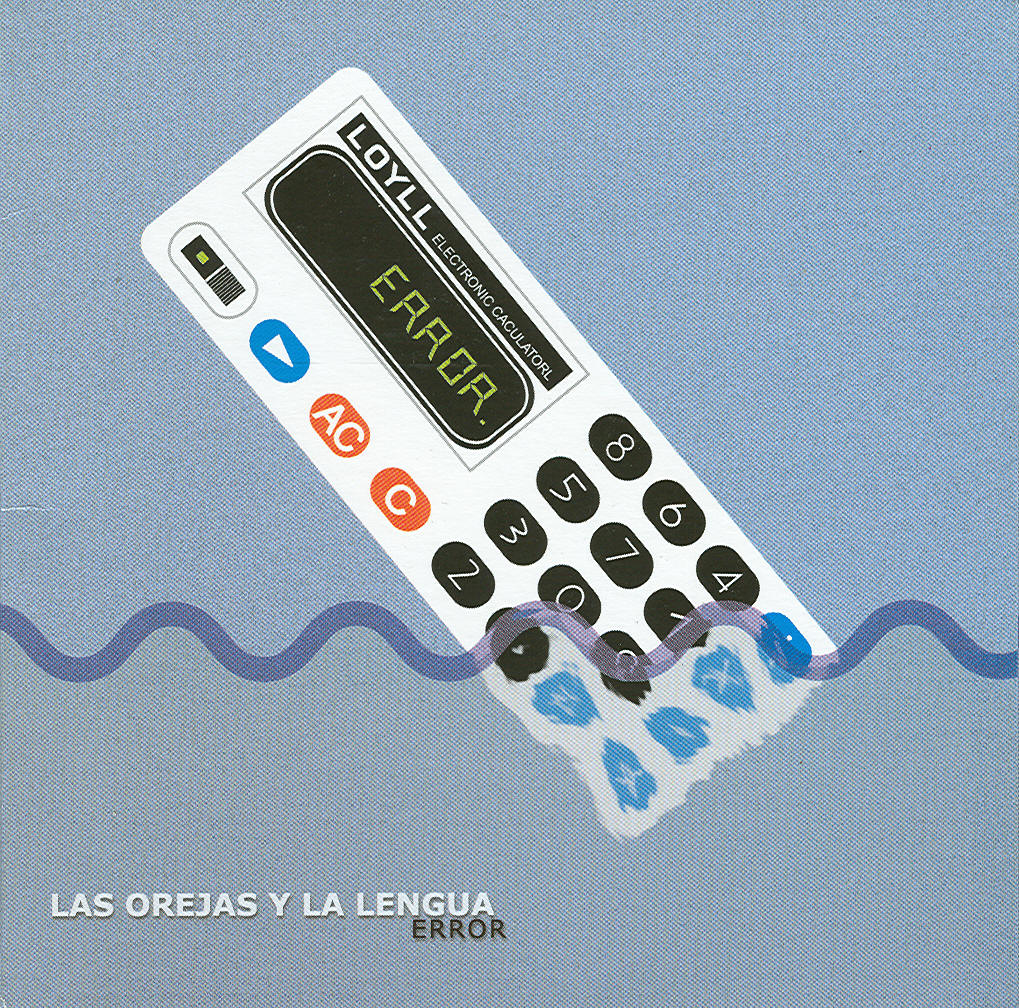
LAS OREJAS Y LA LENGUA: “Error” ****


Recorded 2000


Las orejas y la lengua are an Argentine band created around the core formed by Diego Kazmierski (keyboards), Nicolàs Diab (bass, guitar) and Fernando de la Vega (drums, percussion).  On their two recordings they showed a penchant for unconventional marriage of underdeveloped melodic themes embedded in richly orchestrated but highly sequential arrangements.  The succession of pleasantly interwoven topics betrays their hankering toward approachable aesthetics, which sometimes clashes with the more defiant fragments anchored in avant-prog tradition. 


High-quality production and wealth of original ideas have so far protected the band from become a derivative of this international genre.  One can hope that further successful recordings will see the light of the day.


Eufòrico Tribilìn

A powerful flute’n’rhythm section attack instantly awakens our musical taste buds.  In two short sections, the stop-go regularity fades away before monotony sets in.  This is when a retroactive, meaty guitar introduces a starkly nonlinear fragment with highly selective cymbal playing and a thunderous, almost inert electric bass.  Diego Suàrez’s flute penetration is supreme, particularly in the middle range.  Diego Kazmierski adds some bandoneon samples, but they are barely recognizable owing to speed treatment.  Several olas of dilating flute, bass and percussion will close our first encounter with the band.


Suricata

Carried triumphantly by the excitable duo of piccolo and acoustic piano, the circus-like intro is stripped down to Cartoon-style basics.  Inevitably, the piano penetrates the free jazz land while the Fernando de la Vega’s drumming pre-figures the manual inventiveness of Bad Plus’s David King.  Soon after, the piano and bass figure bring back the memories of Steely Dan’s “Ricky Don’t Lose that Number”, sans the actual theme.  The flute playing, warm and mostly legato is somewhat reminiscent of J.D. Parran immortalized on Anthony Davis’s classic recordings.  Halfway through, another free section kicks in, this time entirely dependent on dampening piano pedals and a snaking flute.  Melodic, high-pitched electric bass and easily legible drumset rescue the track from the morass.  Sharper flute tonguings appear in a-rhythmic combination with the volatile rhythm section.  When the dynamics commences to glow again, the synthesizer turns the hitherto ribboned texture into a more evenly planar arrangement. 


Leandra

This begins with a clanking, almost ‘North American folk’ acoustic guitar.  But this will not be John Fahey’s tribute.  The drummer and organist join in a now-you-hear-now-you-don’t pattern.  Nicolàs Diab’s bows his acoustic bass martelé style until the incipient melodic figure recurs.


Norma

Here we are confronted with an exceedingly lazy, Ry Coodish electric guitar and bells.  By way of contrast, the samples thrown into this idleness could be sourced from an operating room.  But it is dangerous to listen in closely because sudden eruption of guitar pounds forward, Steve Tibbetts’ style (limited grit, measured sustain).  After another intersection with low-key samples, a more ‘doom metallic’ guitar section crashes into an electronic echo.  In a swift progression of astonishing moods, we quickly move over to a bass & rim shot sequence.  In a pivotal moment reminiscent of Metabolist’s LP “Hansten klork”, the tempo accelerates illicitly, though time will run out for another guitar eruption.


Verònica G.

The groove is burrowed here by a stable cooperation of the electric bass, guitar, measured rim shots and hi-hat.  Will the groove erode?  Or will it flick over its momentum onto another structural lattice?  We have already learned the lesson not to trust the quieter passages.  However, this time, the dynamic progression is gradual, almost imperceptible.  A synthesized harmonic glissando expands behind, without affecting the core groove.  The flute swivels with just enough echo, a little like in Dom’s unforgettable “Edge of Time”.  Goofy samples – female backward singing – perfectly wound into the harmony and fall neatly within the beat. 


Ahora sì, chau

Another track which begins with the flavored acoustic guitar.  Its zither-like jangle is almost “pretty”.  Droll ping pong samples and radio static sounds could make it a tongue-in-cheek interlude penned by Albert Marcoeur.


Hermanas colgantes

We first hear car-less street noise samples – multiple human steps, playing children, voices.  This is Nicolas Diab’s tour de force and he appears in three roles at once – on a juicy bass guitar, a melodious Rhodes piano, and the acoustic bass played confusingly high, sul tasto on G-string.  The flute flutters over and above the piano and drum frames.  Dias mistreats his electric bass, testing its low-end capabilities by squeezing the far end of the neck.  Then the Hammond steps in, but its threat is distilled by the flute’s softening presence.  The mood darkens as this 12-note section repeats a dozen times.  Finally, a classicist coda with flute and piano terminates this honest, unpretentious piece. 


Disposable Blood Oxigenator

Hearing a dolorous glockenspiel with bass and a flute, one could be excused for recollecting Nino Rota’s poignant “Casanova” soundtrack.  Here, the band will not dwell on such throwbacks.  Instead, it engages the Hammond organ and acoustic bass con legno, where the strings are tapped with the wood side of the bow.  But the tension is quickly released by the flute and organ theme, saucily contacted by the bent (fretless?) bass guitar.  Rattling xylophone (Fernando de la Vega) will be a belated invitee to this concoction. 


La autopsia de Sandoval

This slow-metered composition first demands a construction of a full-range hexahedron supported by the bass and covered with the flute.  But they no sooner build the structure than it is stripped down to the hi-hat and very quiet bass.  Even this calm is premature.  The Hammond organ adopts a role well known from Italian movie scores by Piero Piccioni or Armando Trovajoli.  The flute now has a lot of space to improvise on top.  Sudden accelerations of the Hammond/flute duo constitute an interesting update on Supersister’s classic sound.  But Diego Suarez is more intrusive than Sacha van Geest ever was and the rhythm section really lives in the 21st century.  The last section is a painstaking rock hymn with piccolo doing its best to live up to the Italian tradition. 


Còrdoba, Oscar

Another heated, crawling entrée, spiced with static à la Fennesz.  This is soon interrupted by a rhythm section and multi-tracked voices of the musicians pronouncing the name of the Argentina’s second largest city.  Quick guitar arpeggios with a military drum roll invite even more diverse vocal versions of “Còrdoba”, each closed by a brief synthesizer section.  In quick succession, Spanish voices cut in, disorienting the listener.  Men and women, old and young appear in dozens of cameo roles, pushing the instruments into the distance. 


***


The band has published two CDs and nothing new has reached the broader audience for almost a decade.  They are, apparently, still active and have augmented their line-up with a violinist. 


LAS OREJAS Y LA LENGUA: “La eminencia inobjetable” (1996)

LAS OREJAS Y LA LENGUA: “Error” (2000)

Published in: on June 18, 2008 at 3:36 pm  Comments (2)  
Tags: , ,

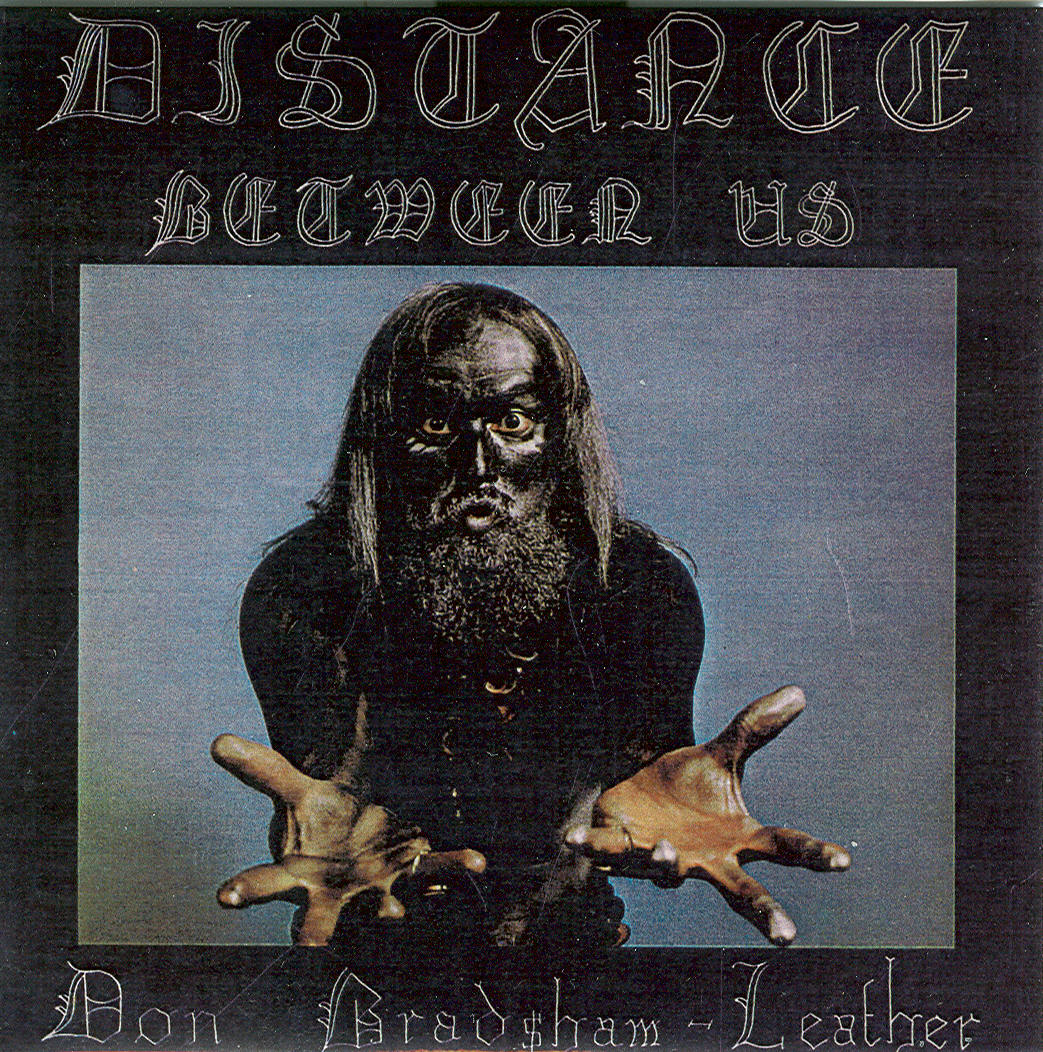
Don BRADSHAM-LEATHER: “Distance Between Us” ****


Recorded 1972


Without getting involved in a speculation who this British keyboard player was, one can easily admit that the “Distance” between the legendary status of this recording and the actual quality of the contained material is less than in many other cases of overhyped “classics”.  Don Bradsham-Leather bequeathed a double LP of precocious mellotron and piano explorations, exhibiting knowledge of Stockhausen’s taboo-bending studio manipulation and imagination limited only by the congenial, but somewhat unwieldy keyboard instrument routinely associated with the sounds of the 1970s. 


“Distance Between Us” is a one-off – or rather a one-off among many other solitary statements left over from the axial era of unprecedented musical experimentation (1969-1972).  Often considered an island on itself, it rather forms part of an archipelago that stretches from Bruce Palmer, through David Stoughton, Joakim Skogsberg, Cro-Magnon, Friendsound, Red Noise, Min Bul, Zweistein, Komintern, Frolk Heaven, Haboob, Syrius, People, Triode, Kokezaru Kumikyoku, Walter Wegmüller, Fille qui mousse, Surprieze, Gruppo d’Alternativa… All these names disappeared after recording one, usually highly idiosyncratic album.  No wonder they are highly sought-after.  Importantly, many of these records have aged better than “Distance Between Us”. 


Distance Between Us, p.1

The dark, mostly minor-scale set begins with a poorly recorded pianist, deeply focused on the left-side of the keyboard.  Seconds later, he will shift from the drenched, earthbound chords, through exalted concerto style and over to a repetitive delirium.  This oscillation between the three piano styles will remain a recurrent pattern on the album.  It will be augmented by a heroic mellotron with alternating “reed” tones.  The molten piano jerks and yanks, but it is slowly, ineluctably drowning in the faux reed aquifer.  When it resurfaces, the intense piano figure is accompanied by hand drums, multitracked on both stereo channels – another trademark of “Distance…”, probably novel at the time.  In the meantime, the panoramic mellotron swaps its “reed” tones to magniloquent “strings”.  The hand drum beat is saved from tedium by gravimetric tympani accents, giving the mellotron tune a quasi-dance quality.  But soon, the drumming speed accelerates and demolishes the meter.  This makes space for a Hammond organ solo, with the rhythmic support from the surviving hand drum beat and a gasping piano working hard to catch up.  The deadpan, curvilinear organ spirals conservatively and the overall perspective is retained when it comes to the fore.  When it stops, the triumphal concert piano returns solo.  After a welcome moment of vacuum, the simple hand drum beat re-injects some life into the form with tambourine.  The last 4 minutes mark the most diverse and accomplished fragment on the album.  It begins with a rhythmic acoustic guitar redolent of German hippy communes, but rendered nobler by female vocalization and some unorthodox vocal clicks and grunts.  The piano moves away from the Homeric overdrive and improvises within scales dominant in Spanish zarzuelas.  The rhythmic gesture is aptly framed into an illusion of horse riding. 


Distance Between Us, p.2

The second part opens with solo piano, quickly condensed into an ominous, obsessive ostinato, not dissimilar from the manner later adopted by Alvaro.  Hollow hand drums are concealed somewhere in the mix.  But we are still in 1972 and the mellotron has to reappear in its string form – introspective and brooding.  It will occasionally venture into other pre-recorded tones (consolatory flutes and cellos).  This multi-tracked “trio” of acoustic piano, mellotron and discrete hand drum will concentrate on mood generation, rather than melodic progression.  When the mellotron strings unfurl their wings, and the first signs of its majestic choral sound appear.  The oniric tone becomes gradually more intense, until overlaid by a nocturnal piano etude, continually hesitating between serene romanticism and convulsive ostinato.  When these two paths are fused, an unexpected baroque figure looms up with trills, much to our relief. 


Dance of the Goblins

Intimidating waves of libidinal mellotron lurk behind the unconscious horizon.  Its menacing ferocity is compiled by the dynamic shifts and a largely indecipherable hand drumming endlessly vacillating between the stereo channels.  The atmosphere is one of foreboding augur.  But where Jasun Martz several years later exploited the pathways leading to an eventual oxidizing climax, Bradsham-Leather’s procedure concentrates on tension build-up and build-up only.  On occasional sharper arêtes, the instrument’s “organ” sound spikes, in vain.  After another failure to reach the imposing peak, the expedition revisits a romantic melody, sketched forlornly on mellotron’s “reeds”.  After such sumptuous exploration, inscrutable percussive clusters surge forward.  Their lifespan is limited.


Autumn Mist

Distant, bereaved piano solo cuts an unattractive, circular theme.  The tremendous mellotron swells again, forcing the piano to define itself in modal terms.  The dynamic contrast here is stronger than on previous tracks and halfway through the composition, the track almost ebbs into nothingness.  It is rescued by a slovenly piano and reedy mellotron.  The mythomaniac piano will continue its Tchaikovsky’s Piano Concerto No.1 – wannabe drivel.  The mix-down is extreme, as if suffocating the keyboardist’s efforts to assert himself.  Until the closing sections of this arcane musical wrestling, it will remain a heroic tussle opposing the Babylonian mellotron, the narcotic piano and the totalitarian mixer. 


***


This is Don Bradsham-Leather’s only known recording.  Many search for this LP due to its legendary status as the ultimate mellotron galore.  Although directly unrelated, Jasun Martz’s “The Pillory” (1978) and Niemen’s “N.AE.Katharsis” (1976) offer a good proxy. 


Don BRADSHAM-LEATHER: “Distance Between Us” (1972)

Published in: on June 17, 2008 at 10:43 pm  Comments (1)  
Tags: , ,

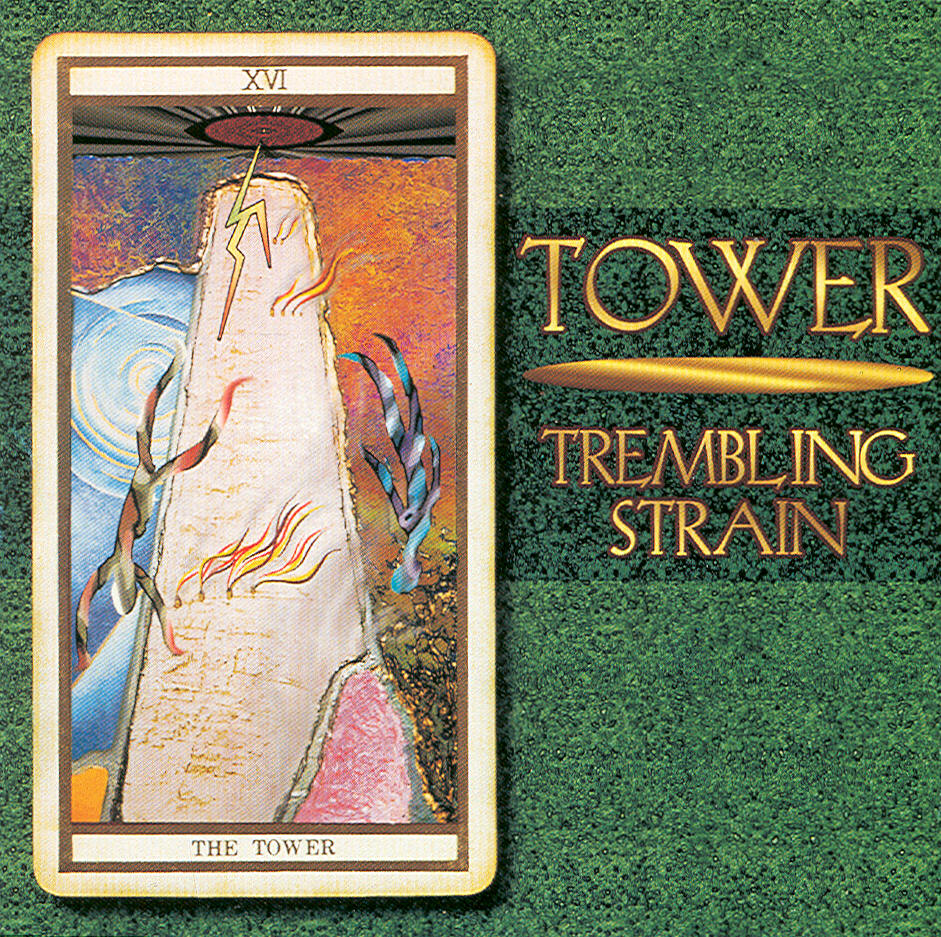
TREMBLING STRAIN: “Tower” ***

Recorded 1996-1997.


In the mid-1990s, electronic and new age music composer Pneuma (Satoru Takazawa) unexpectedly shifted gears, leaving a series of tasteful recordings drenched in funereal mysticism, astrology, medievalism and pictorial symbolism.  Supported by Akira, Shin Yamazaki (ex-Lacrymosa) and Yuko Suzuki, the formation adopted the unlikely name: Trembling Strain.  With the help from other like-minded musicians, Pneuma & Co indulged in exotic exercises of color and space.  Their appetite for trans-cultural combinations collated luscious mirages with Asian, Middle Eastern, African, medieval and Brazilian instruments.  The results of this concoction are usually more than the sum of the parts and occasionally Trembling Strain added to the shortlist of the most accomplished ethnic atmospherics.  At its worst, the band did not avoid the traps of new age noodling. 


Falling short of creating a pseudo belief system, the band paid attention to the visual side of its productions.  The cover art was peppered with collages made up from slices of Max Ernst, Ingres, Breughel, Melanesian art and naïve fantasism. 


Farewell Song at Waterside

The most unusual timbral combination opens the record with Pneuma on bowed psaltery, Daiki Tojima on darabukke andYuko Suzuki on Celtic harp.  Pneuma had perfected his arco technique on psaltery reaching eerie resonance with legato bowing.  I can recall only one precedent – Fisher fidola employed by Orchestra of the Eight Day in the early 1980s.  Darabukke attracts dry, short, swatting echo of a closed space.  From this array emerge purgatorial voices and girlish giggles.  The spectral glissando quality evokes the most memorable moments of Stephan Micus – another explorer of unique timbral juxtapositions.  When acoustic guitar finally etches a pattern, it flows lazily, with little development.  Short arpeggios on hammer dulcimer will not change the overall impression. 


Towers of Silence

There is nothing to see, or indeed hear in Mumbai’s Towers of Silence.  This 17-minute piece does begin with silence.  Akira’s hand drums, Tojima’s upright bass and Akira Kawaguchi’s jembe introduce a densely repetitive, mantric rhythm pattern.  Against this slap-tone-bass motif, Shin Yamazaki improvises on oud, as if lost in the darkened corner of an empty mosque.  Soon, the contour will be affected by reverberating growls, space whisper and ominous howling.  The flow is occasionally stripped down to mere hand drums, chimes and saz, strummed uncomfortably by Pneuma.  Resurgent shakers are immersed in a heavy echo, but otherwise little happens.  It is as if the band was in mid-flight, in a reluctantly improvised mood, waiting for someone to assume leadership – a tin whistle here, a Tibetan gong there.  Pneuma saws his low-key morin khuur – a form of Mongolian erhu, but pitched lower than its Chinese counterpart.  When the acoustic guitar rhythm swings back, a Syrian flute responds.  The track ebbs slowly, back into the silence. 


Moon-Shadow Play

Berimbau, scraped sul tasto gives off a buzzed tone – plated by a thin coating of percussive hypersurface.  Then, a highly inadequate call and response begins between an interrogating, mythological symphonium (mouth organ) and bowed psaltery.  This is Pneuma’s signature tale, explored on Trembling Strain’s earlier records.  For a moment, Pneuma plucks the saz, to bestow on this track a more melodious edge.  When the theme matures, additional inputs come from Egyptian tambourine’s blunt jangle and from Tojima’s acoustic bass guitar.  Before they exit, the heavy growling returns. 


Heaven in a Doze

This is a longer composition in 6 parts.  Its first movement (“Stargazer”) opens with a lonesome, sparse hammer dulcimer theme.  The Fisher fidola – like texture is back, but some fake bird chirping is thrown into the mix, overcooking the imagery already crowded with summertime wind blowing, percolating water and a cuckoo.  Then Tibetan bells begin to tinkle, pre-announcing a wailing mass counterpointed against darabukke’s deftly hand-made echo.  Akira’s vocal chords are breathy, guttural, fibrous.  Multi-element whistles and slothful Celtic harp ripple into the cavernous interior that envelops the listener.  In the next movement, we are thrown into the boundless panorama of heavenly auras, so reminiscent of Popol Vuh’s early records.  Between the celestial layers of immobile, sustained chords, the glissandos of various string instruments compete in high pitch and concentration.  This is the most static moment of this generally contemplative record.  Damned, Dantesque voices plead for our attention from the abyss.  Tojima’s dystopic Tibetan horns finally break the mood and Pneuma’s dull cymbals add splashes of overtones.  After a less seamless transition, Tomoko Katabami brings along an African metal ballaphone.  A simple, mellow figure is synchronous with Javanese angklung, played by Tojima.  The unusual interplay of these timbres is magical.  Pneuma’s singing bowls join with long, ringing delay.  Chimes and tiny bells are counterpoised for detail.  This is a scale-invariant piece that unfolds endlessly.  Finally, the last movement returns to the hammer dulcimer cum birds “solo”.  When it disappears, we are left alone, with crackling twigs. 


***


“Tower” was recorded at the crepuscule of Trembling Strain’s inventiveness.  However, I do recommend their earlier recordings.  They are often saturnine and bleak, but at the same time refined and magnetic. 


VARIOUS ARTISTS: “Lost in Labirynth II” (1994)

TREMBLING STRAIN: “Anthem to Raise the Dead“ (1994)

TREMBLING STRAIN: “Four Pictures“ (1994-1995)

TREMBLING STRAIN: “Bottom of Empty“ (1995-1996)

TREMBLING STRAIN: “Tower“ (1996-1997)

AKIRA & TREMBLING STRAIN: “Dwelling of Telescopefish“ (1997-1999)


Pneuma has appeared on many other recordings, also in duo with his partners from Trembling Strain.  Prior to the formation of this band, he had recorded under the moniker Takami.  Although Takami’s LPs had their moments, they are better left to the fans of 1970s’ Berlin synthesizer scene.  Conversely, Pneuma’s return in trio with Furudate and Arima marked the high-point in contemporary tortured, apocalyptic electronics. 


TAKAMI: “Tenshi-kou” (1983)

TAKAMI: “Yume no kirigishi” (1985)

Tetsuo FURUDATE – Sumihisa ARIMA – PNEUMA: “Autrement qu’être“ (1994-1995)

Tetsuo FURUDATE – Sumihisa ARIMA – PNEUMA: “Autrement qu’être, vol.2“(1996-1998)


Published in: on June 15, 2008 at 8:33 pm  Comments (1)  
Tags: , ,

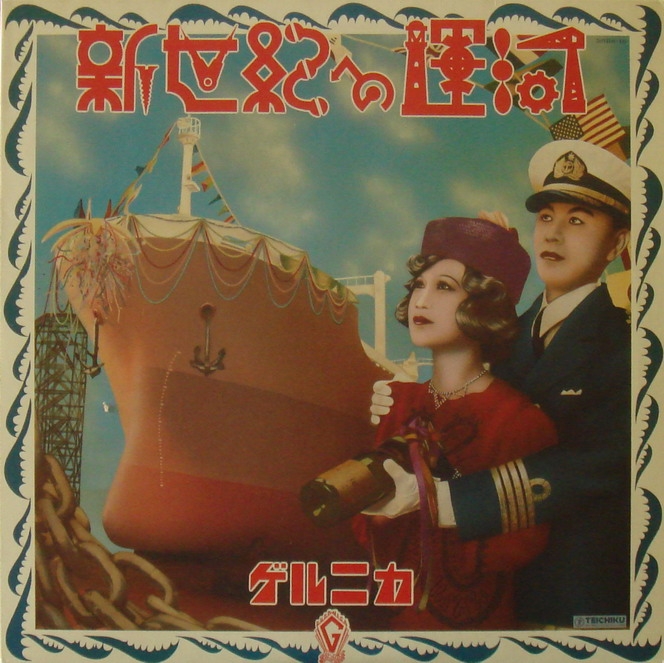
GUERNICA: “Shinseiki e no unga” ******


Recorded 1983.


Guernica was a result of Koji Ueno’s lucid imagination.  In partnership with lyricist Keiichi Ohta and pop-chanteuse Jun Togawa, Ueno produced a series of unforgettable recordings in the early 1980s.  Adopting a moniker from Picasso’s largest canvas, Ueno’s art focused on tongue-in-cheek modernist revival, the praise of machinery, speed and technological progress.  However, contrary to the then reigning coryphées of industrialism, Guernica’s music is eternally optimistic, vivacious, euphoric.  Jun Togawa’s über-versatile voice mauls any pretence of seriousness even for those who cannot understand Ohta’s ironic lyrics.  Togawa shifts effortlessly between malice and hysteria, between operatic arias and coquettish winks.


These modernist manifestos and art-deco stylistics could have been a worn-out pander to a retro wave, but for rock avant-garde, they were a terra nova, soon abandoned like Greenland’s first settlements.  No one has ventured there since.  Jun Togawa pursued her career as an overly eccentric TV personality and became widely disliked by Japan’s mainstream public. 


As we are nearing the end of the oil era, the outside world has yet to discover these inspired and refined statements from a quarter of a century ago.


Jikabigin

A jolting, uptempo chamber orchestra welcomes us to the phantasmagoric world of 1920s.  Conducted by Hiroshi Kumagai and programmed by Tatsuya Satoh, the aerodynamic string nonet includes six violins, two violas and a double bass, deftly propelled by Takayoshi Matsunaga’s dexterous fingers.  Masao Yoshikawa bombards the combo with his tympani runs and Koji Ueno adds some surface treatment on a synthesizer.  That’s all we know after the first several seconds.  And then Jun Togawa’s comic operetta swoons on us with her nervous, taut, insoluble histrionics about… the astonishing forces of a magnet.  The gravity of the subject is adequately underlined by the grand piano and some synthesizer color.  It turns and twists, excited like electro-magnetic forces that this song is devoted to. 


Shûdan nôjô no aki

A definite bow to early Soviet modernism.  The 50-piece orchestra forcefully rolls out a passionate Russian dance, complete with balalaika (Yuzo Murayama).  Togawa’s voice is over the top, spewing tractor and samovar stories at hyperspeed.  In slower, romanticizing moments, her manner evokes Donella del Monaco.  Kazuyoshi Utsunomiya on mandolin further approximates this other pole of modernism.  The incredible rondo ends on a high note. 


Mizushômiya

A more lyrical respite.  Togawa’s strained, wistful voice is cheerless and disconsolate.  The orchestral strings are clearly illustrative, retrofitted with Chinese zheng strings (Jiang Xiaoqing).  A six-piece wind section of flute, oboe, clarinet, bass clarinet, bass trombone and tuba niftily apportions sinified pentatonic bridges that anchor our rhizomatic imagination strongly in mainland East Asia. 


Nihyakujûnichi

“200 days” opens with a classic orchestral overture.  A soaring crescendo ushers in the dramatic persona of Togawa who cloaks, more than reveals, an uncertain melodic line.  The piece sensitizes us to an impending drama with Hitchcockian string arrangements.  Togawa returns; first marauding with her baby voice and then with jarring, unpolished complaints of a brat.  The full orchestra closes with a salvo from an unusual horn section, including Michiya Koide on 19th c. octavin in addition to English horn, flute, oboes, clarinets, bassoons and contrabassoon. 


Shônen no ichiban no tomo

A short monogatari about who the best friend of a child is.  It is delivered in a poignant, naïve, quasi-castrate voice.  The instrumentation is less obtrusive, with additional color from Matsue Yamahata on harp and Yuji Yamada  – viola.  The singer finally reveals who that first friend is – a mother…


Kuraudo 9

The intro serves another morsel of cinematic dramaturgy.  The ever flexible Togawa is supported here by an elusive chorus.  This is an inevitable grande valse, replete with fleeting Straussian quotations.  Ueno’s orchestration and arrangements are over-lubricated, which puts it at some distance from other revival records at that time (e.g. Julverne’s “Emballade”). 


Panorama awa

Back to the high-graded, synthesized sound from Guernica’s first LP.  The song soars with adolescent enthusiasm about inventive visual devices.  An ever optimistic, rotating string section zips through it all with gusto. 


Rinteki

In a complete change of décor, side B begins with this American vaudeville swing orchestra.  Sandwiched between Glenn Miller’s radio days and Ron Pate & Debonairs’ parody days, Guernica surges through the music-hall bacchanalia.  Staccato piano intrusions may slow down like a tired locomotive, but quickly cede to Tommy Dorsey-like zestful horn section.  If this was not sung in Japanese, one could almost forget how satirical this song is.  We learn it all about a cylinder press and how dynamically it revolves – “round and round, round and round”.  The pseudo big band chops adroitly between vocal and orchestral sections, but never loses cohesion. 


Kôtsû sanka

We are back to the formula from the first track – bewitching clash between a strained, castrate voice and ultra-speed string section.  But now Togawa slides boldly into opera, thrusting with her powerful, dramatic soprano (yes, she can sing, but only sometimes she decides to bray instead).  Her voice is blessed with a full tone quality, but her forays are short, though legible enough to make us chuckle at this “Praise for Transportation”. 


Denryoku kumikyoku

This “Electric Power Medley” is a joyless composition in three movements for a ubiquitous horn section.  “Damu no uta”, should, according to the title at least, be a song for shamisen dedicated to a hydropower station.  This is a slow-moving narrative with the now familiar recipe of Togawa switching between vocal styles and registers with the ease of a 1930s cast-iron crankshaft.  The second movement (“Denryoku no tsûkin”) is rich in tympani and orchestral percussion, almost lifted from the tradition of great Russian romantic composers of Moguchaya Kuchka.  Finally, “Denka no kurashi” (“Electrical Life”) is a more melodic fragment with balalaikas and empathetic flute section.  In the final stanzas, Togawa’s vocal style abandons the acerbic and malicious manner and turns coquettish instead.  Trombones close this least aphoristic of all tracks.


Dokuro no enmaikyoku

This distinctly non-circular waltz throws in Orientalist accents painted by strings of desert-prone ‘Lawrence of Arabia’-type nostalgia.  At times, the mood is almost Felliniesque and surrealist, but the reflection is actually Shakesperean; musings on a relationship with a skull. 


Zekkai

The final track tickles our Pacific fantasy.  In a dig to Martin Denny’s Exotica style, Jun Togawa appears with a velvety, hushed voice, singing about “the island at the end of the earth”.  From this oceanic foam, oozes Aphroditean harp and idle maracas.  Somewhere between Japan and Hawaii, waves lap against the pastel shores. 


***


“Shinseiki e no unga” (“Canal to the New Century”) remains the masterpiece of the Ueno-Togawa-Ohta trio.  Still, similar revivalist intensity was achieved on three other recordings, each of which is highly recommended. 


Keiichi OHTA: “Jingaidaimaikyo” (1980)

GUERNICA: “Kaizô e no yakudô” (1979-1982)

GUERNICA: “Shinseiki e no unga“ (1983)

GUERNICA: “Denrisô kara no mezashi“ (1984)

Published in: on June 14, 2008 at 12:55 pm  Comments (2)  
Tags: , , , , ,

DATE COURSE PENTAGON ROYAL GARDEN: “Report from Iron Mountain” ******


Recorded 2001


Date Course Pentagon Royal Garden were a revelation of the first half of this decade.  Born after the break-up of deservedly regretted Tipographica, DCPRG were a bold idea of part-time Ground Zero reed player Naruyoshi Kikuchi.  For the early sessions he brought along the legend of Yoshihide Otomo, who officiated on the first two CDs.  But DCPRG were much more than another Otomo-related project.  Far from the polymetric intricacies of Tipographica, the large-scale orchestration sought inspiration in electric Miles period of early 1970s, heavy funk music and South American fusion.  If that concoction could sound almost conventional 30 years on, it was anything but.  The innovative use of samples, the enterprising gravity of the swashbuckling rhythm section and efflorescent production set DCPRG apart from other bands keen to capitalize on the unexpected funk revival. 


In the later productions, Otomo was absent and DCPRG expanded its horn section, entering a futuristic jazz-funk territory for adventurous ears.  It is hoped that the band will return to studio at some point.


Catch 22

There is something about the greatest of all records.  This “something” is how they begin.  The eponymous “Faust”, the third Motor Totemist Guild, Area’s “Arbeit macht frei”, Lussier-Lepage “Chants et danses du monde inanime”, Volapük’s “Where Is Tamashii?” are among them…  The unforgettable shock of our confrontation with the sudden agglomeration of ideas compressed into several short sequences…  “Report from the Iron Mountain” rings up in this shortlist.  The spine-chilling “I’m Something Special” thrown into our earlobes by a clueless princess so poorly adapted to life in the real world provides for a startling auditory jolt from which no English-hearing listener will recover throughout this engaging collection.  But the band does recover: an electric piano and a dense percussive equivalent of a musical coral reef will carry us through a lazy, unquenchable funk.  Listeners compare this percussive overgrowth to electric-era Miles Davis and especially his more oriental moments.  There no little doubt that Masaki Yoshimi’s cavalier tabla is the main culprit here.  The groovy figure on the leading electric piano (most probably the leader Naruyoshi Kikuchi) operates at a contrived delay to the reigning rhythmic compressor: tabla, sizzling electronics, bass, drums.  The sampled, clueless voice of a spoiled American female recurs with abandon.  In response, a wild, dingy alto sax lashes out obsessively.  The electric guitar interferes with long sustain, but the futuristic machine advances on a perfectionist tripod of drums, electric bass and the ubiquitous tabla.  Yoshihide Otomo’s solo guitar is slightly gritty, located somewhere in the 1970s transpacific tradition, almost independent of the obtrusive rhythmic, orogenic compressor.  After 6 minutes of this delectable progression, an explosion of free noise alerts us to a different serving from the guitar/organ duo (Kohki Takai/Masayuki Tsuboguchi).  The monstrous rhythm section rushes forward, with opportunistic decoys calling on.  But the machine can be easily immobilized: short drum solos interfere, immersed in sudden, disorienting silence.  After another free noise avalanche, it’s one of those classic guitar moments.  “Tell me when it’s over” declaims the clueless lady.  It is over, though.


Play Mate at Hanoi

What a relief.  After this hard-driven deal, this next track welcomes us with a Latin rhythm clanked up on woodblocks.  The synthesizer improvises on top, heavily dependent on pedal-generated bass lines.  Tinny cowbells add accents off the main beat and the radiant organ doubles, but not quite harmonically.  Only when twangy guitar à la Reggie Lucas pays a visit, does the entire rhythm section fall into a “samba falsa” groove.  Soprano sax is too shrill to compare it to David Liebman’s, but its electronic amplification and slight echo are certainly redolent of the mid-1970s drug-enhanced Davis combo.  Here, the saxophone is very agile and blends perfectly while retaining inductive projection.  When we suddenly jump into a funky line – almost Isaac Hayes’s “Shaft” – Kenta Tsugami’s soprano saxophone goes cyber-jazzy.  Finally a 15-note theme appears on reeds and synthesizer.  The wayward soprano departs from the groupthink as soon as it has rejoined.  In full flight, a Korg/guitar duo takes over the first 7 notes from the resampled theme.  Gosekky’s tenor saxophone will supply here a more ‘modern jazz’ color, but the richly chromatic rhythm section (Masaki Kurihara, Yasuhiro Yoshigaki, Nobuo Fujii, Gen Oogimi, Itoken), thickens the texture, especially when reinforced by electronic reversals.  Two guitars (Y.Otomo & K.Takai) improvise separately against Kurihara’s repetitive bass line.  The tabla re-appears, and then we are exposed to a cheesy Korg plunging into a high range hijacked from children’s TV programs.  By now the groove has grown into an excellent dance piece.  If Jacques Tati’s “Playtime” was remade today, the final dance hall scenes would surely require the participation of Date Course Pentagon Royal Garden. 


S

This enigmatically entitled track is a bossa nova for electric guitar and a groovy clavinet.  I find it astounding how often Japanese avant-garde musicians relate to this musical format.  From Toshiaki Yokota’s “Flute Adventure”, through After Dinner’s “Sepia Ture” to Yoganants’ most recent “Bethlehem”, the relaxed musica da praia has enthralled the Japanese artists.  The cultural affinity is always there, introduced by Stan Getz’s classics 45 years ago and reinforced by the special relationship between the two countries and their reciprocal migrations.  The rhythm section here exhibits none of the density and fibrous precision of the rhythm section as we knew it in the previous tracks.  The bossa nova is sensual and breezy and whenever it hesitates, it restarts form a sample.  Organ and soprano provide a rarefied melodic content for a fleeting love story.  Suddenly, two fuzz guitars change the setting, with the help from Masayasu Tsuboguchi’s groovy clavinet.  The compact rhythm section is with us again.  The guitar and keyboard improvisations are atonal and a-rhythmic, but so much is happening within the rhythm section that one could wonder who grabs in the limelight.  When the percussive forest disappears, a screaming guitar and tabla break through.  After a short break the bossa nova returns.  Lambent flute and an empathetic rhythm section are with us this time, unhurried and old-fashioned in their modernism.  We could just as well join a party at Rio’s Museu do arte moderna…  Only some lustful synthesizer squeals in the background, disturbing the reverie… 


Circle/Line ~ Hard Core Peace

Electric piano commences in an almost “progressive” vein, only to yield to range-bound rhythm guitar, electronic pulsation and the 4-man strong percussive tropic back in action.  When the electric piano theme returns, the pulsating orchestra adopts a mantle of a full-bodied framework for a soprano saxophone.  The interplanetary keyboard is quickly drowned out by a fuzz guitar, but the clatter of the drum-percussion section is never really far.  When the soprano returns, the tinny clacking of Latin percussion will be at the ready, in full swing.  The soprano sax will harvest here the cleanest line yet.  By now, the brass section has entered a bop mood, surrounded by the unlikely tabla and sibilant aqua-color from the synthesizer.  If you bring back the memories of early 1970s, then a mix of Funkadelic and Miles Davis, with a pinch of British progressive orchestration would have yielded the basic recipe before you could fast forward 30 years and find Date Course…  The band realizes this, swinging big time with the guitar playing the chords that back then would have fallen on the reeds.  DCPRG’s evolutionary bravura reaches its apex when the real reed section charges through the percussive, keyboard.  Kurihara’s bass rumbles nimbly and a keyboard solo leads onto another brave horn section and then overlays and some.  The ultramodern big band’s panache reaches here Ellingtonian enthusiasm. 


Hey Joe

Cheesy 1970s electric keyboard makes an entrée, but is this Bill Roberts’ composition?  At first, it does not quite seem so.  Rather, it sounds like a clavinet galore, pushed forward mercilessly by the keyboard/rhythm combo.  The bass rumbles lower than usually.  The inserted turns are of heavy funk heritage, taking us back to the plopping, racy flux.  At the next turn, the heavy part is almost hard rock, softened by the plastic Korg sound.  Only after 6 minutes, do we recognize the terms and conditions of “Hey Joe”, the familiar.  Tsuboguchi’s organ is wheeling and dealing out consistent elements from the unforgettable hymn.  Later, the guitar will improvise within the scale, mostly in the higher register, but more with Ten Years After’s Alvin Lee-like sense of urgency than with Hendrix’ corporeal pyrotechnics.  Either way, the swirling organ will smelt the exchange until the very end.  An easily digested morsel…


Mirror Balls

Remember Mirror Balls hanging from the ceiling of 1970s discotheques?  I can’t recall if this theme relates to any of the era’s soul-funk topics, but the atmosphere is of an early morning dancehall closure.  Yes, it is funky, but intellectually so, in almost Stevie Wonder.  The dented notes remind us of his clipped vocal manner from the novel arrangements of the 1970s.  The horn section and the quacking keyboard loom up in unison to give us a jubilant, vivacious, almost catchy stimulus.  The flute makes its second appearance, slaloming between the rhythm section poles.  But when a polite guitar lays out the same program, we realize that this is little more than a collective tribute to the overall effort, with final statements by each musician.  


***


The DCPRG’s discography is somewhat confused.  Early stage repertoire was presented on positions 1 and 2 and reprised on 3 and again on 4.  Remixes from 1 and 2 can be found on 3.  In turn, 7 presents other versions of tracks already known from 5 and from 2.  That basically means that you should seek out 1, 5 and 8 as the best introduction to the band and then explore further the variation on the theme(s). 


1. DCPRG: “Report from Iron Mountain” (2001)

2. DCPRG / ROVO: Sino / Pan American Beef Stake Art Federations (2001)

3. DCPRG: “General Represantation Product Chain Drastism” (2002)

4. DCPRG: “Musical from Chaos” 2CD (2001-2003)

5. DCPRG: “Structure et Force” (2003)

6. DCPRG: “Chaos 2” (2003-2004)

7. DCPRG: “Stayin’ Alive/Fame/Pan American Beef Stake Art Federation 2” (2004)

8. DCPRG “Franz Kafka’s America” (2007)

Kikuchi’s constellation seems to be still active and new dvds occasionally surface from more recent live exposure.  In case you heard of new studio recordings, Sonic Asymmetry would like to learn about them…


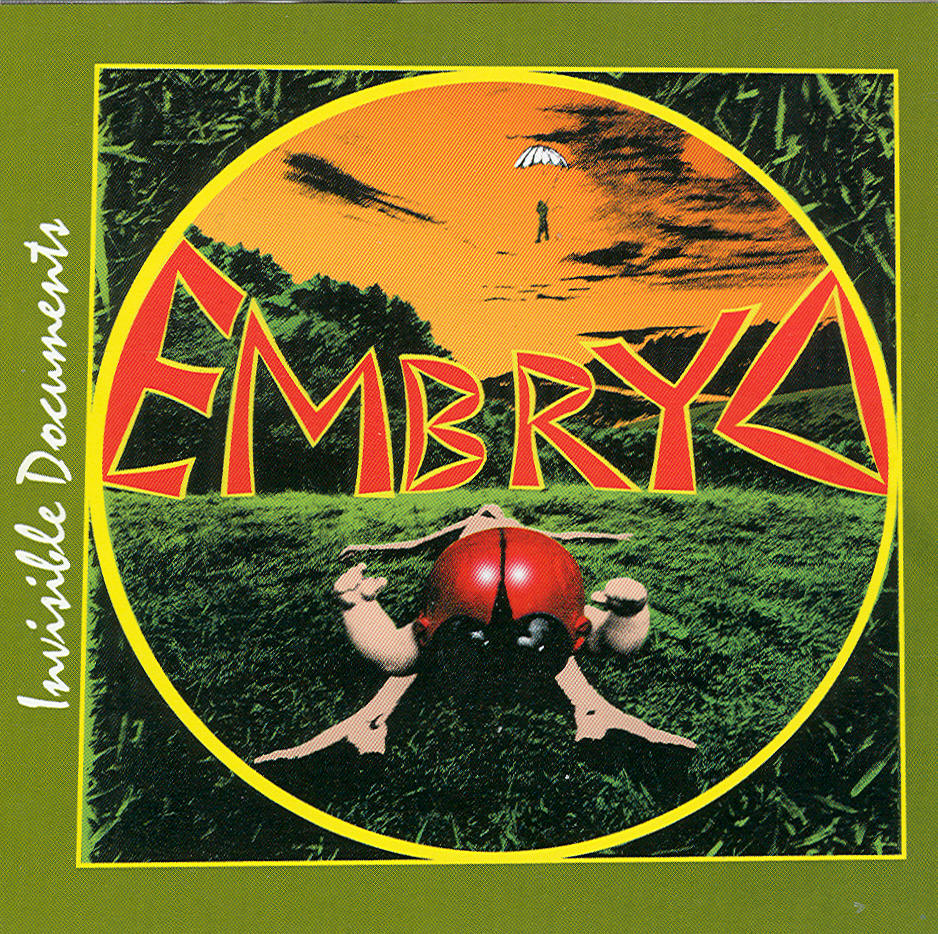
EMBRYO: “Invisible Documents” *****


 Recorded 1974


So much has been written about Embryo that bringing it onto the pages of Sonic Asymmetry could even be deemed superfluous.  Spanning almost 4 decades, the creative persona of Christian Burchard, a drummer and vibraphonist, has inspired two generations of artists from several musical traditions.  From Morocco to India and from Nigeria to Turkey, Embryo never ceased to look for that perfect cocktail of polymetric narratives, timbral exoticisms and figurative improvisation.  These valuable efforts have invariably bathed deep inside a cauldron of spirited pancultural communication and cross-pollination. 


Influenced early on by the unlikely combination of Mal Waldron’s exile jazz and Munich’s wacky improvised rock scene, Burchard was fortunate enough to agglomerate a core of fellow travelers who contributed hugely to the band’s immortality.  Guitarist Roman Bunka, and saxophonist and violinist Edgar Hoffmann were the key forces that managed to propel the caravan in times of recurrent and well-deserved fatigue.  Charlie Mariano, a well-known jazz figure, further enriched Embryo’s heritage. 


The record presented here, published only several years ago, documents a hitherto unknown phase of the band at the crepuscule of its vintage inventiveness.  These live recordings were taped only two months after the first perilous “sell-off” LP – something that major labels imposed on the most talented bands in the wake of the first oil (and therefore vinyl) shock.  “Invisible Documents” is a testimony to the creativity of the underground band that was forced, for several years, to come out in someone else’s skin whenever appearing over-ground.  Happily for Sonic Asymmetry, that unlucky period did not last long and Embryo’s re-birth was spectacular.  We will certainly come back to its epiphenomena one day.


 Invisible Documents

We are in Hamburg’s “Fabrik”, September 1974, watching a rump Embryo.  Just as we walk in, a repetitive, almost cavalier jazz guitar à la Lifetime fends off advances from a strangled soprano sax.  Very early on for a public performance, we are served with a drum solo and then a drum and percussion duo – skins courtesy Christian Burchard and bells from Roman Bunka.  Edgar Hoffmann’s soprano saxophone injects short squeaks into this well-behaved racket.  Bunka puts in some Latin accents on the dull, non-resonant bells, poles apart from an almost cymbal-less drum galore.  The duo climaxes and ends unusually, with orientalizing violin from Hoffmann.  Two or three phrases leave us with little doubt that Hoffmann must have enjoyed Indian sarangi playing.  This is surprising – at that time Embryo was yet to embark on its first venture into India.  The violin loses its distinctiveness in higher registers, where Hoffmann often penetrates.  Meanwhile, Norbert Dömling’s bass is unobtrusive and will remain so throughout this concert, but it does help Burchard with articulation.  A nervous high-hat squashing and guitar crescendo will eventually drown the violin.  Unimpressive vocal calls allow the machine to accelerate and Bunka to proceed in solo mode.  The fast pace of his guitar solo spans the rock and fusion formats, engraving a territory of his own.  The bass becomes more prominent and quasi-melodic, whereas the effects from the gritty guitar are now more diverse, with a slower release.  The rhythmic groove flows organically until the soprano sax ushers in the closing section.  The locus is the theme that we hardly recall from the intro.  Guitar and sax etch this plastic matter, sometimes in holistic unison, sometimes as a cluster of separate strokes.  Here the track ends as if the Revox reel had run out of tape…


Minaret

This half-an-hour improvisation unfolds slowly from a forest of shakers, brake drums and cabazas of nearly Art Ensemble of Chicago – like density.  Finally, a small-toned marimba will apportion equatorial temperature, clearing the veld for an agitated saz.  This long-necked, fretted instrument of Turkish origin has a fuzzy, muddled flavor, even though Bunka always appears keen to hammer down the expressway of his chordal exploration.  In the meantime, an always collectively-minded Burchard opts for a very simple figure on marimba.  An alluvial flute forces its way into this interplay, compressing the saz part into hallucinogenic micro-helixes around the robust core of marimba.  Throughout his pyrotechnic exposé, Bunka stays obediently within the metric code provided by Burchard’s gradated idiophonic attractor.  When the flute briefly vanishes, the duo between marimba and amplified (?) saz enters a tawheed territory.  The flute later returns, but misses the point completely, failing to rise to the religiosity of the occasion.  With the change of guard, the drumset replaces the marimba and the soprano substitutes for the flute.  Quieter, snaky passage leads into a dark corridor where the origins of various sounds are of uncertain origin.  We can only surmise their epidermic, valvate or diodic provenance.  Scraggy, porous, cinderblock soprano disambiguates this enigma and enters a new space within its lukewarm, low base register.  An almost invisible Dömling intones a familiar ethno-funk bass phrase (probably from “Holy Ghost”).  The others follow, in an elliptic, potentially endless fashion.  The electric guitar is, naturally, the most nimble of all the participants in this 8-beat long, revolving structure.  Later Dömling reprises the figure at double-speed and the soprano squawks in a fidgety manner, as if to avoid full involvement.  Cut.


Singing

This is a type of jam that Embryo, groping for direction, perfected from mid-1970s onwards; it is based on a sequence of various bass figures, with little logical or diachronic connection.  Early on, a very basic drum’n’bass flow gives us some misleading cues for the daunting 36 minutes to come.  The soprano sax flounders under some crunchy accents from the guitar.  This now will be Dömling’s only moment in the limelight on this recording, as elsewhere he is usually squeezed into a basic ostinato between a very expansive drummer and an occasionally greedy guitarist.  His cameo appearance in Embryo saga was sandwiched between Uwe Mullrich and none other than Uli Trepte, and so his shyness shows here.  Twist, shake and we are in a plunky funk mode with recurring time signature shifts around the refrain – somewhat of an Embryonnic trademark.  Burchard’s indistinguishable vocalizing and soprano saxophone squeals alternate for a while.  Hoffmann’s is a Bb soprano, pitched an octave below the Eb variant and much warmer in the middle register that he typically prefers.  But nothing lasts here.  The way the ungainly sub-sections connect brings back the memories of live rock medleys from before the sampler era.  The next part is more jagged and overdependent on the saxophone and the guitar, leaving too much vacancy.  This is a tendency that Embryo unfortunately perfected in its least innovative era between 1975 and 1978.  Regrettably, this is also the least inspired moment of this recording, but it soon segues onto a “song” and ends on a higher sax note with a more relaxed wah-wah guitar.  Then the drummer speeds up.  Bunka picks up cowbells.  The sax quacks, distinctively edgy, almost shrill, and occasionally muted (a cup?).  A melodic guitar/bass rock theme crashes in.  Clearly, the loop pedals were not yet available because when the guitar goes solo, the background is occupied squarely by the hard-working bass hand.  The dynamic ebbs a little, just enough to cramp some rarefied lyricism from the guitar.  But the morphology of this musical body is a medley.  Faster time keeping will provide a different easel for Bunka’s improvised art.  One or two bass themes later, the “vacant” part returns.  It is problematic.  There is simply too much space, devoid of proper use of silence, syncopation, or a properly amplified and articulated bass figure.  Luckily, Bunka graces us with several valuable seconds of his guitar orientalism.  His knowledge of Middle Eastern string instruments makes him a natural heir to (US) Kaleidoscope and Orient Express.  There is even that short Cippolina quote in which the sustained twang is allowed to scale up to the instrument’s top pitch in little more than a second.  And from there, we are back in a de-clustered funky land.  Hoffmann is back on his suffocating soprano and, for a moment, a guitar and drum duo exposes its mellower jazz side, pruned as fast as it appears.  The endomorphic closing is formless, and seemingly exhausted, but the guitaris will strike out a farewell that prefigures his solo exploits several years later.


Riad

Roman Bunka’s masterful oud solo explores the Nahawand mode.  The notes are occasionally bent, except in skilful run-ups, with limited reverb.  Hoffmann’s flute operates in a more familiar, Western scale, but the roles are not clearly distributed between the two instruments.  It is like a casual, hushed conversation in the early afternoon when everyone is seeking shade and daily activities slow down to absolute necessities.  The flute silences it all in an almost baroque Rameau style.


Shine of Walt Dickerson

Post-bop vibraphonist Walt Dickerson died three weeks ago (May 15, 2008).  His most memorable contributions were with John Coltrane and Sun Ra.  It remains to be established how strong his influence was on Christian Burchard.  Walt Dickerson R.I.P.


The track opens with a solo vibraphone, poised, exploratory, clean, but not crystallographic.  The vibrato is well controlled.  Burchard is comfortable with tremolos and grunts occasionally, but white noise glissando is almost entirely absent in his play.  After a while, Bunka’s guitar thickens shadowy harmonic background and Hoffmann joins on low-key soprano in low register, while Dömling takes care of muted agogo bells and shakers.  Once the entire quartet is back alive, Burchard moves over to cymbals, generating succulent overtones.  The guitar/soprano unison is quite unique, with the more mobile guitar making shorthand commentaries on saxophone’s soaring lines.  Here again, the bass is very sparse, almost imperceptible in this exchange between guitar and soprano.  Hoffmann’s tone color is excellent, but he avoids rapid skips – so tempting on this instrument, and leaves ramp-ups to Bunka.  Here the recording ends abruptly. 


***


Embryo’s discography is extensive, though mostly dominated by immortalized live jams, many of which are of highest quality.  With the possible exception of the quirky indo-funk period (1975-78), and possibly the heavily “African” recordings in the mid-1980s, most of their output is highly recommended.  Positions 2, 3, 4, 5 and 9 best document the young band’s exploratory transition from an early rock format to a unique ethno-jazz concoction.  Position 15 documents their legendary voyage to Central and South Asia (also on dvd).  From the later recordings, positions 18, 21, 22, 23 and 30 are of highest quality and blend many other Asian and neo-psychedelic styles. 


1. EMBRYO with Mal WALDRON: “For Eva” (1968)

2. EMBRYO: “Opal” (1970)

3. EMBRYO: “Embryo’s Rache” (1971)

4. EMBRYO: “Bremen 1971” (1971)

5. EMBRYO: “Steig aus” (1971, 1972)

6. EMBRYO: “Father, Son & Holy Ghost” (1972)

7. EMBRYO: “Rocksession” (1972)

8. EMBRYO: “We Keep On” (1972)

9. EMBRYO: “Invisible Documents” 2CD (1974)

10. EMBRYO: “Surfin’” (1974)

11. EMBRYO: “Bad Hats and Bad Cats” (1975)

12. EMBRYO: “Live” (1976)

13. EMBRYO: “Apo-calypso” (1977)

14. EMBRYO: “Anthology” (1970-1979)

15. EMBRYO: “Embryo’s Reise” 2LP (1978, 1979)

16. EMBRYO & KARNATAKA COLLEGE: “Life” (1980)

17. EMBRYO: “La blama sparozzi” (1979, 1981-1982)

18. EMBRYO: “Zack Glück” (1984)

19. EMBRYO: “Africa” (1985)

20. EMBRYO: “Yoruba Dun Dun Orchestra” (1985)

21. EMBRYO: “Turn Piece” (1989)

22. EMBRYO: “Ibn Battuta” (1990-1993)

23. EMBRYO: “Ni hau” (1992, 1995-1996)

24. EMBRYO: “Istanbul Casablanca” 2CD (1998)

25. EMBRYO: “Live in Berlin” (1998)

26. EMBRYO: “One Night in Barcelona” (1999)

27. EMBRYO: “2000, Live vol.1” (2000)

28. EMBRYO: “2001, Live vol.1” (2001)

29. EMBRYO: “Hallo Mik” (2002, 2003)

30. EMBRYO & NO NECK BLUES BAND: “EmbryoNNCK” (2004)


Some unique tracks are available on concert compilations, such as “Umsonst und Draussen” (1970s), “F/E/A/R This” (1980s) and “Open Air Herzberg” (1990s).  They have a high documentary value for all Embryologues worldwide. 


Published in: on June 7, 2008 at 7:00 pm  Comments (1)  
Tags: , , , ,

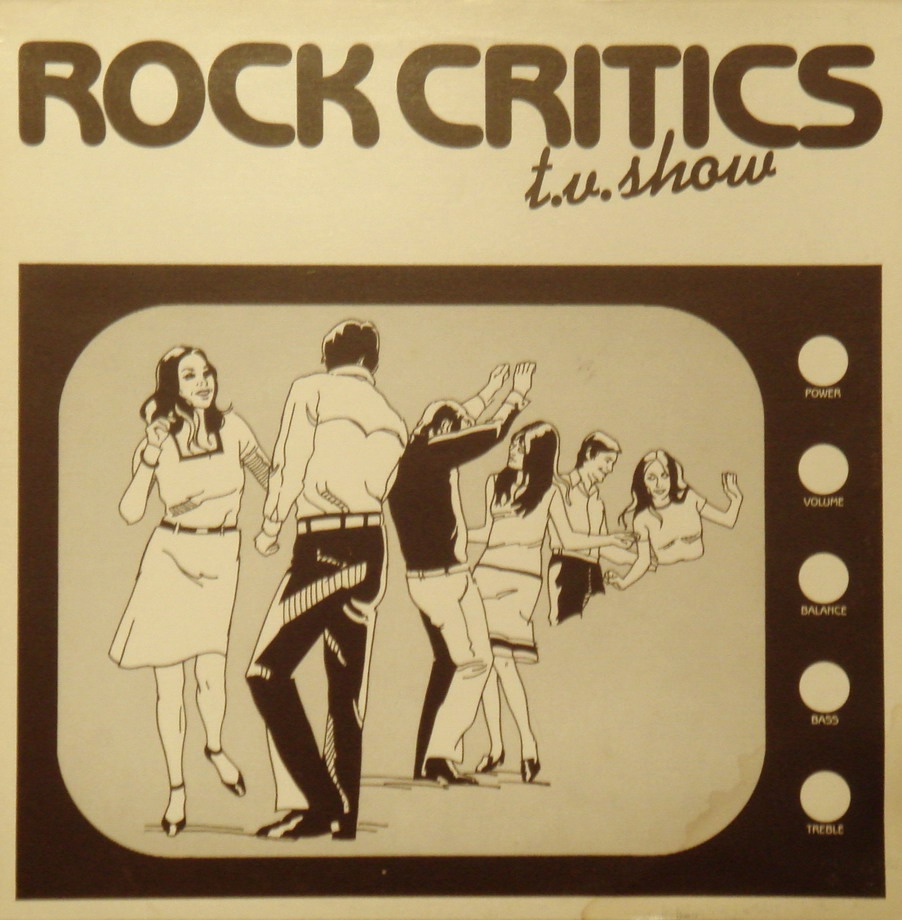
ROCK CRITICS: “TV Show” ******

Recorded 1982


This short-lived project was the brainchild of Luc Marianni (keyboards) and Jean-François Papin (guitars, bass).  Before embarking on a phenomenal sonic journey, both were apparently music journalists in France.  They proposed cunningly knotted electronic instrumentals, seamlessly segueing magnetic narratives punctuated by intelligent use of intriguing excerpts from popular media and elegant multitracking.  The tireless torrent of mysterious fantasias would undergo scale invariant dilation in which contrived electronic parameters sound almost spontaneous. 


The experimental duo, accompanied by additional musicians, left two records.  Luc Marianni later recorded solo, initially employing an equally tasteful, ionized medium. 


Rock News

The LP begins at the very low end of the dynamic range.  From the silence burgeons acoustic piano (Patricia Albertini), and then electric organ.  Suave guitar interrogates this combination.  A different, psycho-acoustic guitar cascades idly in an empty room.  Tardily, this amorphous, ambient wave becomes more audible.  A lethargic, mid-afternoon synthesizer swings drowsily.  A sudden swat from a hand drum and a tense, yet still apathetic guitar line notify us of the impending mutations.  Poorly tuned second guitar struggles to echo this note.  When it fails, it is substituted by a more determined guitar in a (Snakefinger-ish) higher range.  An obsessive piano supplies the rhythm in fours.  We observe an increasingly emotional dialogue between the two guitars – one chaotic and hysterical, the other one posed and rational.  They alternate in their statements, but sometimes try to dominate the exchange.  The holistic dynamic swells minimalistically – striking roots in the proximity of a surreptitious keyboard scale.  At least two of the three instruments patronize the beat, but it is up to an intrusive organ chord passage to bring a rhythmic change.  The tempo doubles.  The regularity remains, but the proportions change.  The drum will always be there, unobtrusive, but unequivocal.  ‘Residential’, wordless sloganeering introduces a menace.  The fuzzed guitar improvises freely against the organ/piano rhythm pattern.  If Thierry Muller used such hydroplaning rhythmic loops then this is how his Ilitch could have evolved.  An echoing vocal cuts through this electro-sphere, but only to emphasize the increasingly fast guitar phrasing.  Endlessly interlocking guitar vortices are too fast to be trippy and too extramundane to be tribal.  But they sure are hypnotic.  A form of hyper-competitive systemic bravura for cyber dervishes ?  Finally, a murky, but carefree piano exercise slows things down.  Austenitic steel strings and a prosaic rhythm box patting take a while to vanish underneath. 


TV Show

Here again, acoustic piano opens, effete and inarticulate.  It is joined by blithe percussion.  A tragic biographical text is being read, but breaks down in mid-sentence.  A tranquil piano theme continues in autumnal mode, without ever developing into a hummable tune.  A very 1980s’ (Wire, Cure) manipulated guitar synchronizes with the piano, somewhat superfluously.  The permeable piano turns nonchalant whereas the occasional texts become warbled and indistinguishable.  Synthesized percussive effects swish around.  Anti-melodic, detached vocal hesitates between DDAA-like condensation and Damo Suzuki’s manic stress on second syllable.  The keyboard cum piano theme is now almost pastoral, never too far from Dominique Lawalree’s ‘nonbient’ creations.  More abstract passage will juxtapose the same downcast piano and earnestly alarming, highly pitched electric guitar.  Many tapes will be overlaid here – microtonal slices of synthesizer, doubtful choral wailing, a grandfather clock, ceremonial children’s choirs, deviant Hawaiian guitars.  This cut is dedicated to German band Faust.


Love Rock

The LP ends with this short vignette for sustained notes of a dim, muzzled organ and water droplets.  Slowly unfolding, almost phlegmatic acoustic guitar explores this register, enveloping something of a refrain.  But each reprise will differ slightly, until the eventual extinction. 


***


Rock Critics left only two oeuvres and several contributions to early 1980s’ compilations.  Luc Marianni’s early solo recordings are equally recommended, even though their rhythmic structures are less pronounced.  Sonic Asymmetry will return to these recordings one day.


ROCK CRITICS: “Pile ou face” (1980)

Luc MARIANNI: “Souvenir du future” (1980)

ROCK CRITICS: “TV Show” (1982)

Luc MARIANNI: “DG Portrait” (1982)

Luc MARIANNI: “Voyage vers l’harmonie” (1982)

MARIANNI-DEMOURON-PITRON-VIAUD: “Four French Forms” (1985)

Luc MARIANNI: “Six Synthetic Suites” (1985-1986)


Marianni continued to record, but what I heard from his later output was too embarrassing to be included here.  


Published in: on June 6, 2008 at 6:42 am  Leave a Comment  
Tags: , , , ,

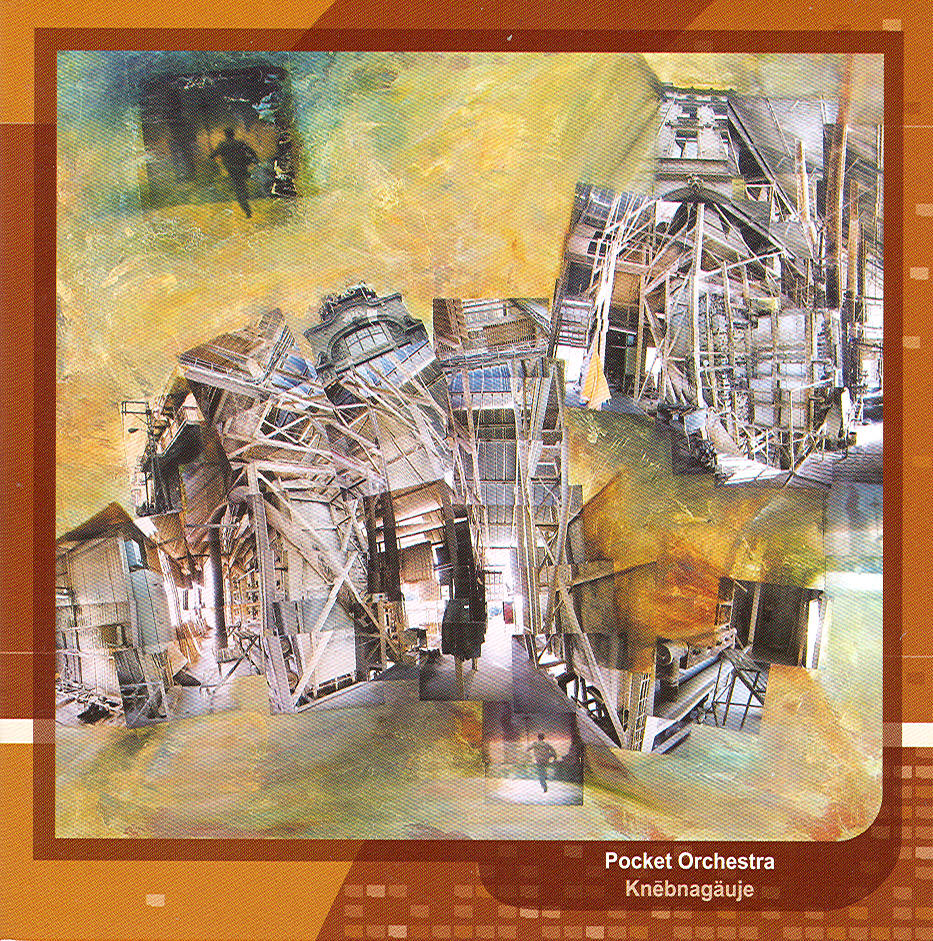
POCKET ORCHESTRA / KNEBNAGÄUJE: “Pocket Orchestra / Knebnagäuje” *****


Recorded 1978, 1979 and 1983


Sometime in mid-1970, Tim Parr from Phoenix AZ brought together several musical soulmates to listen to Rock in Opposition movement’s groundbreaking records and to improvise around stylistically related ideas.  Parr on guitar, Bill Johnston on cello, Bob Stearman on drums, Craig Bork on keyboards, Tim Lyons on bass and Joe Halajian clarinets and saxes evolved together under several monikers, including the unpronounceable Knebnagäuje.  After moving to Washington State, the band made its first recordings – a testimony of eventful elaborations into the non-homogenous RIO style.  The musicians changed the domicile several times, and recorded more tapes as Pocket Orchestra. 


Despite their uncanny ability to string together a plethora of intricately subsumed sets with disorienting complexity, the band failed to publish any of its output before its eventual disintegration in mid-1980s.  They never got back to play together again, but their music was rightfully resurrected by the now defunct MIO label. 


Imam Bialdi

A brooding introduction is only a camouflage for the heavily connectionist exploration of multitracked saxophones, piano interludes, electric guitar races and a guest violin courtesy Craig Fry of Cartoon.  The vitalist tempo shifts with woodwinds that fall short of spasmodic big band romps are closer to the legacy of Moving Gelatine Plates than Willem Breuker.  Other influences are aplenty.  Bob Stearman’s signature percussive “scattering” proves that he studied assiduously how Chris Cutler made accents fall between beats.  On the other hand, the augmented “wind section”, multitracked to perfect unison recalls the Muffins – then the most perfectionist of RIO-like bands in the country.  Unlike any of these predecessors, however, Pocket Orchestra’s sonorities are more extreme, especially in high register pinpointed by squeaky clarinets and silicate acoustic guitar. 


R.V

Hearing Bill Johnston on misty cello buttressed by bass and clarinet we may be expecting a more coherent story development.  But although the somber mood evokes more Noetra than ECM, discontinuity reigns.  After several seconds of a swinging piano, keyboards schlep along a fusion theme, equipped with a nearly Canterbury-tinged optimism.  This is Craig Bork’s composition and his keyboard grandstanding will dominate the rest of the piece.  The pattern becomes more choppy, with high-pitched keyboards, harmonic guitar and repetitive lines from the saxes.  Here the Bob Stearman’s work is more reminiscent of Arti e Mestieri’s Furio Chirico’s fast-paced oscillations.  He was many a proghead’s drumming hero. 


Regiments

A somewhat spuriously delinquent composition, restlessly meandering between varying time signatures and moods, piling up interesting ideas but then segmenting them in a codified, linear fashion.  After clarinet’s opening line, the harmonic cues come from the piano.  Slowly the tension builds up staccato until the softer side of the band opens, with more reflective moments for acoustic guitar and piano.  They are in turn interrupted by more daring parts with winds, electric guitar and piano/drums ascensions.  The structure is unstable and becomes semi-abstract when the clarinet and multiplied percussion intervene.  Somehow, the keyboards always pull everything together and allow the drummer to resume his endothermic, metric role.  A snippet of a theme appears, eagle-spread between comical bass clarinet and a celestial piece from mellotron (?).  The colorful use of acoustic guitar dredges up deposits from both the Italian and UK progressive tradition, but some of the organ passages are quite suspect in the conventional, regressive application of the chords.  On the whole, the composition defeats itself.  Despite the disorienting multiplicity of ideas, the heavily composed 13 minute track is practically devoid of any recognizable structure.  The short parenthesis that opens and closes the piece was supposed to single-handedly carry the fleeting ledgers of its formal scaffolding.  This was a risky proposition.


Letters

Craig Bork penned these alternating moods between atmospheric intrigue, Montmartre lyricism and a hurried jazz-rock run.  Almost a latterday Nino Rota – style mystery creeps in on piano and saxophone.  The best moment gushes when the cello, played pizzicato, encounters a solo piano.  Soon, a pretentious electric guitar and saxophones slowly approach from a more familiar terrain.  Sibilant organ will languish, as if making commentaries on the attempts by the saxophone and the rhythm section to escape from this formal cul de sac.  Instead, they will have to circulate within a very finite domain.  Soprano saxophone will introduce a romantic note with the ease of Steve Lacy, while the piano/organ/drums/bass neoclassicism could almost come from Cartoon – a band Pocket Orchestra befriended.  Unfortunately, the track buckles again under the weight of its inveterate non-linearity. 


Blueing

Although the piece starts in abstract territory, its high pitched guitar and rhythm sections will soon re-emerge, forging ahead in choking staccato, and breezing, not without problems, through sparse percussive distractions.  Later a more straightforward guitar/organ theme will appear with the hyperactive drummer rushing presto vivace ahead of the soloing anti-melodists.  For the first time on this record a consistent melodic theme makes its appearance – a guitar paints a memory of the first exhilarating springtime walk after months of self-imposed exile. 


White Organ Meats

Joe Halajian’s multitracked saxophones and a guitar timbre stolen from Henry Cow’s larder open for a composition which, as all the others, would surprise us by not surprising…  Tempo reversals, skating lines, slow-ups and speed-downs alternate in various orders.  Solid bass rumble and electric piano will support the ascensions and descents by the saxophone and guitar combo.  There is, finally, a recurrent theme, only metabolized by refined drum rolls.  Tim Parr’s guitar comes to the fore and prances around satirically, eventually absorbed by bubbly electronic effects. 


Grandma Coming Down the Hall with a Hatchet

All children know this circus fanfare.  Here, it will derail sardonically.  Still, applying humor to the RIO format was the prerogative of Rascal Reporters so Tim Parr & Co do not persist.  Instead, we are served with a quick succession of illustrative themes for saxophones, a be-bop fragment, a microrhythmic tabla (Warren Ashford).and a downy flute successfully resurrecting the spirit of Ian McDonald (Steve Parr).


Bagon

The final, 16 minute-long composition is Knebnagäuje’s tour de force.  This is a tri-modal structure privileged by early Muffins: theme-development-abstraction-theme-development-abstraction…  A very pleasant electric piano slowly opens with competent support from Tim Lyons’ bass.  When the clarinet rises, a different track unfolds – an allegedly cosmic synthesizer, an overdrive guitar, and Aylerian saxophone.  This speculative structure soon collapses and we are left with the ubiquitous improvisation for electric piano and the drummer’s light but supersonic touch.  The saxophone would occasionally howl until the main theme returns.  In the second development, the squadron of saxophones, keyboards and guitar issues a very strong warning of an approaching challenge.  Acceleration.  Deceleration.  Another abstract moment brings forth electronic feedback and unorthodox fiddling with the keyboard.  Suddenly, the unbelievable happens – a shockingly Iberian quote from Chick Corea’s “La Fiesta”.  The electric piano and the drums follow the original surge even though the melodic line will not surface here.  Habituation is out of question – the swirling soup of electronic keyboards, velvety tenorsax and reactive drums will strut towards the end of the collection through various landforms.


***


Tim Parr and Tim Lyons passed away several years after Pocket Orchestra disbanded and later Bob Stearman suffered a stroke.  To date, only one archival collection has been made available and it has been presented here.


POCKET ORCHESTRA / KNEBNAGÄUJE: “Pocket Orchestra / Knebnagäuje” (1978-1983)

Published in: on June 4, 2008 at 10:19 pm  Leave a Comment  
Tags: , , ,

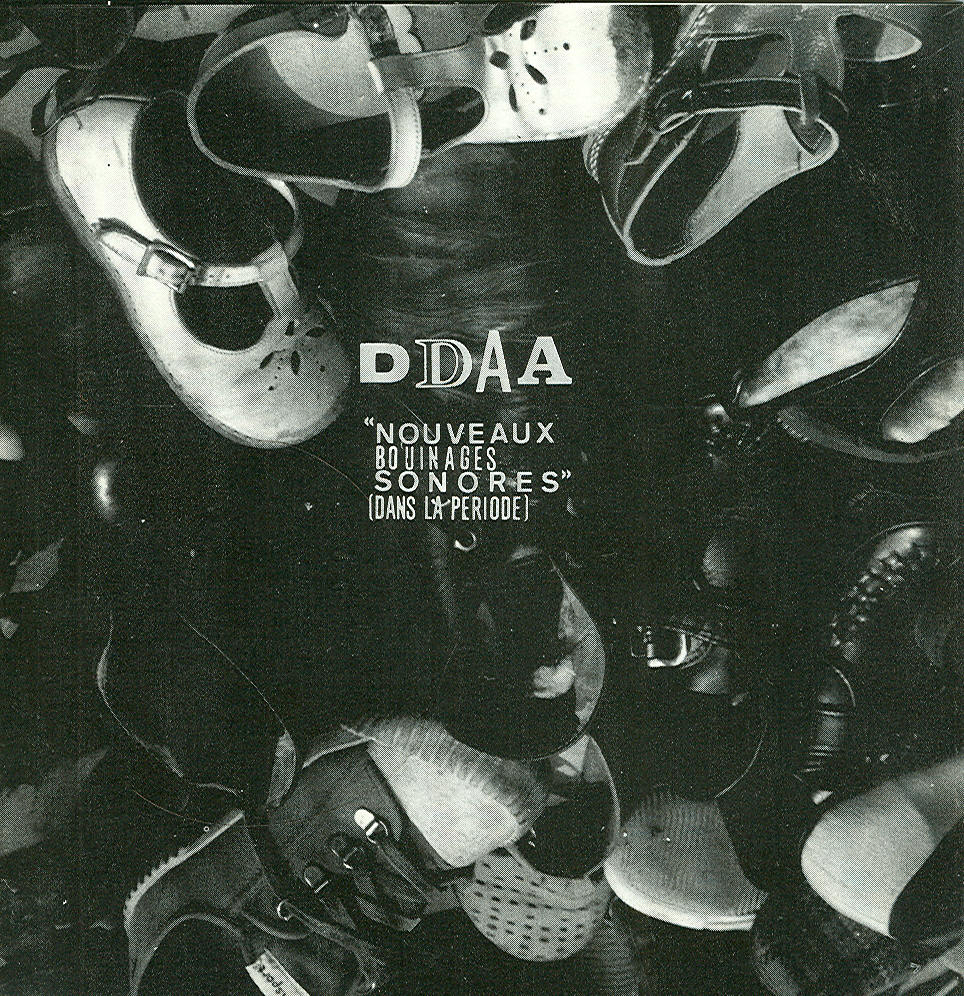
DDAA: “Nouveaux bouinages sonores (dans la période)” ******


Recorded 1990-1992


The legendary French trio of Jean-Luc André, Jean-Philippe Fée and Sylvie Martineau made their debut in the late 1970s and quickly established a dominant position on the then vibrant international cassette scene.  Their label Illusion Productions and their studio Souterrain Scientifique became the marks of defiant creativity.  DDAA – Déficit des Années Antérieures – specialized in neo-modernist collages, drowned in obsessive, organically mixed rhythmic patterns of both human and looped origin.  It is in the instantly recognizable character of these loops – soluble, ductile and reversible – that DDAA made a lasting contribution to 20th century avant-garde rock.


At the beginning of their career, DDAA exhibited fascination with early-stage mechanization and with 20th century Japonisme.  Both motifs interacted gracefully in short, ironic songs and in more extended compositions.  Although the band was on the cutting edge of post-punk avant-garde and frequently appeared on compilations next to such luminaries as Nurse with Wound, Merzbow, Organum, Smegma or P16D4, the trio’s style was always more melodic and eschewed caustic aggression of post-industrial mannerism. 


DDAA remains virtually unknown outside France and little known inside the ‘Hexagone’.  Nevertheless, its historic importance can hardly be overestimated.  The band’s copious heritage deserves a book rather than a mere article.  This is just a timid beginning.


(The titles reproduced here may not correspond exactly to the subdivisions of the single track on this CD)


Chants et tambours Maracayace d’Ankazoabo à Morafénobé

The vacillating intro ushers us into the space filled with scraped strings and various haptic modules tampering with oblong metallic fiber.  Behind us, a distorted voice explodes into spasmodic sneeze.  It will return every 14 seconds as our senses struggle to distinguish a distant factory siren from a ritualistic Tibetan trumpet.  The deadpan sneeze and the siren recur in a mid-tempo loop, while the scraping and fumbling of guitar strings continues its abstract ruminations.


Chant de guerre

Subterranean, volumetric bass figure will carry here a mutilated voice uttering unrecognizable phrases.  Emergent howling confuses us again – are these passionate soccer fans or a South-East Asia’s professional mourners?  These unrelated vocal elements will synchronously fall into a looped pathway.  Uninvited, a buzzing harmonica squeezes itself into this organic whole, but dissolves before a disaffected recitation in English reminds us of 1980s British new wave vocal mannerisms.  Fully immersed in the loops, the lyrics are not audible.  Meanwhile regular waves of French phrases approach us with a bombastically scientific, eggheady attitude.  Acoustic guitar accentuates the polygonal rhythmic engine.  Then, for a moment, a very argumentative female voice flickers. 


La chute de Miandrivazo

It turns out that the self-important “scientific voice” was about wedding preparations.  To the squeaks of a cheap organ and children’s calls, a Francophone robot proclaims “I hear a noise”.  The observation is correct.  The mechanistic rhythm is now more terrestrial, interspersed with industrial noises.  A friend once remarked that 1980s’ DDAA sometimes sounded like a more avant-gardish Cabaret Voltaire would have if it had continued to develop artistically, rather than imploded commercially.  This could be one of these moments.  The aural fabric is embroidered with the multiplicity of voices – anguished commentaries, admonishments, collective doubts and arguments – their contrasted prosody enriches the texture of this fragment.  Martial drums briefly compress the invariant flux, echoing classic Test Dept., but lacking the UK band’s intensity.  Various percussive divagations intervene and occasionally it seems that the porous guitar would become more prominent, but it is all too soon eroded by the transgressive tape overdrive. 


Halte au feu

The next section opens with scuttling percussives, both acoustic and electronically processed.  The form gradually coagulates until the familiar, gritty baritone looms.  His conceited lines are among DDAA’s most directly recognizable trademarks (unfortunately, I never know if this is Jean-Luc or Jean-Philippe). 


Passage de Makay

It takes several minutes before the improvised patting is displaced by a female vocalise, overlaid over and above an old patriotic invocation reproduced from an old 78rpm record.  Various other tapes descend on us.  Sylvie Martineau intones a fragile melody with her petite voice.  Loose metal sheets and unidentified mechanical objects tamper with her efforts to reach our auditory system.  Dull sheets of flailing noise periodically distract us from the overall repetitive format of this section. 


De Mauja à Mahabo

An entirely unexpected recorder (Bernard C.?) announces a change of scene.  A bubbly, high-pitched rhythm box and a mandolin will lead us onto other, spectral pastures.  In the record’s strongest passage, a kaleidoscopic revue of distant memories will pop up, lubricated by an elastic, well-defined loop.  First street marching bands and a maître de céremonie who exhorts the “crowd” to move back.  Later, various official announcements convey a sense of superfluous, Gallic pomp.  They, in turn, will be interspersed with snippets of overexcited sports commentators bent on athletic, machine gun verbal über-performance.  A late-night hard-bop moment overshadows a West African choir.  A static Buddhist ceremony, immobilized by bells and trumpets; a subglacial new age flute; guttural religiosity of monks’ prayers; Indian radio songs…  Some of these elements will filter through as mere forays, but others will morph into a colossal orogeny of sounds.  A shamanic chant stays with us a little longer, with organ and tambourine accentuating the instrumental paucity in stark contrast to the accretive value of the looped effects. 


Ils s’apperçoivent un grand machin mobil

Without interrupting the flow, this part now segues into a polyrhytmic sequence of Karnatic percussion and mantric voices.  Droney choir refurbishes the meditative building blocks of Gong’s early achievements, augmented here by untuned brassy percussion, and then breathy scraping of non-resonant metal sheets.  Equally dull clatter is the only permanent feature here.  The passage is so dense and polymetric that it is impossible to fathom what kind of rhythmic loop would eventually emerge.  And indeed, we have to wait for the band’s very straightforward drumset, Casio and synthesized effects to find a rhythmic clue.  The orthogonal loops operate at varying speeds. 


Un vrai morceau joue de manière fausse

Silence.  Bizarre…  A magical, melodic line emanates from the mandolins, electric bass, sustained viola and soft-clipped electric guitar.  Airy bongos are here to add some chroma, rather than improve on the reining loop’s rhythmic dominance.  The guitar improvises at the center.  The sepulchral viola responds to each of the guitar’s opening chords.  Slow recitation in English ensues.  The solemnity of the voice is crowded with guitar and electronic effects while the granular rhythmic structure becomes more pronounced and distinctive.


Quelque chose d’assez obscur

The final eight minutes take us for a much less abstract exercise of percussive cohesion and a vaguely melodic recitation in English.  The phrases, barely understandable, fall perfectly within the meter determined by the drums and the guitar loop.  A delicate metallophone adds decorative accents over the topmost layer. 


Les 4 soleils à l’horizon

The poignant, unmusical voices will intone a sad song with a faux harmonium sound from a modern keyboard, accompanied by an occasional drum thud and metallic scuttle’n’scrape.  The journey ends here.


***


DDAA’s discography is extensive and not easily available.  Many of the older productions are screaming for a re-edition on CD.  I strongly recommend in particular all the recordings from the first five years of activity (1979-1984) and from the period 1990-2001.  In addition to the records, cassettes and CDs listed below, the band produced a wealth of shorter compositions published on international compilations, including the famed “Masse Mensch”, “Douze pour un”, “Voices Notes and Noise”, “Bad Alchemy no 10”, “Strength”, “Three Minute Symphony”, “Paris-Tokyo” and “Sensationnel Journal no.1”.  Some, although not all of these songs appeared on the band’s own collections.  The trio is occasionally active to this day.


DDAA: “Déficit des années antérieures” MC (1979)

DDAA: “Miss Vandann” SP (1979)

DDAA: “Front de l’Est” 2SP (1980)

DDAA: “Aventures en Afrique” SP (1980)

DDAA: “Live in Acapulco” 2MC (1980)

DDAA: “Action and Japanese Demonstration” (1982)

DDAA: “Prehistoric rejet” MC (1983)

DDAA: “5ème anniversaire” EP (1984)

DDAA: “Les ambulents” (1984)

DDAA: “Objet” (1983-1985)

DDAA: “Lernen 5.  Submusic” MC (1984-1985)

DDAA: “La familles des saltimbanques MC (1984-1985)

DDAA: “When a Cap is Rising” (1982-1986)

DDAA: “En concert” MC (1983, 1986)

DDAA/NURSE WITH WOUND/G.REVELL: “Nekropolis” (1986)

DDAA: “Ronsard” (1988)

DDAA: “Otez votre jeunesse” SP (1988)

DDAA: “Les Corbusier buildings” SP (1988)

DDAA: “Nouvelles constructions sonores sur fondations visuelles” MC (1988)

DDAA: “Bruit son petit son” (1990-1991)

DDAA: “Nouveaux bouinages sonores dans la période” (1990-1992)

DDAA & J-F.PAUVROS: “De Gaulle à Bayeux, un opera Maracayace” (1994)

DDAA: “Baggersee” MCD (1995)

DDAA: “La conférence Maracayace” (1994, 1999)

DDAA: “20 ans de vieille musique nouvelle” (1994, 2001)

Published in: on June 3, 2008 at 9:59 pm  Comments (3)  
Tags: , , , ,