ALVARO: “Is the Garment Ready?” ****

Recorded 1988


Chilean born pianist and singer Alvaro Peña-Rojas achieved underground fame after his exile in Europe.  Although his scandalously entitled debut was recorded in London, Alvaro based himself in Germany, cranking out outsider recordings long before European audiences heard of Jandek. 


Salvaged from obscurity by the Recommended Records’ distribution network in Europe, Alvaro carved for himself a new niche.  In the 1980s, his Spartan recordings became the synonyms of fiery, chaotic and often ostentatiously amateurish songcraft.  During this period, his songs displayed programmatic scorn for large instrumentation, but the structure of his compositions was always unpredictable and remained outside any musical tradition, European or otherwise.  Not surprisingly, Alvaro’s obra is usually considered unclassifiable, separated from isolationist folk by the use of piano, rather than guitar, in both the composition and performance.


Recording both in English and in Spanish, Alvaro offered a metaphoric social commentary on emigrant’s daily life in an epigrammatic, dispassionate manner.  A heavy, hanging cloud of Western Europe’s long winters separated him from the formidable Andean vistas and he scarcely reached out for material evoking South American musical traditions.  His staunchly left-wing exoticism was original precisely because it was deprived of declamatory and folkloristic pander that affected, for better or worse, like-minded jazz musicians from Frankfurt to New York to Tokyo. 


Part One

From the opening seconds of the record, Alvaro’s tremulous voice literally throws at us his downcast, liturgic lament.  A scattering of insulated piano keys follows.  Short silence.  The entire proceeding repeats.  The piano notes are instantly muted, heartfelt and lonesome.  By contrast, there is a slight echo attached to the voice track, enhancing Alvaro’s trademark nasal croon.  His intonation occasionally evokes snippets of a Middle Eastern Tajweed, but the association could be unintentional.  Since the chorus is limited to the piano, the spiritual atmosphere of the crooner’s calls is repudiated by the bare, skeletal piano response.  “The sweetness of this song might drift them away from me”, worries the narrator.  At this point he is joined by drummer Giorgos Notaras and bass player Jens Volk.  The march-like percussion is mixed out at a certain distance.  The bass is pitched high, even above Ferdinand Richard’s G-bass – a reference at that time.  The trio’s fast passage appears to have been just an intermezzo. 


Part Two

The same text will be repeated in “Part Two”, but this time with a rhythm section in neo-punk mode.  The drumming is competent, enveloped with rubbery, elastic bass figures in seemingly endless repetition.  A nine note piano piece is highly melodic, placed in major scale, but it takes at least three turns before unmasking a much more realistic (and less nasal) Alvaro.  This is his osseous opus “Tea and Toast”.  The rhythm section is so dependable in its fast-paced bass ostinato and drum reflexivity that a linear piano improvisation is inevitable.  This departure is simple, unassuming and ultimately convincing in its simplicity.  The chewy bass line invites the drummer to toy around with his snare, the tom-tom and the bass drum, but Volk never transgresses the metric confines determined by the bass player.  This bass and drum duo holds our attention long enough to welcome the return of the instantly hummable main theme.  It is punctured by single piano notes but remains indifferently melodic, stripped down to three syllables and devoid of any profound meaning beyond the denotation of a cheap European breakfast.  Finally, like an old, tired locomotive, the “tea, tea, tea, tea, tea, tea, tea and toast” wagons slow down to a crawl and finally, predictably, stop.


Part Three

A stern piano overture imports some bass divagation.  The slowly unfolding and folding bass is apathetic, misanthropic, low-pitched and barely audible, almost concealed in the comforting vinyl noise.  The instrument burrows, commutes, flexes and wiggles, sometimes only interrupted by the return of the scowling, upright piano overture.  The bass guitar’s low-end freedom contrasts strikingly with the rigidity of the (unchanging) piano notes.  This section recurs several times.  In later stages of the composition, the bass resurfaces more decisively into the audible sphere, but the dynamic contrast with the insistent, jagged piano line makes us too apprehensive to delve again into that avuncular, nestling, sensorial universe of the woolly bass.  Finally, after yet another piano intervention, the bass formulates its own destiny, making fidgety forays into some higher notes.  Finally the entire trio meets in an obsessive ostinato, from which decisive piano salvos break out until the life and death question is nervously asked: “Is the garment ready?  They’re already knocking”.  Could this be more than a tailor’s nightmare?


Part Four

“Part four” is a 1960s style rumba, and a summary collecting the scraps of the lyrics heard throughout the first three parts.  Now it all comes together, reorganized and cohesive.  It is as if Alvaro had composed and anti-suite, which began with reprises and ended by formulating the leading theme.  Half-paralyzed and sloppy, the idle rumba encodes a chronicle of stubborn identity preservation amidst a friendless world of alienation.  The singing never gets overly dramatic or mawkish and the fretless bass keeps the spine well oiled.  But the overall image exudes reluctant romanticism, prefiguring working class anti-heroes from Aki Kaurismäki’s films.  The “Garment Ready” is a metaphor for an introvert’s efforts to connect with the outside world, so indifferent to his cries for inner peace.  “I am ready” yells Alvaro repeatedly towards the end.


***


I am not familiar with Alvaro’s later recordings, although he seems to have continued his musical career way past his 50th birthday, sometimes venturing into adaptations of American and Latin classics. 


ALVARO: “Drinkin’ My Own Sperm” (1977)

ALVARO: “Mums Milk Powder” (1979)

ALVARO: “The Working Class” (1980)

ALVARO: “Four Sad Songs” (1981)

ALVARO: “Mariposa” SP (1981)

ALVARO: “Repetition Kills” (1982)

ALVARO: “Is the Garment Ready” (1988)


“Garment” remains my favorite. 

Published in: on October 10, 2008 at 8:47 pm  Comments (1)  
Tags: , ,

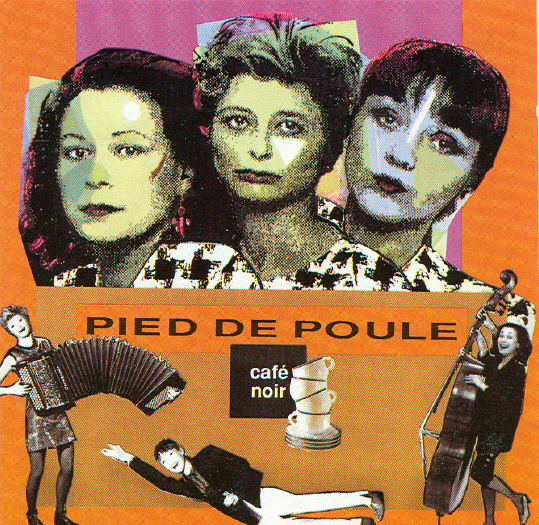
PIED DE POULE: “Café noir” *****

Recorded 1991


Chanteuse and lyricist Dominique Fonfrède, accordionist Michèle Buirette and contrabassist Geneviève Cabannes first recorded together in 1986, before adopting the self-deprecatingly ironic name “Pied de poule”.  For about ten years, these three French women knit together cryptocrystalline pearls of sublime avant-garde chanson.  Although their background was in jazz, classical and improvisational music, the sum of the parts turned out to be much more than simple amalgam of their extraordinary talent. 


Melancholy reigns in the texts and resounds in the individualistic, reflective tone of this highly sensual, feminine creation.  Whenever their lyrical path invited comedy or irony, the melodic line, or theatrical rendition countered the half-smile with a palinode of pensive mood and reflection.  While they certainly did not invent the genre, their unique mélange of witty lines and quirky melodies was always delivered with panache, tasseled with dolorous observations of mature womanhood.


On later recordings, Pied de Poule were often supported by two members of Un Drame Musical Instantané – saxophonist and flutist Youenn Le Berre and percussionist extraordinaire Gérard Siracusa. 


Café noir

Female voice smooth as enamel opens in a constative mode, prodded by accordion’s precise, short phrases and some rapid quarter notes.  Although this opening was penned by the bassist Geneviève Cabannes, she does not appear until later.  This resolutely jumpy chanson plumps the first cubes of melancholy into our musical café break.  Dominique Fonfrède invites us to her world with pithy verse libre.  Her irregular meter and rhyme would allow the semantic content to glide across the lines, increasing the potential for surprise and multiplying the unexpected pointes.  After a short interruption, acoustic bass joins the fray and multi-voice polyphony resumes this short story of the solitude of a café-going woman, always recognized by the waiter.  When the coda comes, it is delivered with an exquisite accordion line, bowed acoustic bass and a canzona-like singing pitched above the preceding theme.  Only isolated phonemes reach us, though, melismatically wrapping random scraps of the now familiar text. 


Le rat

The rat, scurrying about rice and radish baits appears too sly to miss the step imposed by Gérard Siracusa’s extraordinarily nimble drumsticks.  Michèle Buirette’s fast bellow shakes and some rodent calls turn this piece into a pleasing satire.  The dramatic vocal slides could evoke contemporary opera type, but the light stick rattle on hand drums and tambourines distract us by impersonating the shining movement of the adorable, furry animal.  Comic jibes at the rat that refuses to catch the bait bring little result (“Will it, or will it not?”).  The little beast is too astute.  Suspensful accordion and percussive crescendo eventually collapse into a disorderly crowd of rat-like talking heads. 


La banlieue

Dominique Fonfrède’s initial declamation is slowly being transformed into proper melody by a swinging, almost bandoneon-sounding Buirette and an appropriately smoky, walking bass line.  Yet the attempts to construe a proper “song” fail and a more directly conversational form resurfaces, with the Sprechstimme monologue occasionally interrupted by insistent commentaries from Buirette and Cabannes.  This is a dubious tribute to “banlieue” – desolate French sleeptowns, described here with uncharacteristically non-metaphoric candor: “no commerce, no factories, no offices, no cows, no fields, no villages”.


Cha cha gourmand

A refreshingly epicurean Caribbean step with a ‘gavroche’-type wink-wink accordion accents and bowed bass.  A histrionic guffaw at the end of the track invalidates the lightness of its dance-like structure.


Le malfrat

The composition begins with parallel street observations by Dominique Fonfrède and Carlos Zingaro.  When an interrogative chanson commences, Zingaro’s violin introduces a dramatic, focused theme.  Buirette’s accordion appears first in a harmonic role but they part ways when the metric element dissipates and Fonfrède’s performance descends into recitative accompagnato.  Her initially anodyne commentary turns existentialist, harnessing operatic levels energy.  We then hear Youenn Le Berre on flute.  His full, sultry tone softens considerably the lyrical content, but not necessarily the melodic sonorities.  As an aside, one could expect such contrapuntal combination of accordion and flute to be highly promising in the hands of an accomplished arranger.  Joseph Racaille, Frank Pahl, Jean Derome and David Garland each used it with considerable success, but many others tried and failed.  More recently Belgian band Aranis has successfully incorporated such timbral and structural juxtaposition into its orchestrations. 


Les sept mains

This is a multi-tracked solo on double bass.  Dr Jekyll Cabannes appears somewhat hesitant, meting out wooly, investigative pizzicatos on E-string.  Mrs Hyde Cabannes is a romantic, handling adroitly detaché bowing with short, yet reflexively autumnal phrases. 


Liseron I, matin de juin

A remarkably condensed deconstruction of a very private early morning hustle recounted here in passé simple.  The narrative collapses into three competing voices.  Le Berre’s flute and Buirette’s accordion couple with deep successive strokes on acoustic bass and allow Fonfrède to recite the text with a speed of a machine-gun.  Her diction is impeccable, smooth, free-floating.  A reedy, polyphonic solo on accordion engrosses, holding us warmly between the grooves of its bellows, and cradling our heads into abandon.  All this charm was deployed here to tell us some home truths about… a cold shower and a morning coffee… 


Les guêpes

This cantata opens comfortably with a dependable basso continuo and fast, though texturally thick accordion lines.  Fonfrède’s art is to singing what Conlon Nancarrow was to keyboards.  As a result, it is impractical to even attempt to follow the semantic content of the rapid-fire syllables without reading the attached sheet.  It then turns out that her proceeding relies on stammer-like repetition.  The words (hardly about the “wasps” from the title) must have been selected for their phonetic quality and above all for the apparent overabundance of bilabial nasals, ultimately the first consonants we all humans emit with some time after birth.  When the ‘song’ attains its dramatic climax, the tension is soon released through a steady, peaceful decrescendo.  Somewhat superfluously, the trio interjects descriptive elements (vacillating stomps from behind a corner, a decisive accordion-bass dash across the courtyard).  Hyperbolic, coarse moans of devoiced agony side with an arco in audible despair.  In full denial, springtime sentimentality closes the track with inanely banal ‘la-la-la’.


La duchesse de Guermantes

Dominique Fonfrède adapted Marcel Proust’s text and interprets it here in a caricatural, stilted, indignant manner.  A Shelley Hirsch-like homophonic doubling ushers in a slow, matter-of-factly presentation of the same lyrical content.  Hysterical, nervous laughter interrupts the uncertain flow. 


Liseron II, matin de septembre

The track begins as a trio for accordion, flute and recitative.  The flute flutters blithely around accordion’s reliable harmonic stasis.  In one of the most classical moments, the flute and soprano vocal take off for a feathery flight.  The theme is never developed.  Instead, the accordion shifts into an uptempo mode and Dominique Fonfrède’s vocal salvos become grandiose, further enhanced by Carlos Zingaro’s violin.  The instrumental trio of accordion, flute and violin configures a couple of short notes, while Fonfrède descends from her soprano into ungainly shout and pedantic warble. 


Vaguelette

This delicate, elegant tango has its caminada tempo well-defined by a plucked bass.  Buirette and Fonfrède exchange roles, achieving the classic Pied de Poule style.  This is twilight nostalgia at its most poignant, yet with none of Borgesian coraje.  The track’s witty twists and unusual phrasing are as feminine as the beauty of any Porteña’s feline steps.


Canicule

Hot and wet.  The midsummer theme expresses ego-doubts of a cat, with a bowed bass, assertive voice and an accordion.  It is the accordion that feels its way diminuendo around the twisted yellow-lit streets of the 5ème arrondissement or maybe la Recoleta, the emblematic neighborhoods of two cities marked forever by the experienced, urban face of this instrument and its close cousins. 


Les dinosaures

In a welcome departure from the avant-chanson style, the trio plunges into an improvisation awash with riffy bass bowing, robotic panting, susurrando and Angst-whispering.  The frenetic pace and incandescent interpenetration of contrasting elements recalls Steve Hillage’s equally impromptu intermezzo “Fish”.


Destinée I

This most complex composition on the record begins with a Balkan-sounding polyphonic vocal trio.  Slowly the constraints of the French language (the stress on the last syllable) betray the singers’ origins.  When Le Berre intervenes on his unusually highly pitched cornemuse (French bagpipe), the character of the piece suddenly changes.  The French variant of this instrument usually has a small drone and Le Berre always astounded me in his long-winded, spine-chilling contributions to the recordings documented by Un Drame Musical Instantané.  The two bellows-dependent instruments – accordion and bagpipe take us here on a trail with youthful, vivacious, upbeat intentions.  Then the duo steadies for a moment of reflection, extracting unusual harmonies from the air reservoirs (how often do we hear bagpipes and accordion seeking unison?).  Carlos Zingaro’s violin rejoins shortly in one of the more lyrical moments on the record. 


Coda ad hoc

The closing statement for voice and accordion. 


***


PIED DE POULE: “Indiscrétion” (1988)

PIED DE POULE: “Café noir” (1991)

PIED DE POULE: “Jamais tranquille!  Rude journée pour les mouflets” (1993)

PIED DE POULE: “Confection et articles divers” (1997)


The trio can also be found on compilations “Douze pour un vol.2” (1986) and “Bunt” (1991).  All of these records are of the highest quality.  The avant-gardish tension of the early recordings mellowed slightly with time, but in a highly praiseworthy manner.


One could trace the origin of ideas first developed by the trio to Michèle Buirette’s debut LP, on which all the three artists appeared (although never together on any of the tracks).  It was with great joy that we could rediscover Buirette’s world of intelligent and fresh songs four years ago.


Michèle BUIRETTE: “La mise en plis” (1985)

Michèle BUIRETTE: “Le panapé de Caméla” (2004)


One song can also be found on compilation “Bad Alchemy Nr 4” (1986).

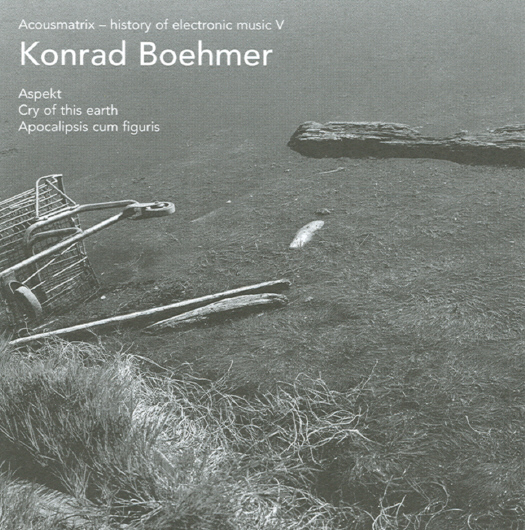
Konrad BOEHMER: “Acousmatrix – History of Electronic Music V” ***

Recorded 1966-68, 1977-78, 1984


Originally from Berlin, Konrad Boehmer honed his compositional skills with the likes of Gottfried Michael Koenig, Pierre Boulez, Henri Pousseur, Karlheinz Stockhausen and Bruno Maderna.  At least half a generation younger than the above-mentioned composers, Boehmer debuted in the early 1960s and has since deployed his professorial talents in the Netherlands and in the US. 


His very detailed approach to composition, however ‘electric’, eschews many of the trappings that defined the canon of processing in vintage electronic music – reliance on generators, sonic masses, echoes.  When Boehmer incorporated pre-recorded tape material, he did so with a fully semantic approach – a far cry from Stockhausen’s intuitive cut-ups. 


Despite the wealth of external inputs, Boehmer’s electro-acoustic creations sound introspective and concentrated.  The structural complexity of his work does not invalidate their seamless and pristine, entirely legible character.  In addition to his ‘electric’ and electro-acoustic works, Boehmer has been also composing for more traditional media, including piano, percussion ensembles, chamber ensembles, choirs and symphony orchestras. 


It is astounding that Boehmer’s talent has remained so underexposed outside the (hermetic) circles of European academia and concert halls.  There is much more in his oeuvre that could and should be appreciated among the fans of Nurse with Wound, Operating Theatre, Hafler Trio or Un Drame Musical Instantané.  The recording presented here should also appeal to those to follow the careers of Dagmar Krause, Phil Minton and Frederic Rzewski. 


Aspekt

This early composition opens by infusing space with an oppressive sonic register: gurglings, chuckling buzzes, non-resonant mechanistic clashes all bite our earlobes with irregular dynamic assaults.  Crescendo of liquid bubbles, staccato cricket buzz and crackling feedback come and go, obstructing our auditory access to swooshing glissando blankets.  The reigning effect here is liquidity, with some extra sibilance on topmost layers.  But the composer refuses to apply insecticide; as another liquid cascade ebbs away, buzzing arthropoda buzz by in gyrating duets and trios.  When gigawatt electronic thunder interrupts this litany of naturalistic associations, windy gusts of grey noise soon follow.  The initial impetus drops off and a fairly slow-paced sequence ensues at various textural levels.  Much space is devoted to flicker noise, but the proceeding seems subtractive, rather than additive.  On one occasion, a reverberating machinery rumble kicks in.  After a short recess, submarine bubbles reinvent the context.  Contrasts are now distributed in a balanced fashion, with much energy still channeled through some liquid medium.  Most of these sensory structures are knit together in a sequential fashion with little, if any overlap.  Stockhausen’s influence is definitely perceptible.  In the last subsection, a sputtering motor sound is being embraced by micro-bubbles and a low-range torrent.  There is some enforced stationarity in the illusions generated by the structural stasis here.  The composition does really not advance, but rather like engines circling on a race track, it alternates in energy levels and frequency.  Boehmer avoids both excessive accumulation and obvious splicing of material.  Overall cohesion relies on atemporal functions, many of which are elicited within a pre-defined range of (mostly liquid) effects.


Cry of This Earth

This composition – part of a trilogy composed in the early 1970s – relies largely on Christopher Shultis’s deeply-pitched percussion – cymbalic overtones, fast tympani rolls – and interjected voice-overs.  The distant mix generates a sense of a stage-like detachment.  Electronics floods the space, but throttles back, slipping down the gutter of nothingness.  When the xylophone comes to the fore, we hear the first declamation – first female, then male, punctuated by a drum roll.  Tympani and stratospheric electronics spice it up with (frustrated) melodic spices.  Finally a soprano joins (Thea van der Putten), colored by a friendly vibraphone.  The delivery is dramatic, somewhat oblivious to the continuing (also female) narration.  Tympani, xylophone and the two voices compete for influence, reminding me of the disorienting operatic effects on U Totem’s first record.  Sequences appear, only to be closed by non-resonant percussions tracks.  The ‘song’ proper is now entirely supported by abstract percussion and xylophone.  Small hand drum prepares the atmosphere for the spoken text in French.  Damning, high-pitched sounds sprout into the short breaks, bruscamente.  Then a spoken male voice in Spanish takes over – to a more defined percussive (xylophone, large cymbals and gongs) accompaniment.  Boehmer’s whispers his own part (in German) – gliding over smeared out notes teased from the vibraphone and electric organ.  Wooden percussion clucking disturbs the emerging order and so does the electronic interjection.  One can’t dispel the sensation that the drummer part requires a lot of attention in this section of the composition.  The other two voices soon return, with more conviction, making a point among the swishing electronic flyovers.  Spanish recitation (male) and French a-melodious chant (female) appear endorsed not only by the avalanches of electro-bubbles, but also by the electric organ’s condescending harmonizing and some graphic accents from the percussion.  A long dying note from a cymbal closes the trilogy.


Apocalipsis cum figures

Dagmar Krause’s voice scares us with cataclysmic scenes of fire and hail, as dantesque and horrifying as Bosch’s nightmarish vistas.  Petrified by agony and horror, the voices also come off as sardonic.  Krause’s voice is sometimes transposed through a chorus treatment and is surrounded not only by an anguished jumble of ghastly slurps, gargles and guzzles, but also a suitably apocalyptic and very metallic piano (Frederic Rzewski).  A refrain of male voices goes almost doo-woop (Jan Hendriks, Ernst Jansz, Henny Vrienten), when a French narrator announces arrival of other creatures.  Overall, a sense of uncertainty reigns, as in the highly improper duet of piano tremolos and unhelpful belching.  German sentences (from Hölderlin) can occasionally terminate a phrase and plunge us into a silence, but it never lasts.  The French text, on the other hand, is delirious, exorcising the images of “semen”, “angels”, the Virgin and God, all surrounded by barking dogs as if hijacked form a Psychic TV or Dali-Wakhevitch recording.  Dagmar Krause picks up some of the more deranged passages from Karl Marx and its juxtaposition with Marquis de Sade does not grate here.  Phil Minton’s plaintive crooning proclaims “I am free”.  Howling monkeys, stately Eislerian piano and a hunched German text operate between a mechanic dynamo and robotic voices – in a dense, crowded underworld where dissonance is order and tonality is hell.  A whole treasure of interjections swamps the listener – simian creatures, pianistic salvos, animalistic glorps, bird calls, French expressions of indignation and blasphemy.  Intimidating, monstrous voice growls as others attempt a conversation above this unsettling canvas.  The piano is punctual and aggressive, but it is the Hague Percussion Ensemble that occupies center stage here: chimes, closing gates, multi-voice ‘Erinnerungen an Prophets’, fast drum runs.  The French recitation is defaced, clipped at the top, molested by devilish shouts of panic, eerily contrasted with doo-woop sing-alongs (apparently a piece by Skriabin).  In this sonic mayhem, growling beasts meet oral hygiene and female scolding mocks male despair.  Some electro-percussive effects are repetitive, wrapped around fragments from an English song.  When a measure of piano-voice order returns the percussive layer reorganizes the texture with march-like snare drum and tom-tom preparation.  Many voices in French are so critically slowed that they are barely comprehensible.  Some voices are muffled, other strangled, other suffocated or vivisected into ingressive-sounding, and that despite a strong bass buttressing that annoys us so much in Hollywood action movies.  That bass phrasing contrasts here with either vibraphone or high piano notes, just when we are to hear about the last hope: “I am god I am god”.  The sacrilegious text is first spoken, then chanted, then exclaimed.  After a male recitation in French, sweeping electronics ushers us into the sinister underworld of growling, braying and vomiting.  And this menace means business: “the night, so deep that you won’t see the way, you won’t hear your own voice”.  Then, the tortured, damned voices reveal, unexpectedly, a tepid bourgeois song, sung in English with a piano accompaniment amid the spiky cacti of electronic swirl, piano arpeggios and all THAT howl. If this really is the end of the world, then this is quite fascinating and worthy living through, sonically. 


***


Konrad BOEHMER: “Acousmatrix – History of Electronic Music V” (1966-68, 1977-78, 1984)


Several other recordings are available, but they are not necessarily electronic or electro-acoustic works. 

Published in: on October 5, 2008 at 9:37 pm  Comments (1)  
Tags: , , ,

VERDE: “Vuoronumero” ****

Recorded 2003


Tampere-based Nokia’s engineer Mika Rintala debuted in mid-1990s, but for years remained an unsung hero of DIY circuit electronics.  But recognition finally came.  His preference for often bulky analog devices set him apart from the generation of digital manipulators and yielded unusually temperate, alluringly corpuscular auralscapes. 


Elements of his compositions appear modular.  Under moniker Verde, Rintala frequently incorporated inspiring field recordings.  His injections of such material are unusually mellifluous, eschewing the pitfalls of the familiar extrema: the dogmatic lessons of musique concrète and the showy interjections so typical of sound expansions in contemporary pop music. 


The utilization of self-made devices and hybrid instruments led him to experimentation with sonic capabilities of home appliances.  And yet, the results are invariably warm and well-rounded – unlike anything achieved by Anglo Saxon post-industrial combos of the early 1980s. 


Rintala has been active in other Finnish formations, not least the neo-kraut apostles Circle and post-funk amalgam Ektroverde. 


Paskaralla kolmen metrin kulmakarvat

The opening guitar chords hang loosely in a somewhat Gallic manner.  This unassuming introduction dusts off the memory of Ilitch’s and Philippe Doray’s classics, but it’s the hoarse trombone solo that refocuses our attention.  Handled with grace by Markku Veijonsuo, the valve pace is steady, unhurried, relaxed.  A throaty electric guitar instantly broadens the increasingly spacious limits, with effects evoking the Fripp and Eno’s operations.  Close to the top of its natural range, the trombone assumes a secondary role, snaking with agility among the ever denser guitar oscillations, probably courtesy Jyrki Laiho.


Veron saa maksaa ensimmäisenä arkipäivänä

Birds chirp and chickens cluck in this, somewhat tentative, juxtaposition of sequenced ‘cosmic’ glissandos and natural sounds.  Another layer of electronics unconvincingly saturates the images of bucolic muck with children’s voices.  A resolution comes with deformed scat intervention, masterfully morphed into the sound of muted cornet.  Recurring buzz keeps us company, ensuring continuity and the unsettling cornet/scat transmutations reverse seamlessly.  The sequenced reliability of the electronic bleeps ushers in lithe, serene notes from a crisp acoustic guitar.  Were it not for the ‘scat’ and ‘zibilant’ woozing, the sequence could be even categorized as dreamlike.  Somewhere, lurking in the shadow, a grippy fraction of electric guitar is lying at the ready, never to be utilized. 


Plusssakortti

More forest warble and playground din fuse with ethereally distant folk songs.  Summertime furikin chimes successfully sustain the atmosphere of sun-drenched ‘farniente’.  But all too soon a gusty rhythm machine and tube-emulated guitar crash in on this premature ode to relaxation.  A brilliant chromatic harmonica (Yrjänä Sauros) enhances the game of contrasts, aided by a liquid guitar solo of quasi-Rypdalian quality.  The oral manipulation of harmonica’s edges leads to disturbing pitch bending.  The tempo is hasty, propelled by the pulsing rhythm machine. 


Vuoronumero

The title track begins with a scale testing on an unidentified string instrument (a high-resonance zither? Or is it a harp?).  After an intermezzo of environmental sounds (crockery and a meowing feline), a sequenced sweeping sound offers plush surrounding to whispered recitation.  Delicately brushed cymbals, zither strings, electronic shuffling and occasional electric organ ensure that we never tire of the ever-changing tapestry.  Throughout, a muffled trumpet brings back a definitively ‘retro’ ambience.  The organization of the composition and its calligraphic motif carefully balance between illustration and abstraction, reminding me of Area’s “Citazione de George L. Jackson”, even though Verde’s voice treatment is less invasive.  Prepared piano keys and impromptu woodpecking close the passage on a high note.


Kalvosinnapeilla voi tehdä vaitukutsen

Preparative checks on some rudimentary machinery elicit little more than jingle-like inanity.  Luckily, a colossal arsenal of martial drums brings a shift in the mood, connoting a sense of solemn determination.  Short excerpts of spoken phrases cut into this fabric, as shreds from the intro are being revisited in ever fading loops.  The fleet drumming is parched and – despite some time modulation – never overwhelming.  The guitar lines endure, ribboned together with downy electronic softness.  The author mutters something almost word by word, depriving the message of regular speech rhythm.  The result is painfully human. 


Pintamuoti

Exploratory guitar hesitations interact gently with electronic blanketing.  Somewhere, a door opens; an abandoned house?  Groping for clues, we identify broad reflection of heeled footsteps.  Rintala’s rain stick and disciplined Latin shakers await the walking figure.  The acoustic guitar/electric organ “duo” develops a circulating, directionless theme comfortable in its autumnal languor. 


EU

After an accumulation of captured effects (chicken, flapping wings, phone dialing) the terrain is hijacked by sequenced rhythms.  Additional elements confuse the expected order in mid-beat. 


Epätasaisia helmoja

Fluid, sensual keyboard intro gives way to acoustic guitar advances.  Note by note, the guitar overlays scanty forms, unhurriedly, despite some snuffing and sniffing around.  Against the background of rustling textile, the guitar noodling gradually betrays its goal – the attainment of a quintessential Appalachian moment.  Bolstered by an unlikely electro-beat, the guitar finally pronounces its first micro-twang.  Then, in spite of the intensifying sequencing, the rural folk-blues comes out in full color.  Uninvited, a somewhat hooliganish electric guitar descends on-beat, as if to disperse the youthful crowd which somehow manages to intersperse its noisy games.  Setting the scolding and altercation aside, the guitarist remains true to his geographic aspiration. 


Ultrakapeat hippahousut

A reverberating voice and empty clapping would, in other circumstances, smack of artistic desperation.  Instead, this solo ‘performance’ is but a joke, completely detached from the core of a track that attempts to demythologize circuit electronics.  It is difficult to dispel here the images of Tom Dockstader or Ruth White.  A hypnotically disorienting rhythm drives up, gearing up the tempo runs.  But, as it gets denser, its defining rhythmic role is lost within a dispersed pandemic of sputtering effects.  Rintala does not dwell in abstraction for too long.  His toolkit delivers watery gulps and birch clipping, each of varying frequency, as if determined by the physical distance.  The track ends with a dose of early 1980s’ post-industrialism. 


External global error

A cantata-like piece owes its archetypical character to the venerable Hammond Organ. As cosmic blankets shift in and out, Rintala gives a proof of good taste by avoiding clutter and overbuilding of layers.  Sibilant values oscillate, occasionally muscling up the volume.  When short frequency ‘aviary’ singing turns out to be electronically generated, the familiarity of ring modulators is striking.  Not surprisingly, the entire track has a feel of long lost experimental sci-fi ventures from the late 1950s to early 1960.  Thankfully, no direct clichés surface. 


Laakkosella takaluukun maalaus 900 euroa

What begins as bass-électronique stomping with instant electro-percussive responses is completely transformed by Sauros’ sculptural harmonica playing.  This time, he conjures up Morricone-style poetic parables.  Such contextualism is unavoidable in this masterful counterpoint of the hermetically recurrent bass and the bereaved harmonica mood.  Sputtering meta-recordings are interwoven, but their representative function is either accidentally blurred in the ubiquitous crackles or was never intended in the first place.  When the harmonica is gone, a progression worthy of Richard H. Kirk ploughs on without interrogation. 


Arvokas kamelinkarvatakki lämmittää pakkasella

An elderly-sounding recitation adopts here a quasi-percussive form.  Accompanying metals and woods tinkle, fart, whistle, resonate, grumble and rattle.  Only after a while does an identifiably musical instrument appear – an electric piano.  The exchange of views between the oft-absent narrator and silence-enamored pianist generates non-sequiturs and impasses adorned by bells, cymbals and flutter.


Timanttikiiltouulet

In a manner foreshadowing collaborative CD “Tower”, three pillars of band Circle join Rintala in this prime example of Finish neo-kraut folk.  Jyrki Laiho, Jussi Lehtisalo and Mika Rättö begin with deceptively aimless, ‘hippy’ drumming.  Soon the guitar figure becomes resolutely mantric, letting the second guitar lay over hypnotic shreds.  Shaking, drumming and hummed vocalizing all add up to the image of an old hippie commune.  And yet the workshop is highly professional.  Lehtisalo’s dizzying agility slides over the elliptic infrastructure in what is probably the most instantly recognizable melodic element on this album.  By the time a second guitar chisels (and then dismantles) these basic structural elements, listeners may revel in their most mesmerizing of space rock recollections.  Naïve shakers and plastic boxes add some extra charm to this well executed collection. 


***


VERDE: “Musical For Cats” (1997)

VERDE: “Traffic Light” (1999)

VERDE: “Modern Electronic Circuits” (1999)

VERDE: “Acib” (1997-2000)

VERDE: “Asill” (2000)

VERDE: “Lokki” (2001)

VERDE: “Karhun epäillään paskantaneen golfkentälle“ (2002)

VERDE: “Live“ (2003)

VERDE: “Vuoronumero” (2003)

VERDE & CLAY FIGURE: “Kalliopora“ (2003-04)

VERDE: “Kato internetist” 2CD (2005)

VERDE: “Legenda“ (2005-06)

CIRCLE feat. VERDE: “Tower“ (2006)


The positions listed prior to “Vuoronumero” are mentioned here for documentary purposes – I have not heard any of them.  Of the last 5 recordings, “Kato Internetist” is probably the most accomplished, if a little sprawling affair. 


Published in: on October 2, 2008 at 9:41 pm  Leave a Comment  
Tags: , , , ,

BROTHERS OF THE OCCULT SISTERHOOD: “Run from Your Honey Mind” ****

Recorded 2005


The Australian band appeared on the internet screens around 2004, proposing a refreshing, antipodean twist on the increasingly tired format of underground free bio-folk occult improvisation cum tribal noise (no kidding!), or drone-folk (now kidding).  What sets apart the impossibly named BOTOS from its English, American and Finnish predecessors is an uncanny ability to bathe overlapping frequencies in forms balancing with ease between realism and abstraction.  Their drones, whenever used, are diverging and oscillating, rather than doctrinal and static. 


BOTOS are a duo of Michael Donnelly and Kristina Donnelly.  Churning out new material on a quarterly basis as if they were trying to live up to analysts’ earnings expectations, the siblings invite the willing listeners to their seemingly effortless collective ritualism and smooth, quasi-trantric interactionism.


Over the last decade, many followers of the drone-folk and improvised outsider psych scenes have noted the apparent (and if anything numerical) superiority of the free-flowing Kiwi productions over the Australian output.  But the artistic success of BOTOS refutes the thesis that in order to meaningfully contribute to the development of this genre you have to trample the twigs of the forests of Kuopio, Kahurangi or Redwoods, sine qua non. 


Our Minds Blow Like Prayers in the Wind

And then there was chaos.  From the first bars, the combination of drum pummeling and droning is subjected to a singularly oval wah-wah treatment.  Yet the reigning ambience never leaves the ozone layer of shakers, cymbals, wheeze, and a room-level (linear) reverb.  Dry, tensile, firm drumming undergoes slow organization around the echoing reflectiveness, conjugated around mid-term cycles of demise and rebirth.  This is followed by high-frequency amp feedback, but the development (if there is any) is obviously devoid of any sense of tempo or harmony.  Instead, the duo masterfully optimizes a sense of spatial perspective.  Sonic reflections and the varying speed of diffusion define the aural limits of the output.  By contrast, the a-metric drumming and non-pitched percussive effects (mostly shakers) operate without any reflection.  These effects crowd the space nearby, slowly reasserting themselves through increased familiarity.  Meanwhile, the electro-echo sucks in the droning sources, displacing them into the background, irrespectively of the incessantly jerky percussive skitter.  The track remains stuck between these two planes – busy upfront acoustic percussiveness and quasi-choral, alien, surreal echo. 


Temple of the Sloth

The band reappears on a gamelan stage.  This is akin to the sweeter (semar pegulingan) version of Balinese music, sparse, serene and intimate.  But the Donnellys are not here to lull us to sleep.  Simmering vocal, clanging guitar, space drums and wheezing engine cycles distract us from the soothing hypnotism of the declamatory bronze metallophones.  The electric guitar catalyzes Kluster-like amp effects and deranged voices inject nonsensical phonemic material.  As if hidden behind an iconostasis, haunted male baritone behind evokes a dark, stern figure of an Orthodox priest.  The voice sources are deformed, reproduced on a tape running at twice the speed limit.  The resulting whining is entirely contingent on the ‘gamelan’ mood, which by now sounds like a very domestic xylophone.  It still has to compete for our active attention not only with voice tapes, but also with guitar condensations and a regular tenor drum beat.  Surprisingly, the a priori simplistic speed manipulations of the voice track make this a highly rewarding aural experience.  Another vocal track (1940s? in French?) is ground to a halt and choral stimuli are non-sequitur, very much in Stockhausen (“Hymnen”) style.  The gamelan scale returns to prominence briefly at higher speed, and with the pelagic company of Hawaiian guitar. 


The Flesh Shall Hang from Your Bones

The composition opens with another exercise in timbral contrast – the guitar reverb is being juxtaposed against instantly-dampened cymbals.  Guitars scuttle, skittle, swaddle and sweep, always adorned with short-lived reverb.  There are at least three overlapping, phased guitar tracks here, with some order meted out by the bass guitar.  This is where the rhythm becomes more regularized, leaving just enough room for a guitar tremolo and an occasional bronze clang.  The accumulation of echo guitar oscillations brings back the memories of Achim Reichel or Günter Schickert.  Then guitars and drums begin to crash, sock and snap with abandon.  The bass (or rather baritone) guitar loyally plucks on, underpinning the sparsely populated range, crowned with xylophone/triangles.  When a cascade of gutter guitar à la Glenn Branca descends on us, it does so in a perfunctory, almost arbitrary manner, never generating the regularity of rhythmic cracking.  Even that motif sinks within the percussive/echo guitar swelling of sonic anti-matter.  Shortly before the end, the dispersed sources of string-plucking and drum-flaying do their best to revamp the marginalized echo device. 


Run from Your Honey Mind

The 21-minute track opens with a droney whizz and a mallet-treated drum.  Sizzling drone oozes in and out, burring in uncomfortable, brown frequency.  Doubled in a drone chorus, it adopts a dubious quality of cosmic dust radiation, saved by alternatively glassy and metallic percussive effects and some electro-alloyed overtones.  Three or four separate strata shift loosely like in a vintage recording of synthesizer rock.  Slowly, a selection of drumming thuds builds up a periodic tapestry, initially distant and vague, but eventually decisive enough to frame the slow burning frizzle of various low-drone frequencies.  When the hovering drones ebb away, the drumming echoes back.  Metallic scraping shares this reverberating quality, but remains ambiguous, enigmatic and reluctantly multiplicative.  Haunting organ-sounds and occasional tam-tam clank amortize somewhat the a-rhythmic pounding, while the ‘motor’ guzzle contests for aural space with an extrusive echo, tribal drum rolls and converter ricochets.  The track gains on meditative quality as the drumming reverb and drone become completely detached from the non-realistic, echoing chorus.  The echoing factor eventually recedes, yielding to uneasy sibilance and recognizable, because hand-operated tools: shakers, clappers and gourds.  Electric guitar tremors define the final descent, concelebrated by self-reflective nylon string plucking and lukewarm gong overtones. 


***


The discography below has been arranged according to the information included on the available CDs and CDRs, but the recording dates are sometimes dubious.  The material described above stands out as a masterpiece and some of the more recent recordings raise the question of the artistic sustainability of such prolific output, but I reserve judgment on positions 10 -12, with which I am not (yet) familiar.


1. BOTOS: “Animal Speak” (2004)

2. BOTOS: “Goodbye” (2004-05)

3. BOTOS: “Lucifer’s Bride” (2005)

4. BOTOS: “Run from Your Honey Mind” (2005)

5. BOTOS: “Canisanubis” (2005)

6. BOTOS: “Odalisque at Secret Vortex” (2005)

7. BOTOS: “Suppress (Detached) Orchestra” LP (2004, 2006)

8. BOTOS: “Preying in Circles” (2004-06)

9. BOTOS: “States from Space” (2006)

10. BOTOS: “Mutact” MC (2006)

11. BOTOS: “Enter the Cult” 2CD (2006?)

12. BOTOS: “Temicxoch” (2007)

13. BOTOS: “Bill Burrowing Under the Moon’s Aerial High Above” (2007)

14. BOTOS: “The World Is at War” (2008)


BOTOS also appears on cross-cooperative CD “Chimes Against Reality” and a split CDR with Golden Oaks as well as several other compilations. 


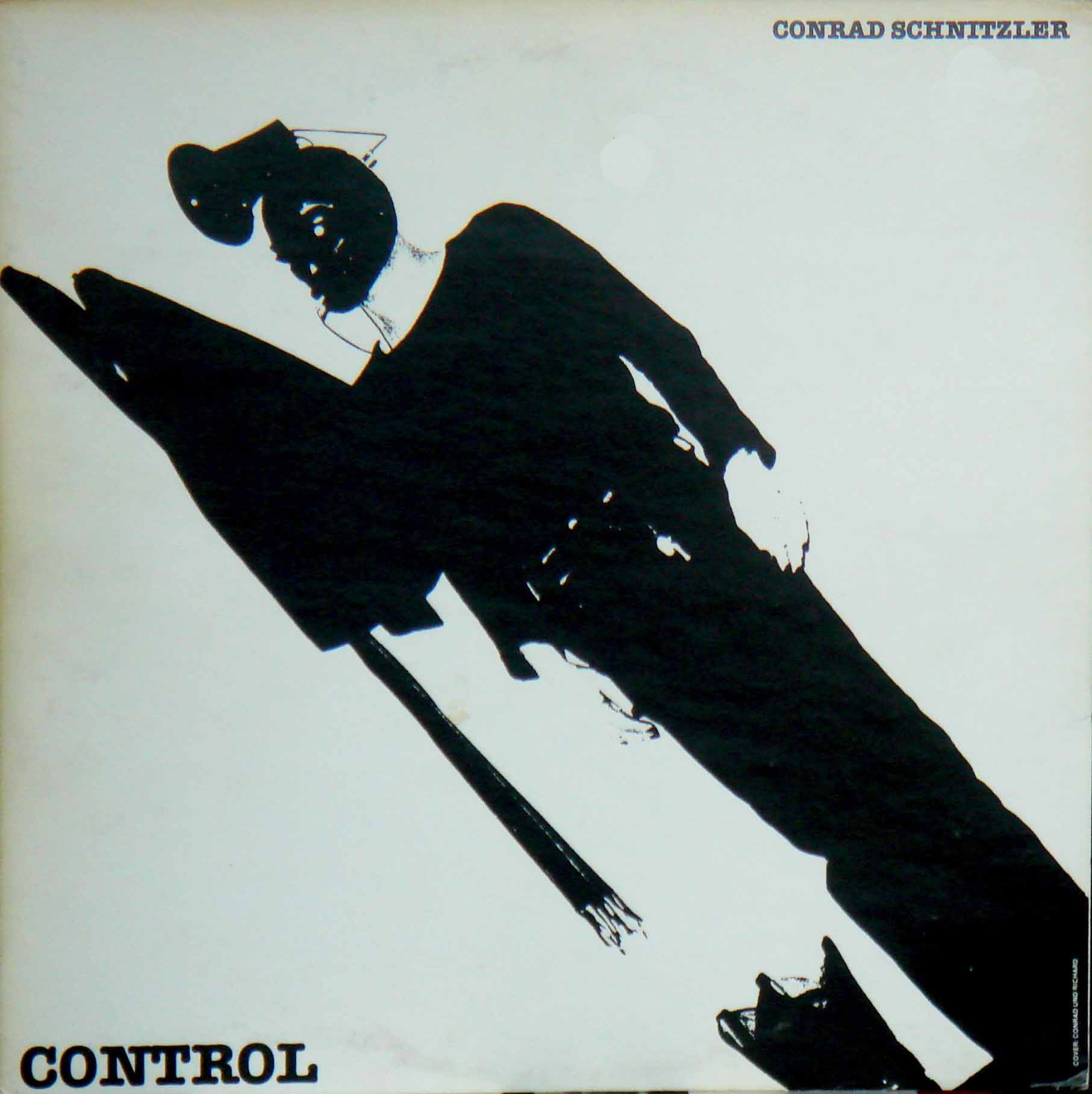
Conrad SCHNITZLER: “Control” *****

Recorded 1978-81


Originally from Düsseldorf, Conrad Schnitzler debuted as a sound artist around 1967.  After studying with Joseph Beuys he moved to Berlin, when he was often associated with the local school of electronic rock even though his soundscapes were never “rock” and his aesthetic was always too idiosyncratic to be pigeonholed.


In his most successful recordings, Schnitzler showed predilection for range compression that was unusual in the early days of analog synthesizers.  It is as if he had done a careful scoping study before each session, imposing restraints on the adopted textures and energy levels.  Nor did he seem to be tempted by excessive multi-layering of additive effects.  His strength lied in poised tone colorings and controlled mood explorations.  His forays into illustration were quickly abandoned and throughout most of his career his music remained subconceptual and non-ascriptive.


Schnitzler’s creations went through several stages.  Beginning with Berlin-based trios Kluster (with Joachim Roedelius and Dieter Moebius) and Eruption (with Wolfgang Seidel and Klaus Freudigmann), his spacious, psychotropic work relied as much on musical instruments as on amplifiers and echoes.  He then moved on to explore in depth the modulatory capabilities of analog synthesizers, achieving much more groundbreaking and lasting results than many of his compatriots.  An artistic hiatus befell him in the second half of the 1970s, when several misguided attempts at electronic rock introduced him to accidental audiences in Germany and abroad.  But unlike the synthesized disciples of the Berlin school, he returned triumphantly in the early 1980s, penning some of the most intriguing and abstract oeuvres yet.  Ever open to experimentation, he engaged in collaborations with new generations of German musicians and then moved onto the digital age, still occasionally leaving recordings which testified his undying tonal curiosity and penchant for deft sound organization. 


Control A

Each side of the original LP is divided into several, untitled sections.  Schnitzler welcomes the listener with atonal kernels of creamy, electronic vibrato, bleeping at varying dynamic levels.  The only order in this disorder is that higher frequency chords are louder, leaving the muddier, brown frequency sounds partly concealed.  At least three layers of these independently originated, expressionist tides collate, but never coagulate.


In the second fragment, foggy synthesizer folds are sustained and then slowly pitch-modulated.  Unlike in the previous track, the very act of modulation generates melodic expectations.  At some subliminal level, there does seem to lurk a barely tangible theme, but it fails to appear de iure; it remains ill-defined and then re-defined by its own shadows – the multiple variations.  Each of the variation ends with longer notes, leaving behind the mood of a desolate, cloudy, open space. 


Electric clangs fall like raindrops hitting window panes curiously intent on rejecting the liquid particles at various frequencies.  This evanescent texture is sparse and the pitches are arranged to accentuate the mutual contrast.  Still, the overall timbral effect is almost childlike.


Another exercise in modulation and phase shifting.  The leading middle layer individuates both the bass line and the crisply sibilant accompaniment, each germinating with a different delay.


A more “industrial”-sounding track based on blender glissandos with controlled sustain.  Tone colors permutate between the illusions of take-off, landing and taxing.  Although the context harks back to the ideas first developed on LP “Con”, the selection of effects is more balanced.  Discrete pitch bending occurs around the usually avoided parts of the frequency spectrum. 


Rotating flywheels send out waveforms which recur in epicycles.  A less prominent sub-theme explores a frail, rounded melodic theme, as if clutching at wavecrest. 


Fast ‘grasshopper’ tremolo is drowned out by an alternating dynamics in doomed quest of nebulous, dormant realm.  The dominant velocity would outpace any other track on the record, but the gesticulation is imperfectly robotic.  Another stratum of glissandos brings a dose of painfully sullied nostalgia. 


Control B

This is an even more atmospheric exploration of chalky textures.  Sheaths of organ give rise to a rare moment of loose harmonic consonance.


Another electronic landscape for stagnating sheets of lengthy notes, modulated in mid-flight.  They all fade away, substituted instantly by clones whose energy dissipates in like manner.  Simultaneous sizzling and rumbling epitomizes the hypnotic character of procyclical, compressed electronics.


Echoey, glassy clocking and pianistic electro-chords flow through a dialogue which explores attention, dis-habituation, expectation, clearing of remorse and doubt about it all.  This is a rare, modal achievement, particularly impressive given the limited toolkit involved in its creation. 


An essing, oscillatory web is delicately overlaid above the leading theme-building.  The focus is on an eventless space, wide open terrain and visibility constrained only by atmospheric phenomena. 


The record closes as it opened – with abstract, a-melodic clusters, collected almost sequentially in search of the right nocturnal mood.  A vague sense of solitude permeates the departures towards to the top of the staff, into ever shorter notes.  Mid-range synthesizer provides some harmonic solution, but the track is cut abruptly.  Did the Revox reel run out or is it another attempt to leave us pensive?


***


The discography below encompasses Schnitzler’s output from the first 15 (analog) years of his career and does not list numerous cassettes, the material from which was later reissued on LP or CD.  Positions 1, 2, 5, 10 and 11 remain my favorites.


1. Konrad SCHNITZLER: “Schwarz“ (1971)

2. Konrad SCHNITZLER: “Rot“ (1972)

3. Conrad SCHNITZLER: “Con’72“ (1972)

4. Conrad SCHNITZLER: “Zug“ (1973)

5. Konrad SCHNITZLER: “Blau“ (1973)

6. Konrad SCHNITZLER: “Gelb“ (1974)

7. Conrad SCHNITZLER: “Live Action 1977“ (1977)

8. Conrad SCHNITZLER: “Con“ (1978)

9. Conrad SCHNITZLER: “Grün“ (1976, 1980)

10. Conrad SCHNITZLER: “Control“ (1978-81)

11. Conrad SCHNITZLER: “Conal“ (1981)

12. Conrad SCHNITZLER: “Conrad & Sohn“ (1981)

13. Conrad SCHNITZLER: “Contempora“ (1981)

14. Conrad SCHNITZLER: “Con 3“ (1981)

15. Conrad SCHNITZLER: “Consequenz“ (1982)

16. Conrad SCHNITZLER: “Context“ (1982)

17. Conrad SCHNITZLER: “Convex“ (1982)

18. Conrad SCHNITZLER: “3.3.83“ (1983)

19. Conrad SCHNITZLER: “1.7.84“ (1984)


His recordings can also be found on several compilations, such as “Three Minute Symphony“ and “Hayfever“ (in the 1990s).  There are countless other cassette, film and gallery materials from the era.


Conrad Schnitzler’s early (1970-72) recordings overlap with his activity in bands Kluster and Eruption.  Indeed, his first “solo” album can be considered a Kluster/Eruption record.  The recordings of these bands are highly recommended for all the fans of vintage kraut electronics.  His appearance on Tangerine Dream’s best LP was the only time Schnitzler played someone else’s music.  Although the recently unearthed positions 5 and 6 are credited to Kluster, they are actually Eruption’s recordings. 


1. TANGERINE DREAM: “Electronic Meditation” (1970)

2. KLUSTER: “Klopfzeichen” (1970)

3. KLUSTER: “Zwei Osterei” (1970)

4. ERUPTION: “Eruption” (1970)

5. KLUSTER: “Vulcano” (1971)

6. KLUSTER: “Admira” (1971)

7. ERUPTION: “Live Action 1972.  Wuppertal” (1972)

KONSTRUKTIVISTS: “Black December” ***

Recorded 1983


It is difficult to pinpoint the exact reasons for the explosion of post-industrial culture in Thatcherian Britain.  This was the time when Sheffield had already become a moribund shadow of “the steel city on the move”.  And within several years Arthur Scargill’s coal unions would be hoisted out of the shaft and shelved onto rarely visited shelves of communal libraries.  Only the Falkland War distracted from the monochrome character of the pre-reform UK.


But it was precisely during this period of the reluctant social and economic transformation that a whole generation of British musicians launched their projects emboldened, rather than hampered by the punk revolution several years before.  Among the styles which benefited from the flourishing of independent labels, post-industrialism created the most lasting of musical documents. 


Glenn Michael Wallis was an active member of the scene, associated with such luminaries as Whitehouse and Throbbing Gristle.  Between 1982-85, under the moniker Konstruktivists, he created dark electronic visions that somehow reconciled the technical and stylistic limits of the era with excellent sense of sonic perspective.  David Kenny who engineered Konstruktivists’ early records also deserves the credit for a healthy, selective approach to analog and tape effects.


Using a limited armature of tools, Wallis successfully generated illusion (but illusion only) of depth and complexity.  His manipulation of reverb density was always tasteful and his novel, particulate textures prefigured later recordings of esoteric underground.  On several occasions, he also betrayed familiarity with electronic rock of the previous decade, a potentially dangerous faux pas in the proud years of post-industrial nihilism. 


Miles away from the harsh experiments that dominated the center stage of post-industrialism, Konstruktivists’ records are a charming, though never infantile, testimony to the style of an era that is rarely celebrated these days. 


Nostalgia

Initially monolithic, semi-stationary waves of analog synthesizer expand their mildly polyphonic reach.  The static plane is construed entirely from high frequency sounds, nearly emulating the unnerving tension that György Ligeti had achieved in his multi-strings compositions.  Although Wallis eschews such direct quotations, the resulting tension is a far scream from the “Nostalgia” alluded to in the title.  Yes, some light-bodied melody does roam somewhere, but it is buried deeply in the downmix.  The synthesizer screen slowly begins to flow in and out.  When it ebbs away, no residuals are left behind. 


The Crimson Path

Dressed in short reverb, a surf guitar (Nick Clark) promenades to the passé grin of a simple rhythm box.  A second guitar, specializing in nickel-clear tremolos, is strongly reminiscent of contemporaneous DDAA.  So is the post-partum wailing of cross-breeding “feminine” voices.  The track zigzags in a directionless fashion with vocal tracks treated by varying doses of delay and contrasted against the tremolo guitar.  Sunnily independent, the surf guitar improvises freely. 


Shadows of White Sand

Synthesizer shales give way to deeply atmospheric, underdefined ill-bience, indirectly evocative of Attrition’s best LP and the less spacey Zoviet France.  Subterranean, larval echoes emerge slowly in waveforms determined at source by no more than three chords.  Woozy matte is spilling out gently.  There is no sense of ominous imminence here, but rather an aura of mystery and irrealization.  What could be dismissed as a case of mere illustrative electronics, bestows on the willing listener just enough freedom to fill this aural framework with liberating numinosum. 


In Kabul

This repetitive rhythm-box and guitar motif, so stiffly grounded within the aesthetic of the early 1980s, is worthy of an early Cabaret Voltaire or Clock DVA record.  But instead of saxophones, the simple set of guitar figures is coupled here with oud-sounding string tunings and addictive vocal echoes (Pilar Pinillos and Elena Colvée).  The tempo is leisurely, despite the notional fill-ins programmed in the rhythm machine. 


Extasie

The sequencer flies into the limelight with an amplitude of a machine-gun.  There is a competition between the several synthesizer sources.  On the one hand, we distinguish classicizing arpeggios, on the other, repetitive chord renewals, chiming in with the rotor-aping sequencer.  The overall climate is closer to Richard Pinhas’ work than to his German contemporaries. 


Decadence

Simple repetitive electro-glorping, suffused with bleeps and destabilized by processed male vocal.  Indeterminate organ clusters, metronomic machine drumming and guitar hooks determined by the simplistic structure of electro-beat recall the simplicity of the long-forgotten artists of the era – Eric Random and Bill Nelson.  


Red October Black September

The most memorable moment on the record is the track built around a pulsing, yet melodic bass skeleton.  Throughout this passacaglia après la lettre, illusory verbalizations adopt an almost ingressive mantle due to ingeniously mixed synthesized hyperplanes.  The voices are slotted in with dynamic jumps, and alarmingly so.  They recede at various stages of decomposure – fading, wilting or transmogrifying into metallic reverberation.  A patchy cobweb of guitars and synthesizers embroiders a denitrified tapestry, underscoring the critical role of the electric bass ostinato.  The effect is intoxicating.  It all ends too soon. 


***


For those willing to explore the dark corners of analog atmospherics, any of the first three recordings are recommended.  There were also many cassette issues. 


KONSTRUKTIVISTS: “A Dissembly” (1982)

KONSTRUKTIVISTS: “Psycho-Genetika” (1983)

KONSTRUKTIVISTS: “Black December” (1983)

KONSTRUKTIVISTS: “Glennascaul” (1985)


Many unique pieces can also be found on compilations, e.g. “The Elephant Table Album” and “Four Years in 30 Seconds”.  We owe the latter to the fact that Wallis resuscitated Konstruktivists in the 1990s. 

Published in: on September 9, 2008 at 9:05 pm  Comments (1)  
Tags: , , ,

Keiji HAINO & Tatsuya YOSHIDA: “Mizu ga honô wo tsukamu made” ****

Recorded 2000


The earliest sign of recorded collaboration between these two giants of Japanese avant-garde go back to Keiji Haino’s guest appearance on Musica Transonic’s “Gashô keshin”, also known as “Incubation”.  This was in 1997, and little at that time indicated that the shock of titans, mediated by Makoto Kawabata and Asahito Nanjo was anything more than accidental. 


Instinctively, Yoshida’s topological drumming technique should not sit comfortably with radical mood swings that Haino had been infusing with quanta of kinetic energy for nearly three decades.  And yet, when the legends met again in 2000, sparks flew. 


Whereas in other duet formats, Yoshida tends to dominate the proceedings thanks to his intuitively mathematical memory, in his collaboration with Haino, the distribution of outcomes suggests equal repartition of rights and duties.  Despite moments of premeditated asynchrony, the musicians achieve a measure of multi-climactic exaltation.  They never seek full symbiosis, but nor are they content with mere cohabitation.  Instead, we witness metathesis and occasional cross-mutation of ideas.  And what does bring these very different souls together is the essentially haptic nature of their musical practice. 


In the trio format, their collaborations are more than the sum of the three.  Haino’s gitara picaresca transfers the center of gravity, turning the polymetric Gordian knots into veritable jewels of avant-rock.  As Knead, they were joined by bassist Hisashi Sasaki, formerly of Ruins.  On Sanhedolin, Sasaki was replaced by Mitsuru Nasuno. 


As a duo, Haino and Yoshida often go beyond the electric assault and roam unplugged, bringing back the memories of itinerant troubadours, equipped with acoustic string and membrane instruments from Hindustani, Bengali and Berber traditions.


Please note that the record described here, originally published in Hong Kong, is also known under English and Cantonese titles: “Until Water Grasps Flame” and “Deng shui zhua dao huo wei zhi”, respectively.


Yoi sareru wa seishinbunseki no chimayoi

Thunderclaps of blitz guitar crash in before Yoshida’s multi-directional impetus disturbs the distant discharges and drag the guitar distortion much closer into an echo-less, closed space.  Haino’s axe transforms his a-melodic shrapnels into heavily infused, compressed, pyroxenic seams.  It is Yoshida’s feet that rule here, jabbing the low-pitched drums with determined rolls.  His busy cymbal work is disactivated whenever the guitar fizz evaporates.


Nadaraka na shiyôgo no ketsui

A very different duo of the same pair of hands.  Haino appears first on a wonderfully sentimental Mughal sarod.  Yoshida joins the misty sunset scene on darbouka.  Haino’s irreverent glissandos turn his sarod into a mantric oasis of short cycles, but his hedonistic style will take a while before accelerating.  Yoshida handles a multi-effect Korg X5D, here in liquid bass role, but with a trousseau full of other percussive sounds: glockenspiels, cog rattles and flexatones.  As the effects accumulate, the atmosphere becomes very dense.  The clamor of the electro-bass has almost distracted us from Haino’s riffing race to nirvana. 


Yokka to yutta to tan

A more familiar setting of chuckling jazz guitar and brushed percussion.  Haino, who had played with Derek Bailey four years before, hesitates here between the master’s non-speculative anti-documentarism and a peculiar stutter perfected by Davey Williams.  Although Haino does sound less angular and more rounded than either, he does not fall into the full-bodied, leathery nostalgia of his duets with Loren Mazzacane Connors.  Or perhaps, Yoshida just would not allow him to.  The track progresses by fits and starts, with aptly mobile drumwork evolving in parallel, and never in competition with the guitar.  This is rock improvisation for jazz sounds.  In the dry, clipped “rock” context, Haino’s sound is closer to Sonny Sharrock’s than Eddy Marron’s.  After another swell of nonmetric drum patterns, Haino desists again, contenting himself to punctuating Yoshida’s most defining beats.  Eventually, an eruption does arrive, embodied in higher riffing gear and more constructive buttressing from the drumkit. 


5Hz e no kansha no in

Here Haino picks up guembri, a three string lute of Berber origin.  He will exploit the instrument’s vascular, hollow sound with restrained, kindly pentatonic plucking.  Yoshida’s skin rumble is perfectly adjusted, color-wise.  The duo achieves a tribal asabiyya even before Haino hurls his first howl.  Yoshida’s bass drum rejoins, balancing the contributions adequately.  Soft drum rolls coarsen whenever Haino’s howling masks the delicate articulation on guembri.


Setten wo yowayowashiku shite shimau itteki

High pitched, wailing notes from Haino’s guitar are quickly corrected by Yoshida’s multiplicative drumming.  Henceforth, Haino is reduced to playing some combinations of quarter notes and 8ths, with irregularly interposed rests.  Their junctures create unexpected filling effects. 


Tokku ni kanatte iru hazu no LHNZ to iu kekka na no ni

Haino is credited here as playing “gothan”, a low-resonance string instrument of unusual tuning.  His strikes (probably plectrum) recall false, additive raga accelerations.  Yoshida operates mostly on brushes, mixed deep, but with very short reverb, and a clearly audible large tomtom on the right.  When silence falls, Haino intones an East Asian-sounding “melody” from his instrument – a slowly flourishing dance with bizarre dragon interjections and shouts.


‘Mochiron kare dake no tame’ to iiwake wo suru

Deep, tunnel-like echo buries the unlikely duo of bowed esraj and Korg X5D.  The esraj, a fretted Bengali instrument related to sarangi, gives off an eerie, heterotropic image.  No temple possesses such long-decay acoustics as applied here, but the atmosphere certainly is one of meditative concentration.  Yoshida’s clicking electro-rhythm does not distract, but the gesture of his rhythm-keeping differs radically from his physical drumming.  This is a novelty and a plus.  Later, the Korg’s bass function is switched off.  Scrapers, graters and microtonal rattling correlate nicely with an angrier accumulation of distorted meend from the esraj.  When Yoshida elicits vitruous effects from the low-end rumble, memories of classic Jon Hassell flow back. 


Owatta shôko misetagaru seimon

Although the track begins with Haino’s stammering guitar technique, so perfectly displayed on his first Aihiyô recording, it later settles into a more familiar, almost ‘jazzy’ mode.  At various intervals, the narrative sequence recurs: presentation, silence, resolution and release.


Kioku wo tadotta toki ni nankai ka atama ni ukabu akarasama to no sôiten

This is mostly Yoshida’s show.  He opens with his cocky vocal retributions, strongly in the improvised Zamla tradition, not nasal enough to be truly ‘tongue in cheek’.  The guitar sound is warm, welcoming, running scraps of medieval scales.  The drumming is unabashedly aperiodic.  When Yoshida defaults into his falsetto, Haino’s guitar veers off into a herbal, fruity terrain.  Quite unexpectedly, we are confronted with one of the more intriguing moments on this record.  From the fragrant orchard emerges an attempt at ‘melody’.  Granted, it is a mere “attempt”, but sustained as a perennial promise, not frustrated by an abstract collapse or a cacophonic break-out.  Instead, the promise is being subsidized with a conclusive dialogue between the two musicians, each caressing his miraculously sonic object.


Sabetsu to mitomerareta anna fun’inki

A duo of two darboukas.  Haino does well by not trying to compete with the world’s best drummer, but nor does he fall into non-pitched melodism of his percussion solos.  Rather his fingers nimbly send hurricanes across the darbouka’s membrane, keeping up with the vertiginous pace posited by the master.  Yoshida’s excitement is noticeable when his trademark vocalizing fuses with nonsensical glossolalia.  They rush through these minutes, barely touching the ground. 


‘Masaka’ to omotta toki no naka ni fukumareru  natsukashisa wa nan paasento?

The record culminates here with over 12 minutes of determined guitar and drum mayhem, not unlike Fushitsusha’s mid-period volcanism.  Chord progressions repeat but each time at different length.  Some guitar incisions sound almost groovy (or is Haino poking fun at Kurihara?).  The drumming is also more obviously ‘rock’: Yoshida’s avalanches of irreversible tremors are nothing short of impressive.  He perfects his craft whenever Haino’s riffing goes free.  And when Haino returns to his staccatos, Yoshida’s drumming suddenly becomes regularized.  It is Yoshida who takes the lead to pull the duo each time off the edge of repetition.  Haino’s anthemic moments are short-lived.  His guitar suffocates with a mere droplet of fuzzing pathos.  Then a brief, abstract section follows, filled by drumming in search of perfect architecture.  But it is a riff galore that will end the track.


Kiete yuku kono yôna kanashimi hô

Haino meows surreptitiously to Yoshida’s Korg and an astonishingly simple meter.  As if unaware, a detuned string instrument (banjo?) rambles on with a corrugated effect.  There are surprises – the Korg imitates tabla’s left-hand drum with a deeper, variable pitch.  The ‘banjo’ melodically shadows the polyrhythm.  Haino swoons into monosyllabic chanting, peaking mid-phrase (here’s the regularity) and varying the release (here’s lack thereof).  


***


For a bold listener in search of avant-rock improvisation, there are excellent moments on each of the recordings listed below.  My favorites remain 1 and 2.  I have never heard position 4.  Material on 7 and 8 partly overlaps. 


1. Keiji HAINO & Tatsuya YOSHIDA: “Mizu ga honô wo tsukamu made” (2000)

2. KNEAD: “Tokete shimaeru shiyawase mo.  Melting Happiness” (2001)

3. KNEAD: “Knead” (2002)

4. Keiji HAINO, Tatsuya YOSHIDA, Mitsuru NATSUNO, BUS RATCH: “Live at Cafe Independants” (2004)

5. Keiji HAINO & Tatsuya YOSHIDA: “New Rap” (2005)

6. SANHEDOLIN: “Majoicchi wa mukô” (2005)

7. Keiji HAINO & Tatsuya YOSHIDA: “Uhrfasudhasdd” (2007)

8. Keiji HAINO & Tatsuya YOSHIDA: “Hauenfiomiume” (2008)

Published in: on September 7, 2008 at 3:14 pm  Leave a Comment  
Tags: , , , ,

HELLEBORE: “Il y a des jours” *****

Recorded 1983-84


Hellebore were initially a quartet of Jean Caël (bass), Antoine Gindt (guitar), Daniel Koskowitz (drums) and Denis Tagu (keyboards).  Initially equipped with Rhodes piano, the band expanded the sound considerably by co-opting Alain Casari on saxophones and clarinet and purchasing a popular crumar synthesizer.  This is the line-up on their only LP, decorated with art work prepared by Colorado’s Mnemonists/Biota.


By the early 1980s, these young French musicians were among the most talented epigones of Rock in Opposition style.  Certainly, they were too young to compete with the British luminaries of the movement.  And yet, the ex-post criticism of their output, often meted out by some of the members themselves, was probably a mite too harsh.  Even today, three decades after Henry Cow’s demise, the musical world is still receiving the dividends from that artistic investment.  There was clearly nothing wrong with this 25 years ago.


Soon after Hellebore folded, Jean Caël launched Szentendre, a short-lived band guided by similar searchlights.  Koskowitz and Tagu initially joined, but soon left.  Four musicians of the quintet also appeared on Look de Bouk’s first LP.  Koskowitz soon rejoined Gindt and Casari in Neo Museum – a logical continuation of Hellebore, if a little more saxophone-fronted.  But that incarnation did not last either.  Koskowitz disavowed the entire scene and made a radical stylistic move towards more pugnacious forms of modern French rock, most prominently with Soixante étages.  Denis Tagu and Jean Caël have continued to charm old and new audiences in the surviving DIY projects Toupidek and Look de Bouk. 


Introduction végétarienne

“There are those days, there are such hours”, proclaims a Reichian voice loop.  Rather than cutting up formants, Hellebore allows the entire phrases to be reproduced, and repeated.  And so, we learn about “the weight of responsibility” and the concerns regarding the financial future.  Still, “vegetarian” it is not.  The tape material is prodded by an emulsion of drums, assorted noise and vinyl crackle.  Slowly harmonic hints are being diffused by Denis Tagu’s electric organ, stiff cowbells, a Cartesian rhythm box, triste piano and leaden-footed electro-beat.  Against this pile-up of orchestration, the melody had to come in higher notes, and come it does, in the form of Antoine Gindt’s surf guitar.  He marinates the emergent theme with delicate, broadly optimistic gestures.  It all happens with a velocity of tired hoofs, allowing Alain Casari’s clarinet to entwine within the constraints of the inelastic tempo and densifying texture, rather than ad libitum.  Jingling cowbells free their partials, carried with non-descript electrified veneer.  A variation on this theme is then performed on piano, clarinet and organ.  Unimpressed, Daniel Koskowitz’s cymbals announce a new movement for a solo guitar, punctured by the axle of a piano playing exactly the same notes.  The effect is warm, and softening, which could be surprising given the difference in prefix characteristics between these two instruments.  The 25-note theme returns with avuncular clarinet.  It is up to the pianist to bring it all down to the stop line. 


Tetraktys

Two, lengthy ‘harmonium’ tones are quickly tamed by the cymbals and a guitar introducing another slo-mo, lazy, numbing theme borrowed from late summer.  Jean Caël’s bass is unobtrusive in its solidifying role.  When it speeds up, alto saxophone alternates with (almost forgotten) crumar synthesizer.  An electronic drapery lunges forward in short chunks, allowing the drummer to lose the metronomic precision of the opening.  Stylistically, Casari’s sax merely shadows the synthi-led staccato, even after an obligatory change of time signature.  The harmonic agreement between the saxophone and the keyboard is finally broken by prominence-reordering whispers and dry skin drumming from Koskowitz.  The final subsection is aperiodic, with a clean resolution from the synthesizer, bass and clangorous cymbals. 


Artefact

A bleak, plaintive intro temporizes through the plasticity of bass-organ-saxophone triad.  The eventual conflagration is sparked by the drums, a capriciously low-tuned guitar and a sandblasting alto sax.  The band zigzags through multi-guitar progressions and saxophone-led interrogations.  But this trendline soon collapses, giving way to keyboard-led blanket morosity.  It is here that an in-your-face box rattling hijacks the spotlight from the predictably a-metric drumming, lumbering bass and a mid-flight saxophone line.  Denis Tagu accelerates on his piano, faithfully traced by Gindt’s guitar mutualism. 


Film di Ripratoria

Fast, if commonsensical saxophone melody interrelates here with a fatalistically joyful guitar.  By comparison, satirical piano arpeggios sound as if collected from another dimension.  When heraldical drums and cymbals join in, the band can no longer fend off the accusation of Henry Cow fanaticism.  A jangly guitar gains prominence over the academically pointillist band, destabilized by arbitrary repression from saxophone blow-outs.  This is almost as good as the Muffins’ take on the British original.  Clapping, skitter, dilapidated drumming, intrusions into piano’s underbelly…  Strings are hammered, powders shaken, hands clapped, surfaces scraped until the guitar and saxophone return with a neutral variant of the opening head. 


Warme Wasser mit Grass

Drum and bass drive in, seemingly with little idea where the theme would lead them.  When Caël’s bass and an entire balustrade of glassy and metallic flickering finally embark on a rhythmic journey, a This Heat-type hairpin takes them down the slope through a blackened, well-oiled connubium of guitar and drums.  At each life-saving turn, a fair amount of repetition resurfaces.  The guitar meows on its own account.  Then it gets dirty, cocky, squawky, occasionally punctured by the reeds.  A drum salvo will close this rockiest of Hellebore’s cuts.


Umanak – Marquis de Saint Circq

Despite Koskowitz’s intelligent space drum presence, this is little more than a smoky piano solo, a lyrical nocturne, a contemplative poem.  A smiling guitar line looks on, a box ticks with soldierly regularity, and Casari’s clarinet knits its windy napkins with inscriptions from 1001 nights.  The structure tends to shift – piano and bass exchange their respective roles with the guitar.  But then a drastic wake-up call clarions: a mountain howl from the Northern Carpathians, powered by an organ squeak.  This apparent tribute to Plastic People of the Universe acts like a shock therapy to overconfident listeners.  The chunks of organ scatter around, oblivious to the saxophone and crumar in overdrive.  Only Caël’s bass still retains the ominous beat calqued from the Jan Hus’ worshippers.  The saxophone, synthesizer and multiplex percussion drizzle off till the very end.


Debout

Anachronistic electro-beat and acoustic piano slowly lurk out to witness perky hiking hum.  A romantic juxtaposition of piano and clarinet injects a static ornament.  A keyboard duo of organ and crumar sizzles aimlessly, with bass overdrive piercing through with abstract splashes of color.  The organization around some eternally renewable energy pays off.  When piano chords die out, the rhythm box and keyboard march out on the stepping stones to dynamic resolution.  The drum machine, synthesizer and cowbells re-anchor on the closing theme.  Tagu improvises on the modal piano, compressing the range focus.  But the moods revert.  On the back of a fatuous nursery rhyme clanked out by the piano and clarinet, a martial rhythm of drums, piano and guitar trundles through, prompted by Casari’s war calls on alto.  It is precisely the lone saxophone that survives on the battlefield. 


Ce sont des choses qui arrivent

What happens when a pianist, a saxophone player and a percussion virtuoso meet?  Nothing.  You need a guitarist to lead them from their abstract maze.  When that happens, the saxophone runs may be brief, epigrammatic and self-limiting but they remain structurally decisive nonetheless.  The track concludes with a sumptuous piano fragment captured in a space whose acoustics brings back the childhood memories of intimidating concert halls.


Eclaté / 3ème / après

Saxophones second an infantile, rhyming beat.  The organ slices chunk after chunk.  For a logical solution to the set, the ‘chalk against the whiteboard’ scrape is coming a little late.  Hoofsteps clock along.  And then, at long last, a Grande Finale is ushered by the band in full glory and in a rather melodious mood: the saxophones, mandolin, bass, and piano. 


(On side B, the track description on the insert differs from the one provided on the label; consequently, the comments above may not adequately correspond to musicians’ original intentions).


***


HELLEBORE: “Il y a des jours” (1983-84)

SZENTENDRE: “Un tour gratuit” (1985)

NEO MUSEUM: “Volume 1. Nouvelles ethnologiques de l’obscure museum” (1985-86)


Hellebore’s tracks also appeared on compilations: “Douze pour un” (1982), “Voices Notes and Noise” (1983).  Szentendre can be found on “Douze pour un vol.2” (1986), and Neo Museum on “Rencontres du premier type.  Strasbourg, Vandoeuvre, Reims” (1985) as well as “Douze pour un vol.2” (1986).


Fans of Hellebore should also seek out Look de Bouk’s debut LP:


LOOK DE BOUK: “Lacrimae rerum” (1985)

Published in: on September 1, 2008 at 7:56 pm  Leave a Comment  
Tags: , , , ,

P16D4: “Distruct” ***

Recorded 1982-84


Ralf Wehowsky is sonic artist originally from Mainz in Germany.  From the very beginning of his recording career, he was enamored with tape manipulation.  At a time when most no-wave bands in Hessen indulged in spitting out their nihilistic messages, Wehowsky’s first band PD chopped, stewed, grilled and mixed contrasting input sources from various group improvisations.  Having mutated into P16D4 with Ewald Weber and Roger Schönhauer, Wehowsky plunged in careful research into the tonality of the source material.  Combined with in-house improvisations, the inputs would undergo speed transpositions, unusual oscillations and re-modeling of both macro- and micro-structure of the material. 


At least half of P16D4’s material fused sonic inputs contributed by other artists.  Wehowsky et al would habitually rework the original material beyond recognition.  The manipulated arrangements were deemed successful whenever the corresponding parts of the source material and their contiguous sections became correlated.  Whenever the inputs were overlaid in a relatively “raw” form, the results ranged from free form abstraction to noisy, chaotic forms with very little, if any, repetition. 


If P16D4 constituted an a-melodic revolution, they were never programmatically anti-melodic.  Despite the apparent balance between the use of electronic and acoustic tools, it does seem that P16D4 privileged brutal contrasts in the former and rather subtle, organic shifts in the latter.  Elements of untreated (or less treated) noise were often drowned in an illusion of surrounding space.  This was a lesson of multidimensional abstract expressionism. 


The record presented here summarizes well the way “mid-period” P16D4 organized its work.  The source material was provided by a number of sonic artists from the early 1980s post-industrial and noise scenes (Nocturnal Emissions, Bladder Flask, Philip Johnson, Die Tödliche Doris, Onnyk, DDAA, Frederik Nilson, The Haters, Nurse With Wound, Hiroki Kocha, Harold Schellinx, Vortex Campaign, Merzbow, De Fabriek).  However, this is not a compilation.  Rather, it is a sequence of compositions using bared building elements of the original sources.  It is pointless to try to detect the threads leading back to the artists enumerated above. 


The band, as such, was active only for about two years, between 1981-83.  Between 1983-88 the moniker P16D4 was used for recordings realized by Ralf Wehowsky’s social circle. 


Kultstudien zu Anselm Weinberg

Flat slabs of ferritic steel respond with muzzled, chinked sound.  Burring guitar and wowing bass introduce us to semi-paralyzed, dilatory pace of AMM-like exploration.  The big difference is in the guitar treatment – not nearly half as dense as Keith Rowe’s.  Ewald Weber’s anvils, clanky plates and empty metal boxes speak with a short, tinny grin.  Drumsticks are trying to force some resonance from metallic, wooden and polymer surfaces, to no avail.  The guitar wahs numbly, note by note.  Steven Stapleton’s deeply treated voice is being played backwards as if in memory of yesterday’s slaughter.  The treatment of source material imparts a sensation of intense concentration.  Brought to reluctant prominence, some pangy, earthy cymbals choke dryly.  Canisters shake and wobbly bass scoops the notes, clipping the release.  A modicum of rhythm is unveiled when the metal box hitting is multiplied by skin drumming and distant temple shimmer.  The sonic landscape is becoming crowded: shuffling sounds, backward voices, highly-pitched feedback, a sandy cascade repeated over and over again.  This last component will become more “rhythmic”, organizing tangential intrusion from jackhammer and obnoxiously pink noise.  At its tail-end, a violin attempts a lyrical theme, all too soon lost to jackhammer’s violence. 


Meere Giganten und Berge

If the previous track instilled an expectation of reserve, here P16D4 are endeavoring to demolish it outright.  Skitter, rustle, footsteps, running, wooden boxes – all these sounds meet, but never mix, inside a large, resonant hall.  Electronic microtones squeeze here and there, slurring the effects of abstract percussionism and irregular metallic bangs.  Then we hear an unwelcome rhythm box (courtesy Nigel Ayers of Nocturnal Emissions), quickly undermined by another, even faster electro-beat and electric piano arpeggios.  A political speech in Russian (apparently V.I. Lenin’s harangue) interferes with references to England and France (how timely!).  It is juxtaposed against deep, hollow grey noise and voices sent through by the members of Tödliche Doris.  The beat has now long disappeared, but when it does come back, it appears as fragile, orphaned, “pure” drum exhibitionism.  A longer note from a poorly identifiable object (a horn?) closes the section.


Extended Symbols

A wheezing sound is dragged across the range at a breathy tempo.  The angelic vocalize barely palpable, while sequenced post-industrial tapestry juts in and out of audible spectrum.  A male chorus, a sledgehammer and jackrigs are all layered together with a disorienting simultaneity.  Onnyk’s Hedorah-like vibrating noise platonifies a standard guttural growl.  Finally, a lonesome saxophone solo dismisses the company of a skittery, a-metric drumming.  Both are dying out in a large, “factory-like” space. 


Aufmarsch, heimlich

Unlike on the first side of the LP, here Ralf Wehowsky’s gestures are determined, his accents are forceful and prefixes abrupt.  The snippets, he uses (Soviet marching songs and Peter Lambert’s alto saxophone) are treated with Stockhausen-like non-linear decontextuatlization.  The unnerving chop-up slowly gives way to multi-tracked saxophone lines, whose soaring runs are instantly undercut – either by the recurring snippets of the marching song, or by another sax layer, alternatively by a loose crankshaft wheel.  The alto sax finally oxygenates the atmosphere in the direction of Anthony Braxton’s intense graphism, albeit with longer notes than the master’s.  The higher range is allowed to echo and the treated stacattisimo nearly transforms the reed into an ersatz guitar.  All along, electronics bubbles and rumbles behind this frontal complexity. 


Svenska Förtäring

In this tiny miniature provided by DDAA, Wehowsky demolishes a tape with the lesson of Swedish.  You can (almost) hum along.


Kryptogramme 7-11

Although several sources are listed here (notably Bladder Flast and Onnyk), the opening does seem to be overreliant on Wehowsky’s strident cello scraping and sadistic pizzicato assaults, which, by comparison, would turn Tom Cora’s games into tender caress.  Unexpected guitar fuzz, and NWW-type retroactive electro-dust complicate the envelope.  Saxophones multiply in a most abstract manner, despite attempts to limit the thrusts to 2-3 notes each.  Although this is Wehowsky on the piano – its cold, frozen, repetitive stalactites are reminiscent as much of his Permutative Distortion as of Robert Haigh’s Sema.  Meanwhile, noisy crowds ooze in and out.  The plaintive wheeze is forced into a higher life form, further sacrificed for a prominent, monster-movie guitar in shameful overdrive. 


Upset Twilight

No meter and no beat here.  Just metallic skitter, hammering, clanks and such like timbral explorations.  Although some electro-buzz appears to underlie the clatter, the sequence is entirely devoted to empty metal boxes and accompanying metallic rustle. 


Les honteuses alliances

Phil Johnson’s voice tapes do the trick – processed, vocoder-ed, electro-beaten.  Another warmer, inviting voice in British English beckons from the other side of the universe.  High pitched sound (Bladder Flask here) goes almost hissy as the space gets populated with wobbly sources.  Masami Akita’s flute is inaudible.  Instead, it is noise distribution stuck in a rut, repeating on and on, locked in a groove, Asmus Tietchens-style.  The entire routine is repeated once again, with the noisy rut getting even more oppressive.


Martello Tower

Peter Lambert’s alto sax and Nigel Ayers’s rhythm box do their pentatonic thing in P16D4’s laboratory. 


Luxus & Mehrwert

Roger Schönhauer is responsible for this collage-like accumulation of contributions from De Fabriek, Vortex Campaign and Hiroki Kocha.  It begins with a charming, old vinyl record crackle reproducing a pre-War orchestra.  The turntable arm skips, skips, skips – like Philip Jeck’s or Pierre Bastien’s modern-day machines do.  This is followed by a frattage of environmental noises, field recordings, electronic processing, machine-type rhythms, Yasujiro Ozu-style black and white moods, circus melodies, hammering, and then back to the old, Pierre Henry-type cortical take-off.  Upon which, the vinyl record skips again.  Schönhauer’s art meets here Nurse With Wound circa “Sylvie and Babs”. 


***


P16D4 was strongly rooted in the early 1980s cassette culture and many of these recordings have resurfaced in recent years on vinyl or CD.  They contain some of the very best recordings from the “transitional” era, capturing the shift from PD’s post-punk electro-experimentalism to more sophisticated abstract forms.  Luckily, Wehowsky et al dwelled on that thin edge long enough to bequeath several high-quality sonic documents of their morose enthusiasm.  Most of the material recorded between 1980-82 is highly recommended, with 4, 8 and 13 being my favorites.  6, 7 and 12 include recordings of various members of PD.  Recordings made after 1982 are best explored by the lovers of musique concrète and electro-acoustic traditions (to which P16D4 does not directly belong). 


1. PD: “Inweglos” (1980)

2. PD: “Alltag” EP (1980)

3. Ralf WEHOWSKY: “eaRLy W one” (1980)

4. Ralf WEHOWSKY: “early Two.  Nur die Tiere blieben übrig” (1980)

5. Ralf WEHOWSKY: “early W 4.  Ajatollah Carter“ (1980)

6. ERTRINKEN VAKUUM/KURZSCHLUSS: “Ladunter / Kurzschluss” (1980)

7. PERMUTATIVE DISTORSION / LLL: “Brückenkopf / Schlagt sie tot!“ (1980-81)

8. P16D4: “Wer nicht arbeiten will, will auch nicht essen” (1980-81)

9. P16D4: “Von Rechts nach Links“ (1980-81)

10. Ralf WEHOWSKY: “Early W – Three.  Neue Deutsche Peinlichkeit” (1981)

11. PD: “Startrack / Freiheitsgeschmack” (1981)

12. P16D4 / Der APATISCHE ALPTRAUM: “Tödliche Schweigen / Der Apatische Alptraum“ (1981)

13. PERMUTATIVE DISTORSION: “Brückenkopf in Niemandsland“ SP (1981)

14. P16D4: “Kühe in ½ Trauer” (1980-83)

15. P16D4: “Distruct” (1982-84)

16. P16D4: “Tionchor“ (1982-86)

17. P16D4 / SBOTHI: “Nicht niemand niergends nie!“ 2LP (1986)

18. P16D4 / ETANT DONNES / ESPLENDOR GEOMETRICO / VIVENZA: “Bruitiste“ 2LP (1986-87)

19. P16D4 / Asmus TIETCHENS / SBOTHI / NACHTLUFT: “Captured Music“ (1987)

20. P16D4: “Acrid Acme” (1981, 1987)

21. P16D4 / MERZBOW / SBOTHI: “Fifty” (1989)

22. SLP: “SLP” (1989-90)


Naturally, Ralf Wehowsky has continued to record prolifically throughout the last two decades, but digitalization and sampling transformed his work since the early 1990s. 


Among P16D4’s recordings included on various compilations, the following ones can be considered the most significant.  Indeed, position 2 belongs to the most important monuments of monochrome post-industrial collage culture of the early 1980s. 


1.“Schau hör, Main Herz ist Rhein” (1981)

2. “Masse Mensch“ (1982)

3. “Sensationnel Journal no.1“ MC (1982)

4. “Ohrenschrauben” (1982)

5. “Bad Alchemy Nr 5“ MC (1983)

6. “Ohrensausen“ (1984)

7. “Strength“ (1984)

8. “Devastate to Liberate” (1985)

9. “A Gnomean Haigonaimean“ (1987)

10. “Ciguri” (1988)