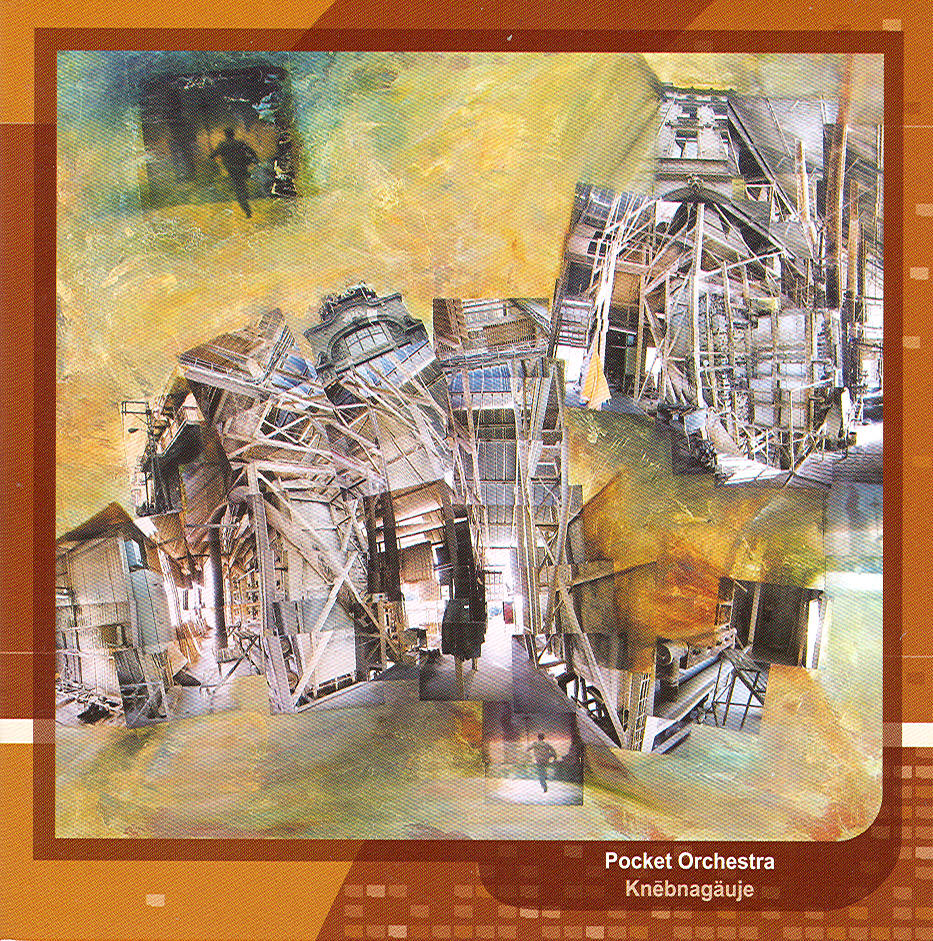
POCKET ORCHESTRA / KNEBNAGÄUJE: “Pocket Orchestra / Knebnagäuje” *****


Recorded 1978, 1979 and 1983


Sometime in mid-1970, Tim Parr from Phoenix AZ brought together several musical soulmates to listen to Rock in Opposition movement’s groundbreaking records and to improvise around stylistically related ideas.  Parr on guitar, Bill Johnston on cello, Bob Stearman on drums, Craig Bork on keyboards, Tim Lyons on bass and Joe Halajian clarinets and saxes evolved together under several monikers, including the unpronounceable Knebnagäuje.  After moving to Washington State, the band made its first recordings – a testimony of eventful elaborations into the non-homogenous RIO style.  The musicians changed the domicile several times, and recorded more tapes as Pocket Orchestra. 


Despite their uncanny ability to string together a plethora of intricately subsumed sets with disorienting complexity, the band failed to publish any of its output before its eventual disintegration in mid-1980s.  They never got back to play together again, but their music was rightfully resurrected by the now defunct MIO label. 


Imam Bialdi

A brooding introduction is only a camouflage for the heavily connectionist exploration of multitracked saxophones, piano interludes, electric guitar races and a guest violin courtesy Craig Fry of Cartoon.  The vitalist tempo shifts with woodwinds that fall short of spasmodic big band romps are closer to the legacy of Moving Gelatine Plates than Willem Breuker.  Other influences are aplenty.  Bob Stearman’s signature percussive “scattering” proves that he studied assiduously how Chris Cutler made accents fall between beats.  On the other hand, the augmented “wind section”, multitracked to perfect unison recalls the Muffins – then the most perfectionist of RIO-like bands in the country.  Unlike any of these predecessors, however, Pocket Orchestra’s sonorities are more extreme, especially in high register pinpointed by squeaky clarinets and silicate acoustic guitar. 


R.V

Hearing Bill Johnston on misty cello buttressed by bass and clarinet we may be expecting a more coherent story development.  But although the somber mood evokes more Noetra than ECM, discontinuity reigns.  After several seconds of a swinging piano, keyboards schlep along a fusion theme, equipped with a nearly Canterbury-tinged optimism.  This is Craig Bork’s composition and his keyboard grandstanding will dominate the rest of the piece.  The pattern becomes more choppy, with high-pitched keyboards, harmonic guitar and repetitive lines from the saxes.  Here the Bob Stearman’s work is more reminiscent of Arti e Mestieri’s Furio Chirico’s fast-paced oscillations.  He was many a proghead’s drumming hero. 


Regiments

A somewhat spuriously delinquent composition, restlessly meandering between varying time signatures and moods, piling up interesting ideas but then segmenting them in a codified, linear fashion.  After clarinet’s opening line, the harmonic cues come from the piano.  Slowly the tension builds up staccato until the softer side of the band opens, with more reflective moments for acoustic guitar and piano.  They are in turn interrupted by more daring parts with winds, electric guitar and piano/drums ascensions.  The structure is unstable and becomes semi-abstract when the clarinet and multiplied percussion intervene.  Somehow, the keyboards always pull everything together and allow the drummer to resume his endothermic, metric role.  A snippet of a theme appears, eagle-spread between comical bass clarinet and a celestial piece from mellotron (?).  The colorful use of acoustic guitar dredges up deposits from both the Italian and UK progressive tradition, but some of the organ passages are quite suspect in the conventional, regressive application of the chords.  On the whole, the composition defeats itself.  Despite the disorienting multiplicity of ideas, the heavily composed 13 minute track is practically devoid of any recognizable structure.  The short parenthesis that opens and closes the piece was supposed to single-handedly carry the fleeting ledgers of its formal scaffolding.  This was a risky proposition.


Letters

Craig Bork penned these alternating moods between atmospheric intrigue, Montmartre lyricism and a hurried jazz-rock run.  Almost a latterday Nino Rota – style mystery creeps in on piano and saxophone.  The best moment gushes when the cello, played pizzicato, encounters a solo piano.  Soon, a pretentious electric guitar and saxophones slowly approach from a more familiar terrain.  Sibilant organ will languish, as if making commentaries on the attempts by the saxophone and the rhythm section to escape from this formal cul de sac.  Instead, they will have to circulate within a very finite domain.  Soprano saxophone will introduce a romantic note with the ease of Steve Lacy, while the piano/organ/drums/bass neoclassicism could almost come from Cartoon – a band Pocket Orchestra befriended.  Unfortunately, the track buckles again under the weight of its inveterate non-linearity. 


Blueing

Although the piece starts in abstract territory, its high pitched guitar and rhythm sections will soon re-emerge, forging ahead in choking staccato, and breezing, not without problems, through sparse percussive distractions.  Later a more straightforward guitar/organ theme will appear with the hyperactive drummer rushing presto vivace ahead of the soloing anti-melodists.  For the first time on this record a consistent melodic theme makes its appearance – a guitar paints a memory of the first exhilarating springtime walk after months of self-imposed exile. 


White Organ Meats

Joe Halajian’s multitracked saxophones and a guitar timbre stolen from Henry Cow’s larder open for a composition which, as all the others, would surprise us by not surprising…  Tempo reversals, skating lines, slow-ups and speed-downs alternate in various orders.  Solid bass rumble and electric piano will support the ascensions and descents by the saxophone and guitar combo.  There is, finally, a recurrent theme, only metabolized by refined drum rolls.  Tim Parr’s guitar comes to the fore and prances around satirically, eventually absorbed by bubbly electronic effects. 


Grandma Coming Down the Hall with a Hatchet

All children know this circus fanfare.  Here, it will derail sardonically.  Still, applying humor to the RIO format was the prerogative of Rascal Reporters so Tim Parr & Co do not persist.  Instead, we are served with a quick succession of illustrative themes for saxophones, a be-bop fragment, a microrhythmic tabla (Warren Ashford).and a downy flute successfully resurrecting the spirit of Ian McDonald (Steve Parr).


Bagon

The final, 16 minute-long composition is Knebnagäuje’s tour de force.  This is a tri-modal structure privileged by early Muffins: theme-development-abstraction-theme-development-abstraction…  A very pleasant electric piano slowly opens with competent support from Tim Lyons’ bass.  When the clarinet rises, a different track unfolds – an allegedly cosmic synthesizer, an overdrive guitar, and Aylerian saxophone.  This speculative structure soon collapses and we are left with the ubiquitous improvisation for electric piano and the drummer’s light but supersonic touch.  The saxophone would occasionally howl until the main theme returns.  In the second development, the squadron of saxophones, keyboards and guitar issues a very strong warning of an approaching challenge.  Acceleration.  Deceleration.  Another abstract moment brings forth electronic feedback and unorthodox fiddling with the keyboard.  Suddenly, the unbelievable happens – a shockingly Iberian quote from Chick Corea’s “La Fiesta”.  The electric piano and the drums follow the original surge even though the melodic line will not surface here.  Habituation is out of question – the swirling soup of electronic keyboards, velvety tenorsax and reactive drums will strut towards the end of the collection through various landforms.


***


Tim Parr and Tim Lyons passed away several years after Pocket Orchestra disbanded and later Bob Stearman suffered a stroke.  To date, only one archival collection has been made available and it has been presented here.


POCKET ORCHESTRA / KNEBNAGÄUJE: “Pocket Orchestra / Knebnagäuje” (1978-1983)

Published in: on June 4, 2008 at 10:19 pm  Leave a Comment  
Tags: , , ,

DDAA: “Nouveaux bouinages sonores (dans la période)” ******


Recorded 1990-1992


The legendary French trio of Jean-Luc André, Jean-Philippe Fée and Sylvie Martineau made their debut in the late 1970s and quickly established a dominant position on the then vibrant international cassette scene.  Their label Illusion Productions and their studio Souterrain Scientifique became the marks of defiant creativity.  DDAA – Déficit des Années Antérieures – specialized in neo-modernist collages, drowned in obsessive, organically mixed rhythmic patterns of both human and looped origin.  It is in the instantly recognizable character of these loops – soluble, ductile and reversible – that DDAA made a lasting contribution to 20th century avant-garde rock.


At the beginning of their career, DDAA exhibited fascination with early-stage mechanization and with 20th century Japonisme.  Both motifs interacted gracefully in short, ironic songs and in more extended compositions.  Although the band was on the cutting edge of post-punk avant-garde and frequently appeared on compilations next to such luminaries as Nurse with Wound, Merzbow, Organum, Smegma or P16D4, the trio’s style was always more melodic and eschewed caustic aggression of post-industrial mannerism. 


DDAA remains virtually unknown outside France and little known inside the ‘Hexagone’.  Nevertheless, its historic importance can hardly be overestimated.  The band’s copious heritage deserves a book rather than a mere article.  This is just a timid beginning.


(The titles reproduced here may not correspond exactly to the subdivisions of the single track on this CD)


Chants et tambours Maracayace d’Ankazoabo à Morafénobé

The vacillating intro ushers us into the space filled with scraped strings and various haptic modules tampering with oblong metallic fiber.  Behind us, a distorted voice explodes into spasmodic sneeze.  It will return every 14 seconds as our senses struggle to distinguish a distant factory siren from a ritualistic Tibetan trumpet.  The deadpan sneeze and the siren recur in a mid-tempo loop, while the scraping and fumbling of guitar strings continues its abstract ruminations.


Chant de guerre

Subterranean, volumetric bass figure will carry here a mutilated voice uttering unrecognizable phrases.  Emergent howling confuses us again – are these passionate soccer fans or a South-East Asia’s professional mourners?  These unrelated vocal elements will synchronously fall into a looped pathway.  Uninvited, a buzzing harmonica squeezes itself into this organic whole, but dissolves before a disaffected recitation in English reminds us of 1980s British new wave vocal mannerisms.  Fully immersed in the loops, the lyrics are not audible.  Meanwhile regular waves of French phrases approach us with a bombastically scientific, eggheady attitude.  Acoustic guitar accentuates the polygonal rhythmic engine.  Then, for a moment, a very argumentative female voice flickers. 


La chute de Miandrivazo

It turns out that the self-important “scientific voice” was about wedding preparations.  To the squeaks of a cheap organ and children’s calls, a Francophone robot proclaims “I hear a noise”.  The observation is correct.  The mechanistic rhythm is now more terrestrial, interspersed with industrial noises.  A friend once remarked that 1980s’ DDAA sometimes sounded like a more avant-gardish Cabaret Voltaire would have if it had continued to develop artistically, rather than imploded commercially.  This could be one of these moments.  The aural fabric is embroidered with the multiplicity of voices – anguished commentaries, admonishments, collective doubts and arguments – their contrasted prosody enriches the texture of this fragment.  Martial drums briefly compress the invariant flux, echoing classic Test Dept., but lacking the UK band’s intensity.  Various percussive divagations intervene and occasionally it seems that the porous guitar would become more prominent, but it is all too soon eroded by the transgressive tape overdrive. 


Halte au feu

The next section opens with scuttling percussives, both acoustic and electronically processed.  The form gradually coagulates until the familiar, gritty baritone looms.  His conceited lines are among DDAA’s most directly recognizable trademarks (unfortunately, I never know if this is Jean-Luc or Jean-Philippe). 


Passage de Makay

It takes several minutes before the improvised patting is displaced by a female vocalise, overlaid over and above an old patriotic invocation reproduced from an old 78rpm record.  Various other tapes descend on us.  Sylvie Martineau intones a fragile melody with her petite voice.  Loose metal sheets and unidentified mechanical objects tamper with her efforts to reach our auditory system.  Dull sheets of flailing noise periodically distract us from the overall repetitive format of this section. 


De Mauja à Mahabo

An entirely unexpected recorder (Bernard C.?) announces a change of scene.  A bubbly, high-pitched rhythm box and a mandolin will lead us onto other, spectral pastures.  In the record’s strongest passage, a kaleidoscopic revue of distant memories will pop up, lubricated by an elastic, well-defined loop.  First street marching bands and a maître de céremonie who exhorts the “crowd” to move back.  Later, various official announcements convey a sense of superfluous, Gallic pomp.  They, in turn, will be interspersed with snippets of overexcited sports commentators bent on athletic, machine gun verbal über-performance.  A late-night hard-bop moment overshadows a West African choir.  A static Buddhist ceremony, immobilized by bells and trumpets; a subglacial new age flute; guttural religiosity of monks’ prayers; Indian radio songs…  Some of these elements will filter through as mere forays, but others will morph into a colossal orogeny of sounds.  A shamanic chant stays with us a little longer, with organ and tambourine accentuating the instrumental paucity in stark contrast to the accretive value of the looped effects. 


Ils s’apperçoivent un grand machin mobil

Without interrupting the flow, this part now segues into a polyrhytmic sequence of Karnatic percussion and mantric voices.  Droney choir refurbishes the meditative building blocks of Gong’s early achievements, augmented here by untuned brassy percussion, and then breathy scraping of non-resonant metal sheets.  Equally dull clatter is the only permanent feature here.  The passage is so dense and polymetric that it is impossible to fathom what kind of rhythmic loop would eventually emerge.  And indeed, we have to wait for the band’s very straightforward drumset, Casio and synthesized effects to find a rhythmic clue.  The orthogonal loops operate at varying speeds. 


Un vrai morceau joue de manière fausse

Silence.  Bizarre…  A magical, melodic line emanates from the mandolins, electric bass, sustained viola and soft-clipped electric guitar.  Airy bongos are here to add some chroma, rather than improve on the reining loop’s rhythmic dominance.  The guitar improvises at the center.  The sepulchral viola responds to each of the guitar’s opening chords.  Slow recitation in English ensues.  The solemnity of the voice is crowded with guitar and electronic effects while the granular rhythmic structure becomes more pronounced and distinctive.


Quelque chose d’assez obscur

The final eight minutes take us for a much less abstract exercise of percussive cohesion and a vaguely melodic recitation in English.  The phrases, barely understandable, fall perfectly within the meter determined by the drums and the guitar loop.  A delicate metallophone adds decorative accents over the topmost layer. 


Les 4 soleils à l’horizon

The poignant, unmusical voices will intone a sad song with a faux harmonium sound from a modern keyboard, accompanied by an occasional drum thud and metallic scuttle’n’scrape.  The journey ends here.


***


DDAA’s discography is extensive and not easily available.  Many of the older productions are screaming for a re-edition on CD.  I strongly recommend in particular all the recordings from the first five years of activity (1979-1984) and from the period 1990-2001.  In addition to the records, cassettes and CDs listed below, the band produced a wealth of shorter compositions published on international compilations, including the famed “Masse Mensch”, “Douze pour un”, “Voices Notes and Noise”, “Bad Alchemy no 10”, “Strength”, “Three Minute Symphony”, “Paris-Tokyo” and “Sensationnel Journal no.1”.  Some, although not all of these songs appeared on the band’s own collections.  The trio is occasionally active to this day.


DDAA: “Déficit des années antérieures” MC (1979)

DDAA: “Miss Vandann” SP (1979)

DDAA: “Front de l’Est” 2SP (1980)

DDAA: “Aventures en Afrique” SP (1980)

DDAA: “Live in Acapulco” 2MC (1980)

DDAA: “Action and Japanese Demonstration” (1982)

DDAA: “Prehistoric rejet” MC (1983)

DDAA: “5ème anniversaire” EP (1984)

DDAA: “Les ambulents” (1984)

DDAA: “Objet” (1983-1985)

DDAA: “Lernen 5.  Submusic” MC (1984-1985)

DDAA: “La familles des saltimbanques MC (1984-1985)

DDAA: “When a Cap is Rising” (1982-1986)

DDAA: “En concert” MC (1983, 1986)

DDAA/NURSE WITH WOUND/G.REVELL: “Nekropolis” (1986)

DDAA: “Ronsard” (1988)

DDAA: “Otez votre jeunesse” SP (1988)

DDAA: “Les Corbusier buildings” SP (1988)

DDAA: “Nouvelles constructions sonores sur fondations visuelles” MC (1988)

DDAA: “Bruit son petit son” (1990-1991)

DDAA: “Nouveaux bouinages sonores dans la période” (1990-1992)

DDAA & J-F.PAUVROS: “De Gaulle à Bayeux, un opera Maracayace” (1994)

DDAA: “Baggersee” MCD (1995)

DDAA: “La conférence Maracayace” (1994, 1999)

DDAA: “20 ans de vieille musique nouvelle” (1994, 2001)

Published in: on June 3, 2008 at 9:59 pm  Comments (3)  
Tags: , , , ,

LE SILO: “3.27830” *****

Recorded 2006


Le Silo is a highly accomplished trio of Miyako Kanazawa (piano and voice), Yoshiharu Izutsu (guitar and voice) and Michiaki Suganuma (drums and voice).  They exploded suddenly in 2003 with a groundbreaking “8.8”, instantly setting a new standard for the avant-prog idiom.  The trio masterfully combined an irreverent attitude to Japanese and international classics with a penchant for sudden mood alteration.  Unlike many bands evolving in this style, Le Silo opted for a skeletal instrumentation dominated by the acoustic keyboard sound.  The pace is often frenetic and the compositions are plagued by calculated discontinuity; chopped up into contrastive subsections.


Among the myriad of ideas ranging from aggressive assaults to disjointed improvisations, there are also unexpected moments of melancholy deriving from the experiences of impressionistic European jazz.  It is not clear if this is an erudite exercise de style, or a convergence of genres, a quarter of century later. 


Undeniably, Le Silo belongs today to Japan’s foremost acts. 


Reguhon

The opening of the record is loud, but rather unassuming.  A robust piano, a defiant guitar, and accretive drums…  A context not heard since the heyday of Cartoon… But we are in Ikebukuro, Tokyo.  We begin to recognize the female and male voices.  After a spell of silence the trio unleashes its raw power, propelled by the vehement piano invasions.  This will remain the band’s signature throughout this recording. 


Miwaku no Hawaii no ryokoo

Aloha, or just about.  If that trip to Hawaii was so “fascinating”, then it must have been one of the honeymooners’ group tours where bored newlyweds are forced to impersonate Presley songs…  The obsessive, ugly tune here competes for Lebensraum with a crackly old vinyl record, but the chorus is thousands of miles away from the Pacific – an impotent, effete, indifferent wailing à la 1980s’ Reportaz.  The mixing is opaque and soupy.  The band breaks free through this self-imposed patina but fails to develop a melody.  Instead, it rushes through a polymetric gallery of constructivist scraps until the main guitar theme returns, calling the absurd chorus back.


Inu

After some very Nippon-style vocal interjections from Miyako Kanazawa, we are accosted by a duo of crude, unrefined piano and drums.  The keyboard will intone a simple figure, mellowed down by a jazzy drum.  When the song reaches its dynamic peak, the non-sensical, anti-climactic chorus returns, resolutely shattering the tense build-up.  It is up to the guitar to pick up the pieces.  Miyako’s soprano squeaks down from all the structural bridges. 


Nichiyoo no hiruma ni doa wo tataite okosanaide (ryaku shite nokku)

“Don’t knock on the door on Sunday to wake me up”, proclaims the title, but the knocking is exactly what we hear.  This transmutes into a drum intro for a very competent fuzz guitar.  When it weans itself from the harmonic role for the melo-rhythmic piano, Yoshiharu Izutsu’s guitar can barely escape comparisons with Bondage Fruit’s Kido Natsuki.   It will excise melodic notes with a kamikaze velocity, but then a classicist solo piano and cymbals will calm it with a dose of melancholia.  The nap does not last.  The ‘knock-knock’ is a wake up call for an angry, caustic guitar.  The indignant piano line reminds us here of Miyako’s jazz contemporary Hiromi in her more classicist ventures. 


Ura ru*shi I…

The first of the three improvisations in which, according to the description, the three musicians swap the instruments.  While the drums appear lost for direction (Izutsu), the coincidental vibrations uniting the guitar and the piano are of some interest.


Numazapa II

A first track under this title can be found on Le Silo’s first CD and together they are Michiaki Suganuma’s only compositional contributions thus far.  This one begins with a percussive entrée, followed by a very mystical right-hand keyboard arpeggio.  It approaches us slowly, building up tension while the cymbals remain almost imperceptible.  Before we are forgiven for thinking that this is a Rainer Brüninghaus recording, the guitar theme will be laid out, sketching sluggish monumental scales against those scuttling piano lines.  The piano will eventually take over the lead.  All along, Suganuma’s percussion constructs a four-dimensional structure, busily welding, riveting, filing, piling and forging his cantilevered decorations. 


Ru kusuchiaa

A barely understood English text is instantly exposed to a whispered reaction from a woman.  Soon after, Miyako Kanazawa’s composition plunges into a staccato, reinforced by a Zeuhlish choir.  Several sequences will follow in this tight, perfectly immiscible track.  Here, and here only, Miyako’s voice evokes Jun Togawa’s memorable Guernica moments.  The progression is unstoppable; distorted vocal fragments, smooth guitar gables and pilasters, and zeuhlish choirs all advance like a regiment of condemned slaves.  Impressive.


Hebidansu

This “Snake Dance” starts with a very nimble guitar narrative, and a rolling drumset.  The piano is given a lot of freedom for an almost swinging solo against the rattling skins.  The level of complexity rises here, as the guitar chokes, piano hiccups and drums belch at competitive speed.  Miyako’s keyboard enters an atonal territory without ever sounding like a Cecil Taylor’s derivative.  The guitar will waddle in an unusual, heavy bass timbre.  These are spacious, illustrative fragments, as if destined to quote from Bill Frisell, Steve Tibbetts and, inevitably, Terje Rypdal.  But Izutsu’s sustain is shorter and the drummer is far more intrusive than Jon Christensen ever was.  Against the racket, the piano is anabolic, but it becomes very shy on its own.  Eventually, the initial theme returns, despite the attempts to re-phrase it through a brief drum solo.


Ura ru*shi II 

A very abstract piece, more accomplished than “Ura ru*shi I”.  The exact consonance of the guitar and piano leaves some doubt if this is a pure improvisation, or a replay of an earlier idea.


Sabireta machi

Izutsu’s beautiful tune has been scored adeptly for crystalline piano, circumspect electric guitar and brushes.  It is evocative, brooding, sentimental and almost ECM-ish.  This time, Rypdal’s “Odyssey” ghosts are with us for longer.  The texture is sprayed out, undulating and wavy.  When the piano takes over, one really wonders if engineer Norihide Washima grew up on Jan Erik Kongshaug’s daily staple.  The last sequence is a stroll through an abandoned, rainy cityscape – a strikingly cinematic theme.  Asia’s best film directors – from Hirokazu Koreeda to Hou Hsiao Hsien – should take note.


94K2 (kushi-katsu)

This track consists of three spokes, as if wiggling perversely toward the hub.  First we hear the voice of someone asking directions (a food stall?)  A rather shrewish sounding female explains.  Are we in Osaka?  Then we hail Chopinesque chords crashing through the spiky wall of drums – the US band Cartoon comes to mind again.  In another twist, we hear a traditional Japanese song, quickly distorted into an Alboth-like piano/drums attack.  The guitar will reproduce the plaintive song’s theme but will need to ascend and descend against the sonorous grindcore tsunami.  The vocals meddle, hysteric and over-the-top.  Is this Prince Dracula at the piano?  Spine-chilling, bowel-wrenching, frightening!  The short syllables are being belched out by the chorus, reminding us of Koenjihyakkei’s most galvanizing moments. 


Ura ru*shi III

Acoustic guitar only.  Kore de owari desu.  


***


When Le Silo’s debut was issued in 2003, it was greeted as a revelation.  It remains an absolute classic to this day.  This second opus follows in its footsteps, although I do miss Tatsuya Yoshida’s crystal-clear production at Koenji Studio, so apparent on the first record.  Sonic Asymmetry can’t wait for more.


LE SILO: “8.8” (2003)

LE SILO: “3.27830” (2006)


Published in: on May 29, 2008 at 10:02 pm  Leave a Comment  
Tags: ,

FAUN FABLES: “Family Album” ****


Recorded 2003


Faun Fables is nom de lettre adopted by Dawn McCarthy, an American songstress and painter inspired by the melodic traditions of the old continent.  In most of her endeavors, she is supported by a very unlikely presence of Nils Frykdahl – better known from his spasmodic vocal equilibristic in Idiot Flesh and Sleepytime Gorilla Museum. 


McCarthy’s and Frykdahl’s graceful songs alternate with adaptations of little known European classics – Scandinavian, Swiss, Polish, French.  But for the adventurous (and young) American audience, this is simply Faun Fables, a sensual and pensive update on the 21st century “singer-songwriter” trend.  Tasteful, flamelike arrangements and justified eclecticism of the material set these collections apart from the bulk of the output of pop singers whose imagination operates within the restrictions of Celtic mannerism or Appalachian fingerpicking.  If there is an objection, it should be addressed at the artists’ exhaustive attitude to these productions – they invariably contain one or more superfluous songs that somewhat spoil the overall cohesion of these records.


Eyes of a Bird

Is there a better way to open a nostalgic collection than with the sounds of scampering Italian children?  Yes, there is.  It is the sound of scampering Italian children interspersed with flashes of flutes and droplets of acoustic guitar.  We meet Dawn, an unpolished singer and guitarist who, in this song and many others, will tell us about the relation to her very personal past and (less often) to a future.  On this track, Nils Frykdahl is omnipresent – on guitar, on bass and on occasional flutes.  It is a swinging, unhurried introduction to the set, but one that does not fully capture the magic of later songs.  Yet, the tail-end is so raspy and manic that no one will be deceived into thinking that this is going to be merely a record of a folk poetesse.


Poem 2

With some back-up voice support (Robin Coomer) and a twinkling glockenspiel (Max Baloian) Dawn reproduces here the lyrics apparently transmitted through a medium.  We are slowly being immersed into the arcane ambiance of “Family Album”.


A Mother and a Piano

This is another family story, with recurrent nylon guitar from Frykdahl, ascetically affective vocal from Dawn, and a barely audible vibraphone (Phil Williams).  It rounds off with an archival piano recording.


Lucy Belle

Finally Frykdahl puts on his lipstick and shows off how his bass can skid into falsetto.  This is entirely his song, one that would fit into Sleepytime repertoire.  The invocation to animal roles is appropriately unnerving.  Dawn backs-up before howling wolves vanish into the woods.


Joshua

McCarthy sings a sad text about what could’ve/would’ve/should’ve happened, had the existential discontinuity not terminated the young life’s journey.  Marika Hughes’ cello awakens just in time, embroidering the title name and then sawing across the accelerating latter part of the song. 


Nop of Time

An uncanny flute doubles on a voice of a 7-year old girl who improvises her own song.  The captured sounds of the girl’s surrounding and the purely responsive role of the flute evoke Robert M. Lepage’s clarinet pieces.  The passage is strangely joyless.


Still Here

Another Frykdahl’s song whose guitar recalls the tuning Fred Frith applied to a 6-string in his New York phase.  The melodic disunity of this piece borders on incoherence.  It is a mere narrative and the melodic line’s only role is to illustrate the morose atmosphere laid out by the story of separation.  Both Frykdahl and McCarthy sound remarkably hoarse when singing in unison. 


Preview

McCarthy’s vintage song is another throwback to her pre-adolescence memories.  Her very adult voice deconstructs the uneasy relationship between experience and puberty.  In higher registers her voice projects poorly and the transitions crack.  Does this matter?  This was Dagmar Krause’s “problem”, but she became a legend.  Frykdahl lightens the mist with his playful chords coaxed out of his autoharp. 


Higher

Archival operatic recording of “Holiest Night” opens this track and the sustained organ chords will outstay the invitation, eventually providing undulating fabric for McCarthy.  The atmosphere is almost of a sparse gospel, complete with an undisciplined choir in misstep with the lead vocal.  The organ goes chunky, but not funky.  This piece may have some private value for the artist, but does strike a little like a filler.  Its justification probably lies in the title of the record.


Carousel with Madonnas

This is Zygmunt Konieczny’s astounding masterpiece from the early 1960s.  Originally Ewa Demarczyk’s most famous anthem, the knock-out staccato is reproduced here perfectly by Brian Schachter on piano.  But what is truly stunning is the fact that Miron Bialoszewski’s poem is so ardently expressed by McCarthy’s uncanny, polysyllabic diction.  She makes it appear easy, but it is not.  Who would have thought that this song would be translated, much less sung so distinctly in another language?  The rectilineal form is only slightly softened by Osanna-like flutes and decorative percussion.  Nonetheless, it will remain a demonic stop-go waltz, fully dependent on emphatic piano attacks. 


Rising Din

After that volcanic paroxysm, comes the anti-climax of Frykdahl’s ballad.  This is another very emotional and personal theme.  Turgid and apathetic, it does not quite stand up to the standard of the rest. 


Fear March

One of the more original tracks here, “Fear March” is the most percussive and exalted, nearly approaching the heroic lashing by Het in the early 1980s.  The Faun herself and Mike Pukish take care of the clubbing.  McCarthy makes her proclamations, while Frykdahl assures both the instrumental and vocal bass buttress. 


Eternal

Another classic remake of a classic.  Brigitte Fontaine’s voice was also hapless.  This song comes from her charming, elated debut (“Est folle”), recorded before she became a jazz chanteuse with Art Ensemble of Chicago.  One cannot resist concentrating on the differences between this excellent version and the original.  To Faun Fables’ credit, there are some, and they are good: the flayed skin drum (Sheila McCarthy) and very loosely sounding bass weren’t there back in 1969 and nor were some of the vocal arrangements.  Towards the end, after a very ‘Grace Slick’ ascension from Dawn, the band shifts into a jamming mode, but cuts off too early.  Not on “Family Album”, I suspect…  Dommage.


Mouse Song

Frykdahl’s initial recitation is met by twiggy flutes before we can recognize a traditional Alpine tune with obligatory yodeling.  Dawn’s mastery of this technique is commendable and it comes with dancing spoons and a jaunty guitar.  This is an invariably mirthful and optimistic moment – very much unlike the rest of the record.


Old And Light

Another reminiscence from a very personal childhood and one of the better songs penned by Dawn.  Here, she operates in the higher range again, punctuated by a drum, and distracted by frail voices from “Picnic at the Hanging Rock”.  The Italian kids return.  The lesson of nostalgia is over.  Time to go home.


***


This is an unusual statement to make, but one that Dawn McCarthy fully deserves: her recordings have actually been improving with each new issue.  After the somewhat hesitant debut came the intriguing sequel and then the third CD described above.  But it is “The Transit Rider” that fully deserves the term ‘masterpiece’.  Do not miss it.


FAUN FABLES: “Early Song” (1999)

FAUN FABLES: “Mother Twilight” (2000)

FAUN FABLES: “Family Album” (2003)

FAUN FABLES: “The Transit Rider” (2002-2005)

Published in: on May 28, 2008 at 9:21 pm  Comments (1)  
Tags: , , ,

Alain MARKUSFELD: “Le monde en étages” ******


Recorded 1970


Born into a musical family, this French artist burst into the post-1968 scene with two chefs-d’œuvre which did not age well, because they did not have to.  The music remains the testament to the era which left behind scores of adventurous recordings.  Markusfeld reveled in combining the then unlikely elements – barely nascent rock sensitivity, sensual chanson, very un-pop choral arrangements, and early stage exploration into modern instrumental textures.


There was little continuity in Markusfeld’s output and it is hard to gauge today the extent of his popularity at the time.  With very few exceptions, the accompanying musicians are not known, although his second LP was produced by Laurent Thibault of Magma fame. 


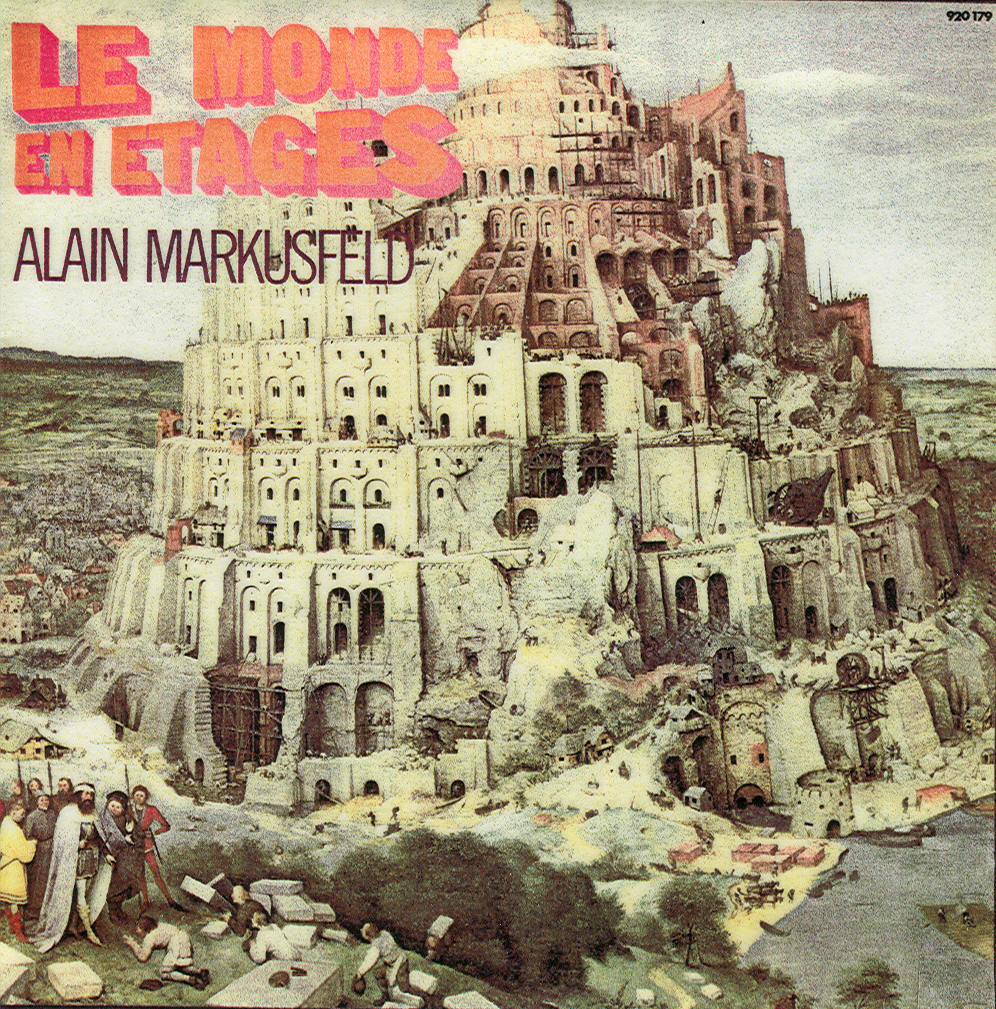
A sidenote.  His first LP, described here, sports Pieter Brueghel’s “Babel” on cover (I do not recall if this brighter original is now in Vienna or in Antwerp).  The 16th c painter enjoyed something of a revival in late 1960 / early1970 record collections, not least thanks to Pearls Before Swine. 


Musique fatidique pour nuages fatigués

The LP begins with a frontal assault by strident acoustic guitar and an inconsequential vocal part, instantly juxtaposed with a choir and a quaint electric guitar.  This is a truly puzzling intro and gives little clue as to what we should expect next.  We believe to be helped by the rhythm section, which alludes to a putative “rock record”.  But then we notice acoustic piano, immersed in deep echo, tuneful harmonics from the guitar and a chorus.  When the track becomes more organized, it is almost over. 


Dans la glue moyenâgeuse

This time the acoustic guitar is scintillating, engraving the appropriate scale for a breezy flute.  There is little doubt that the track was written with the guitar in hand.  When the proper song finally begins, Markusfeld is supported by the chorus, emphatic organ and pastoral guitar.  There is something of the medieval mood we expected from the title, bu the morceau will stagger between dynamic extremities.  Markusfeld shouts and hums and it’s the slowest moments that are played fortissimo.  Conversely, the faster the fragments, the deeper they are mixed down.  There is no time to get accustomed.  Several themes evolve sequentially, apparently with little or no linkage between them.  A bluesy hoedown here, a faster hard rock there.  No respite. 


Dors! Madère

A more traditional song format here – with lyrics about a country of drunks.  The instrumental backing is typical for European soul of that époque – heavy on the organ part.  In refrains, Markusfeld is supported by the light-hearted female choirs, just as Japanese or Eastern European “modernizers” would do back in 1970.  His vocal is slightly distorted by a vibrato, but his overall manner is reminiscent of contemporaneous Melmoth/Dashiell Heydayatt’s recordings.  Piano and guitar alternate in keeping the serene melodic content in this otherwise tight and well thought-out composition.  It eschews the overkill of effects that invaded our auditory system on previous tracks.


La terre se dévore (partie 1)

Good, unpretentious guitar-fronted rock courtesy Denis Lable makes this an instrumental passage of surprising tonal strength.  It is rhythmically too complex and chromatically too harsh to fall into a jazz-rock category, and it remains remarkably competent without being flashy.  Within this basic idiom, there are not many recordings from 1970 that have defied obsolescence thanks to the wealth of chord shifts and unstable velocity. 


La terre se dévore (partie 2)

The supposedly 2nd part of the above track has a very different rhythmic structure, a less sturdy guitarist (Markusfeld himself) and more flowing thematic development.  But then unexpectedly the demonic, female voices throw at us the choral avalanche as if hijacked from J.A.Caesar’s or Tokyo Kid Brothers’ early days.  It is an eerie experience.  One has to keep staring at the record cover just to remember that this is a French, not Japanese record. 


Les têtes molles…

The liquid guitar intro seems to be a brief quotation from Hendrix’s “Burning the Midnight Lamp”.  Other fragmentary tributes will appear later (Jerry Garcia)…  Against a slender pillar of decorative flute and acoustic guitar, Markusfeld’s chant is here more in line with the French tradition that privileges voice over the instrumental content.  Still, this will remain an exception on this album.  Excellent Hammond organ (Jean Schulteis) has a timbre redolent of the Nice or Egg, but there is not place here for any baroque intrusions.  Piano tuning reminds of the first “Renaissance” (then one year old) and will lead us towards a romanticizing theme of a typically Parisian mode.  This is a very pleasant moment, but only for those who do not mind 3 minutes of melancholy in their avant-garde ears.  Well written and well executed.


Actualités spatio-régionales

Markusfeld opens with a recitation delicately posed on a tenuous link between electric guitar and organ.  They are replaced by sinewy acoustic guitar and busy cymbals, until J-C.Michaud’s bass line steps up the tension.  In a parody of a sci-fi newsreel Markusfeld yelps out nonsensical “news”, entangled within the coils of cavernous guitar, rueful piano, granitic organ and sepulchral choirs.  Messianic declamation alternates with flaccid 12-bar codas and the band will keep on until Bernard Duplaix’s bassoon offers us the only 10 seconds of musical comedy. 


***


Markusfeld followed up with his second opus in a slightly more somnambulant manner and then disappeared.  When he returned 5 years later, his recordings became less naïve, more crisp and instrumentally accomplished, but the innocuous charm of his debut was gone.  He apparently continued to produce into 1980s.


Alain MARKUSFELD: “Le monde en étages” (1970)

Alain MARKUSFELD: “Le son tombé du ciel” (1971)

Alain MARKUSFELD: “Le désert noir” (1977)

Alain MARKUSFELD: “Platock” (1978)

Alain MARKUSFELD: “Contemporus” (1979)


Published in: on May 27, 2008 at 9:09 pm  Comments (2)  
Tags: ,

KIPPLE: “Flashes of Irrational Happiness” *****


Recorded 2006


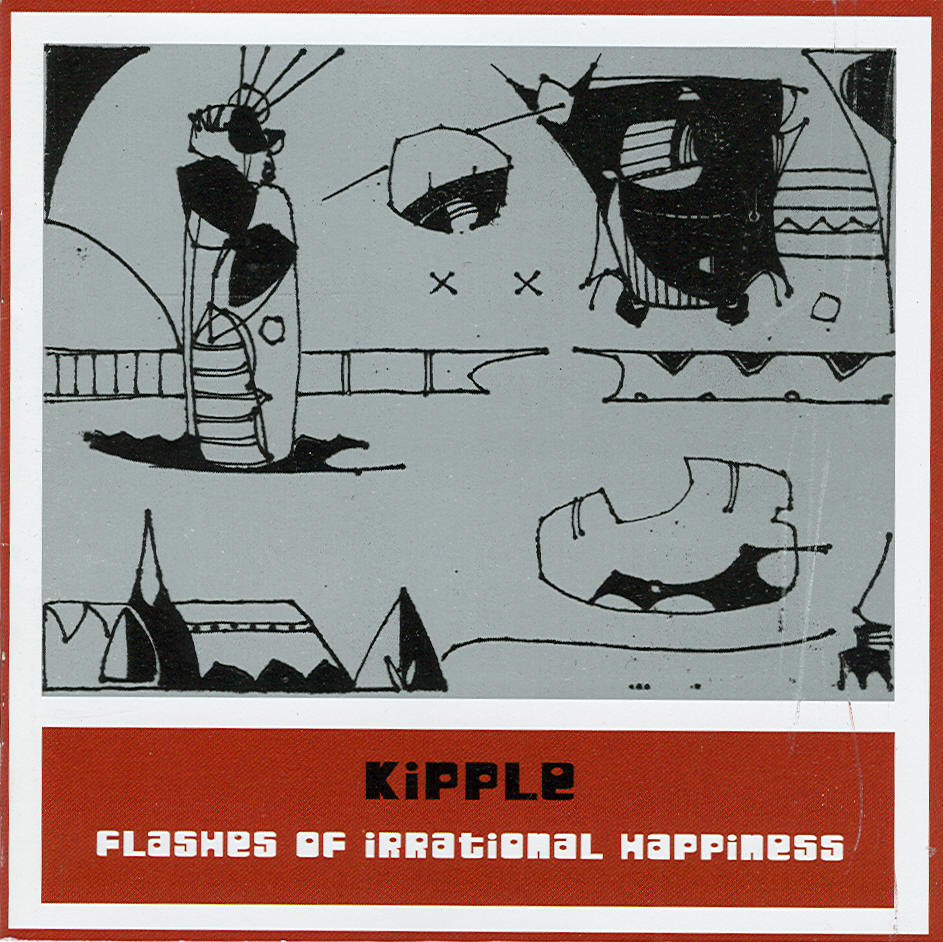
Kipple is the brainchild of Aaron Novik, a composer and clarinetist known for his contributions to various contemporary US bands and for his own inventive klezmer jazz explorations.  On this (one-off) proposition, Novik restricts himself to the role of composer and arranger, with resplendent results.  The retro hues of the adopted instrumentation (electric piano, marimba, theremin, vibraphone) are original, seductive and perfectly coherent.


Novik aligned a crew of young musicians who had studied under such luminaries as Fred Frith, Marc Ribot, John Zorn, or performed in the most exciting bands of the day – Sleepytime Gorilla Museum and Trio Convulsant.  They are competent, restrained and focused.  The CD is divided into two suites, as an old-time vinyl recording would naturally be…


The Cull-spiracy Man Infests

The opening belongs to Ches Smith who single-mindedly produces generous, sparkling overtones from his cymbals.  He is accompanied on sustained electric guitar drone, and amplified, bumpy percussion. 


Craftly Apples

This is Kipple’s tour de force.  An insolent voice proclaims: “You can’t stop progress”.  Snare joins when Mitch Marcus initiates the obsessive, repetitive figure on Fender Rhodes.  It will bathe in a cocktail from Moe Staiano’s rich menagerie of dry percussive sounds.  The guitar goes mantric, allowing the Fender piano to meander with something of a harmonically constrained solo, while well-suited marimba splutters chromatically.  There is no sense of urgency here.  The drum section dissimulates the regularity of the relentless beat with the scraping attitude to the skins.The guitar solo unfolds imperceptibly within this structure.  In fact, we do not even notice these solos – there is simply so much else going on there.  Suddenly, a dubious epiphany.  This is actually hornless retro-jazz/rock!  This music does draw repeated comparisons to 1970s Miles…  Still, Kipple has absorbed all the other lessons of ethno-jazz and rock that Teo Macero could have never dreamed about.


Con Aria

Erik Glick Reiman’s theremin impersonates a mezzosoprano as Graham Connah’s keyboards add splashes of fast receding color.  Guitar strings are scraped and the ensemble blurbs, bleeps, clanks and swishes.  Not surprisingly, Moe Staiano seems to feel at ease in this abstract environment.  .


Infinity Plus One

More potent bass drive courtesy Lisa Mezzaccappa, sizzling cymbal rolls and two drummers (Ches Smith and Tim Bulkley) – create a powerful migratory wind for the guitar and Fender Rhodes.  After several minutes, the prattling of four drumsticks disrupt the voyage until a rather Frippian guitar and the electric piano retake initiative.  A fragment from a sci-fi novel is being read, apparently reproduced from a crackly vinyl recording.  Frictional percussives and the rhythm section will try again to continue blithely, but the keyboards ruminate, increasingly sterile, dissipating into eerie twilight. 


The Excess Is Novel

Staiano’s ‘bug’ device emits an unlikely rattle of low resonance, but hyper-speed marimboid tones.  Excessively congenial commercial talk about oceanic sightseeing fails to stir our imagination.  The vision becomes more all-too deceptively outlandish as high-note synthesizers pierce our ears.  The incessant pounding and crashing Chinese cymbals build up an anguished atmosphere.  The crescendo ascends further, with hyperactive marimba clucks and uncontrollable clatter from other sources. 


Volium

Thus begins the second suite.  It is initially nondescript and takes some time to rivet our attention.  Dahveed Behroozi extracts some otherworldly clouds from his synthesizer, but the 4-people strong rhythm section will keep us firmly on earth, sometimes south of Rio Grande, thanks to the choice of non-pitched wooden percussives.  Despite some interesting special effects, this track seems to be circulating within an all-too familiar territory.


Lain

Another tape recording from a sci-fi flick (?).  Dispassionate female voice sounds the way our typical venusian or martian should sound, i.e. dispassionate.  Prepared vibraphone, acoustic bass and bowed cymbals generate glass-like, scintillating, pristine beady sounds.


Why Scat Alone, Ian?

Merry-go-round ambiance is being introduced with Lowrey organ tones and undulating rhythms.  This will be a more guitar-based track.  John Finkbeiner limits himself to two-three chords, but Myles Boisen joins here to let his instrument purr and squawk.  This could be tedious, were it not for the fluidly transmuted polyrythmic framework. 


Back and Forth Forever

Kipple’s closing statement begins with a stately intro, largely dependent on the aerial synthesizer.  The meter changes when theremin and guitar engage in a unique interplay.  Jason Levis on marimba provides the backbone for this unusual duet, while Staiano’s “bug” takes care of the texture.  The track ends with street noises – sirens, passing vehicles and, eventually, silence. 


***


Aaron Novik also appears on a number of recordings by Telepathy, Karpov, Transmission and Edmund Welles.  I have not heard any of them.  But I have heard Gubbish and found its elegant version of klezmer chamber jazz quite appealing.  It compares favorably to some of the recordings on Tzadik label, but probably lacks the sharper edge that fans of the genre often prefer.


GUBBISH: “Notations in Tonations” (2004)

KIPPLE: “Flashes of Irrational Happiness” (2006)


Published in: on May 26, 2008 at 12:52 pm  Comments (1)  
Tags: , ,

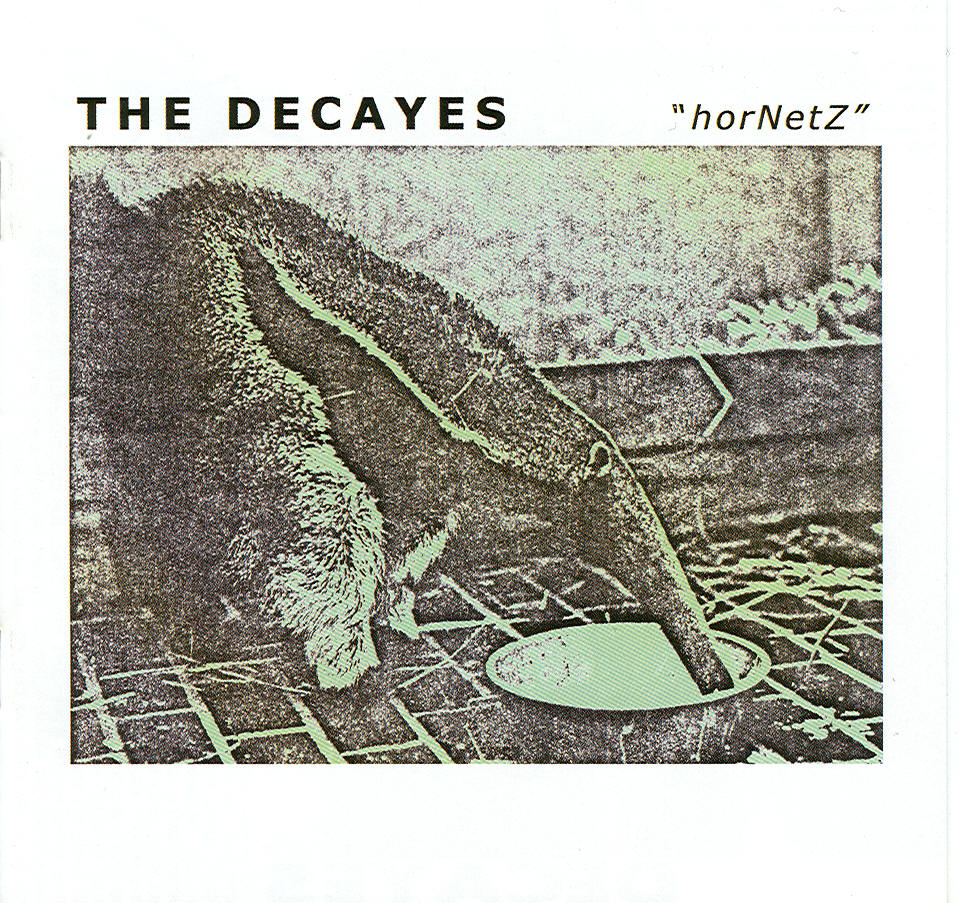
The DECAYES: “horNetZ” *****

Recorded 1981.


The Decayes were a loose collective centered around Ron Kane (bass, guitar, clarinet, kybds) in Southern California. They grew out of premature garage experimentation in the late 1970s and burst into celebrity among isolated fans around the world. Locally, they could never accrue much following, despite an occasional association with Los Angeles Free Music Society.


Their repertoire ranged from primitive, but highly inventive studio experimentation to a more basic, but never commercial song format. Despite the obvious mannerisms of the period, the young musicians were cognizant of the krautrock legacy and Czukay’s studio achievements. For the Decayes, this was work of passion – the tapes were heavily edited, run through feedback devices, spliced and overlaid masterfully, enriching rather than cluttering the musical texture. On “horNetz”, Kane was joined by Warren Bowman (bass, guitar), Mark Florin (kybds, guitar), and John Payne (drums, perc).


The Paranoid Department

The record opens with a fanfare and a female grandiloquence in Dutch. Snare drums roll and euphoniums fart. The pomp swells further when a male commentator chimes in. Cut! We are listening to the band now – the drumset recorded with a rhythm-box regularity, bass, hypnotic but flatly sounding electric guitar, and the (oh-so 1980s!) clarinet. Voices crawl in the background. The double reed licks and the incisive guitar figure will keep this riding fragment on a roll.


Breeding in Captity

Against a very Doors-ian organ in high register, we are facing a fast-paced sardonic recitation about “breeding in captivity”. It receives a well-suited, simple support from the clarinet, the rhythm section and a very sparse guitar. One feels some (accidental?) affinity with C.W. Vrtacek’s early recordings.


…but, Dad…

Snippets from TV series (dad and daughter bicker about a robot) are purposefully humorous. We hear more harmonic electric organ, and dialogues on fast-played tapes. It is almost “Lumpy Gravy”, minus the giggle.


Dance Hall

Honky, high-pitched organ appears here next to a hollow sounding amplified guitar. The rhythm section is very bare bones. Our attention is brought to the comic selection of tapes with recordings in American English and French. They are long enough to convey the meaning of entire sentences and the self-righteousness of some passages indicates that some must have been at least two decades old at the time of the recording. Some other natural effects are more heavily processed at varying speed, but without overkill. The rhythm section, chicken organ and sometimes clarinet keep it all in place.


What More Could You Ask For?

This really sounds like some loser who really can’t sing is spewing out his frustrations in what could stand for a sci-fi instrumentation two generations ago – all complete with space organ and clarinet. Not much else is happening in the stanza-refrain formalism, even if it’s ironic.


The Head Popped Off

Expressive bass line is what keeps it going, almost funky-way, against a busy “A Certain Ratio” type of John Payne’s percussive lead. One wonder if this is the track with Dennis Duck of LAFMS. There are screams form the clarinet, sustained notes from a cheap synthesizer, choking guitar cracks, a cuckoo clock and some taped voices again. But overall this is a driven post-punk-funk that’s too lean to fall into superfluous complexities. At the end, the instruments get un-tuned – almost the opposite of an orchestra warm-up.


Flamethrower Bloodbath

Spooky march that could easily find its way into Residents’ “Commercial Album”’s instrumental parts. This is neither a pastiche nor a tribute, but does exemplify just how influential the San Fran giants were. The guitar is 100% Snakefinger, the rhythm section is stomping on a Warren Bowman’s basso profundo, but not as succulent as Jah Wobble’s. All the while, some maniac is yelling his soul out, echoed only by crows. It fades out nicely.


Nobody Loves Me

There was something about the lyrics written for the wave of electro-pop in early 1980. For whatever reason, outside the ubiquitous balladry at least, most songs married the Bowie/Ferry crooning with post-punk assault by writing the stress on the first syllable of each line. This is the manner that the Decayes ape here, successfully, so to speak. Luckily the reed “section” remains disciplined, providing both the harmonic line and more dynamic upswings in higher registers. Ron Kane proves he can play the clarinet.


Out to Lunch

No, not Eric Dolphy’s immortal classic. Rather, this is another fast-paced chorus on a tight bass-drum railroad. The clarinet squeals and squeaks, but does not fundamentally alter the formula-bound score.


Hornets

It starts heavier, with a less uptempo drive. Clarinet and acoustic guitar punctuate a mixed-down landscape with multiple male voices. The clarinet occasionally bleeps in the range where it loses its distinctiveness. But this is not a virtuoso record and should not be held to such benchmarks. Intrusions of taped elements seems to play an imperceptibly rhythmic role, albeit on a larger scale.


Big Dessert

Two basic chords are busily repeated by the right hand, but they quickly loses projection, and become subordinated to other electronic sounds, rhythm machine, wooden-sounding guitar clicks.


I Don’t Know, I Don’t Even Care Why

Another hasty number. The untrained vocal ensures us repeatedly about the wisdom of the title statement. Wooden percussion adds some color.


Table for Two

Lovely electric piano somehow survived from the previous decade, nudging its way among honking buses and other (automotive) garage noises. The keyboard (Mark Florin?) has a rounded, warm timbre, here contrasted with the street noise and the drumstick hesitating between the drum frame and instantly muffled cymbals. The tapes are, this time, very gracefully selected and make this into the most nostalgic moment on the record. Shuffling steps and some engineering work in the workshop stays on during the passages devoid of the electric piano. A testimony to the musicians’ rich, synesthetic imagination.


Love Me

Dudley Moore’s song from movie “Bedazzled” is a very simple organ-drum-bass trio on a quick, chunky bus tour. Back in the 1970s, this could be a theme for any TV show, but now it would probably qualify for Aavikko’s CD. The record closes with an effect of a tape fast moving audibly through recording heads.


A Man and a Woman

The next four tracks do not belong to the original LP, but appeared as bonus tracks on the CD reissue in 2004. This one is a choppy instrumental based on the same trio formula as some of the simpler tracks on horNetz LP. It speeds up towards the end.


How Do They Know?

Sketchy song alluding to the then state of the record business. It is very organ-based, with the same predilection for the contrast between the sizzling tone quality of the keyboard and the mixed down rhythm section. Again, a very ‘residential’ melodic guitar snakes through the repetitive pattern.


Victor

The romping sound almost calls for “London’s Burning” scream, but instead we get a lilting, optimistic guitar figure and a hapless voice that would not be out of place in the UK scene that worshipped such declarative singers at that time.


Woody

Excellent vignette for multiple guitars in high tuning. The guitars go around their business in flat, dry fashion, occasionally stopping to hear the response from the drummer. This is an intelligent construction, without being flashy.


***


The Decayes’ originals are hard to come by and I am yet to hear all of them. Their debut crept into Steven Stapleton’s notorious list and thus vanished entirely from second-hand market. It is highly recommended.


The DECAYES: “Ich bin ein Spiegelei” (1977)

The DECAYES: “Accidental Musik“ (1978)

The DECAYES: “Not Yet“ (1979)

The DECAYES: “horNetz” (1981)

The DECAYES: “Ten Guitars” (1982)

Published in: on May 25, 2008 at 8:28 pm  Comments (4)  
Tags: , , ,

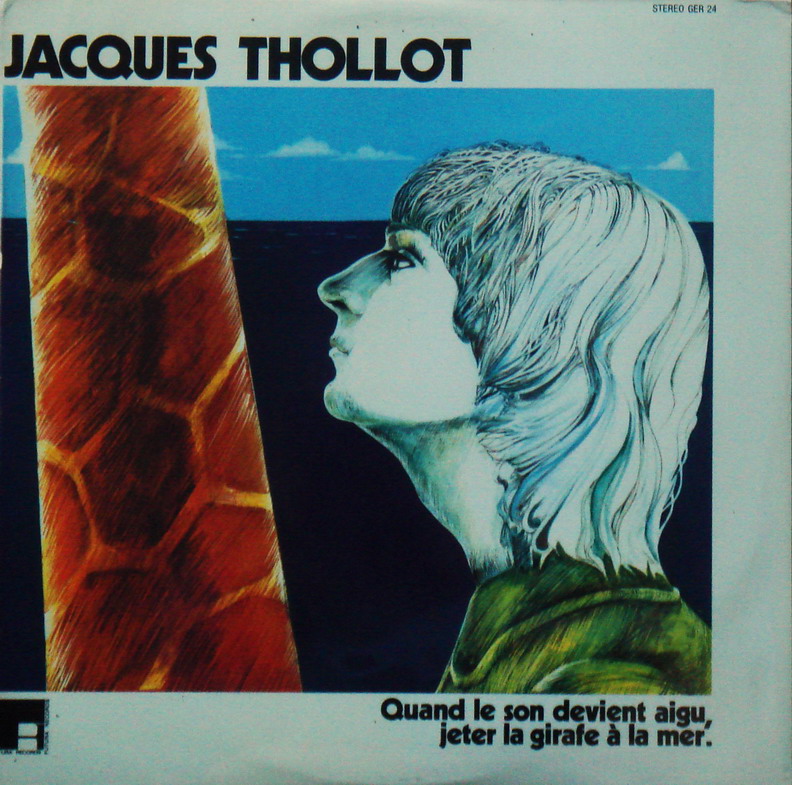
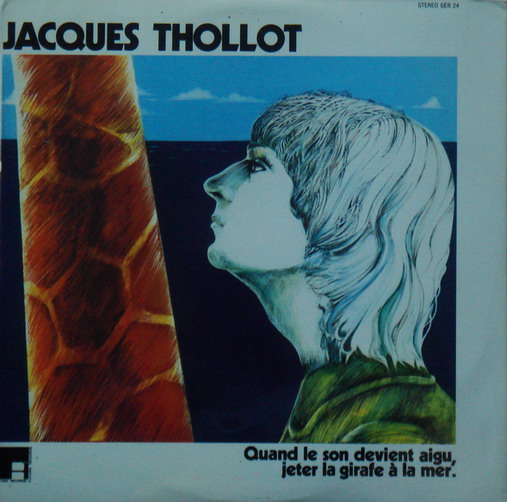
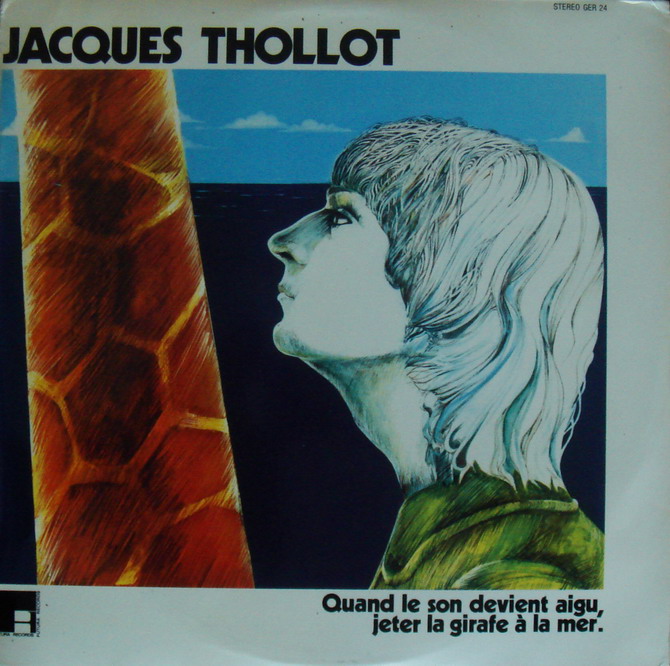
Jacques THOLLOT: “Quand le son devient aigu, jeter la giraffe à la mer” *****

Recorded 1971


Originating from the 1960s’ French jazz scene, Jacques Thollot left a string of unclassifiable recordings ranging from free neo-expressionist explorations for keyboard and percussion to ornate, carefully arranged baroque jazz. But Thollot’s imagination was too rich to enclose him within jazz idiom. His instrumentals, proportional and highly inventive, are often fragile and elusive. His rich arrangements were as lofty as they were airy. Formally impeccable, they were never academic.


Were it not for his first LP, issued on a highly collectible Futura label, Thollot would have probably remained virtually unknown outside France. He deserves a much wider renown among adventurous listeners worldwide.


Cécile

The record starts with a dry, obsessive, bell-like piano stuck in high register, with a subordinated, more full-bodied acoustic piano at the back. The repetitive figure’s percussive sounds and flat hi-hats leave haunting after-images. The percussive keyboard is gradually arpeggiated. When the sound suddenly clears we realize that all we have heard thus far was deeply muffled. Now the screen is gone and we are fronted by a full percussion kit, a marching drum, and a guiro. The hypnotic, circular theme bathes in an aura of mystery and the increasingly brittle arpeggios prefigure Florian Fricke’s notorious “Ah!” a year later.


Position stagnante de réaction stationnaire

Contrary to the title, this polyrythmic, but subtly melodic drumming evolves into a tremolo, slowing down, then up, then down again. Most membranes are high-pitched and some sticks touch the frames instead. This will be Thollot’s trademark technique throughout this record.


Enlevez les boulons, le croiseur se désagrère

Liquid sounds from a tone generator (this is 1971 and Thollot does not operate here a fully-fledged synthesizer) are followed by several figures from the piano, then a sound of lower manual harpsichord, all too soon distorted into a poorly projected, faint music box ersatz. The tinny sound alternates with another keyboard that rushes with the speed of Conlon Nancarrow’s player piano. Occasional entries by electric organ close this chapter.


Mahagony extraits

Lukewarm, low-resonance piano solo intones Kurt Weill’s 20th century European classic. There is some dissonant quality to the timbre of Thollot’s instrument and its tuning recreates an aura of an abandoned ballroom, filled only with the performer’s early morning loneliness.


Qu’ils se fassent un village ou bien c’est nous qui s’en allons

Here the piano is in a more heroic mood, supported by drums and megaphone voices echoing in a large hall. This filtered noise gains numerical superiority over the struggling instruments.


Aussi long que large

Thollot was, first and foremost, a drummer and this drum solo, probably electronically processed, is characterized by an extraordinary fluidity and dexterity. There are moments of premeditated hesitation, although Thollot does not employ negative spaces or straightforward silence. The tempos are additive, but irregular and the dynamic range is quite extreme.


Quiet days in prison

Futura’s original is not telling us who plays the mournful cello solo to the piano’s delicate accompaniment. As the mystery player alternates between D and A strings, the composition retains a very lyrical, romantic quality.


De D.C. par J.T.

Thollot’s rendering of Don Cherry’s theme is built around a high-baroque scale progression, albeit with more anthemic openings. His trademark, ever-shifting percussive support competes for space with the domineering piano. The latter will end on a chime-like set of notes.


Virginie ou le manque de tact

Purposefully, the composition provokes disgust by exposing us to a braying child’s eerily low voice. We then hear again Thollot in another drum solo with most elements from earlier tracks – bright passages rattled over the full range of drums, but almost no cymbal work. The unpleasant, sobbing voice recurs, and when the tape accelerates to its natural speed for a moment we have no doubt that the intuitive recognition of a brat was correct. The drum solo will close this section…


N.G.A.

…only to open this one. A speedy piano repetition is never too far behind, with occasional supra-harmonic assistance from an organ. This is a very fast-moving piece.


Aussi large que long

The most abstract track yet will also be the longest on this record. Its coarse texture relies largely on the exploration of fast damped piano chords and percussive brushwork. In higher registers, the pianist allows for a slower decay, quite against the natural capacity of the instrument. The perspective in this non-representational composition is unusually flattened. Pattern recognizability seems to be of no concern to Thollot. The result is best reserved for those who delight in the raw juxtaposition of piano and drums, devoid of expressive bass lines.


Quand le son devient aigu, jeter la girafe à la mer

The title track opens with a very New Orleans-sounding piano line, but a high-pitched keyboard unexpectedly transports us to 1970s Italian soundtracks. Double keyboard and drums will, with some trouble, oscillate around this annunciatory melodic line. This part segues awkwardly into another free passage for piano and drums. The keyboard attack is more pronounced than on the previous track and the drums stick to a purely demonstrative role.


Marche

Yes, this is an urban march complete with the hacking meter and the proud piano line.


A suivre

A far too short coda picks up where the opening “Cécile” left off 40 minutes ago – a piano-organ-drums interplay, as if to invite us for a second listen.


***


After this very free debut, Thollot opted for a string of more melodic recordings. Fragments of his tunes could be found interwoven in new compositions, most recently in mid-1990s. But he probably reached his creative climax on “Cinq hops”.


Jacques THOLLOT: “Quand le son devient aigu, jeter la giraffe à la mer” (1971)

Jacques THOLLOT: “Watch Devil Go” (1974, 1975)

Jacques THOLLOT: “Résurgence” (1977)

Jacques THOLLOT: “Cinq hops” (1978 )

Jacques THOLLOT: “Tenga niña” (1995)


There are certainly other recordings that I did not have a chance to hear. Jacques Thollot should not be confused with the much younger François Thollot who early this century created two highly acclaimed avant-prog collections.


Published in: on May 24, 2008 at 8:05 pm  Comments (1)  
Tags: , , ,

Ghédalia TAZARTES: “Hystérie Off Music” ******

Recorded 2007


Ghédalia Tazartes traces his roots to North African Sephardic tradition. His recordings exemplify the most prosperous marriage ever of ethnic vocalizing and imaginative electronic collage. Tazartes’ strength lies in his dynamic, rhythmic and harmonic restraint. The element of surprise, while ubiquitous, does not rely on the shock of opposites. Rather, his compositions flow naturally, always apportioning tasty ingredients, but in an organic, gradualist fashion.


His activity now spans three decades, yet his music is hors temps. Over the years, his bequest has graced many visual performances, but has stood on its own among the most accomplished French creations. From emotional psalms to shamanic hymns, Tazartes vocal eclecticism makes his art unclassifiable and distant from the electro-acoustic orthodoxy in his country.


His recording output dried out in the 1990s and many feared that the legend had been silenced forever. It is, therefore, with great expectations that fans of sonic asymmetry hail his return to a more prolific form.


Soul 1

The recording does not “open”, but breaks through the wall, imploding and rapidly mutating into old man’s lament. Increasingly discernible and sometimes nasal, the sorrowful voice will be accompanied by a piano abandoned on the desert hill.


Soul 2

Change of scenery. We are in a deep tropical valley as depicted earlier Jorge Reyes’s electronic landscapes. Tazartes’ art is less linear, though, with multiple harmonies emanating from a ringing synthesizer and interrupted by a crashing guitar feedback. The static spectacle is further enriched by hollow, impersonal voices flattened through the phone lines.


Soul 3

An apocalyptic moan, most probably in Hebrew, emerges from a cocoon of barely audible synthesized strings and subtle bass drone. We are close to post-“Imperium” era Current 93, but when Tazartes falls into the title Hysteria, the effect is less exaggerated than in David Tibet’s case.


Soul 4

A stylistic mystery tour, mountain calls from the Caucasus, stern Coptic choirs, plaintive Arabian voices – all masterfully cohesive in this short sample of Tazartes’ mixing genius.


Soul 5

Electronic whispers, slothful electric bass, sinusoidal harmonics and dovish sobbing all return in loops of various lengths. The nocturnal quality of this fragment relies on the changing piano-forte combination of these four elements.


Country 1

Scraps of acoustic guitar tuned similarly to Haino’s Black Blues give way to a love poem recited with a falsely foreign accent. The poet forsakenly expresses his love for a ‘little French girl’. When several violin notes intervene, the text begins to alternate credibly between English and French.


Country 2

A sharp electric guitar loop cuts through the previous track’s poem. Without the sudden ruptures, this would be a blues. But again, unruly children’s voices, weather events and lost chamber quartets distract the listener.


Country 3

“Yes – this is a Love Song”, an old man’s voice announces. Self-ironic and very carnal song, indeed, follows. There is a marked contrast between the accompaniment by a congenial bowed acoustic bass, and the singer’s drunken, limping snort.


Country 4

After these short vignettes, the longest track on the CD unfolds with cinematic strings, oppressive seagulls and majestic ship horns. By the time we visualize a Titanic or Lusitania tragedy, a parody of jazz scat explodes, as if filtered through a long tube. Sustained echoes from Deep Listening tradition, electronic clicks, and finally an uncertain melody all posture in front of the cinematic theme. Tazartes sounds here like an adult impersonating a naughty kid, but not without some humorous twists. The blues guitar loops back in, briefly echoing an earlier passage in a structural formation reminding of 1970s progressive suites. It then becomes the main focus; harder, and as decisive as Albert Collins’s. The last two minutes are sent to us from another world: a falsely demure Japanese girl (Yumi Nara), a choking wah-wah guitar, an opera mezzosoprano and crashing drums.


Country 5

To the accompaniment of two guitars – acoustic and wah-wah, Tazartes sings out his regret of not being a Spanish nobleman. His characteristic, weeping manner, never breaks into self-parody.


Jazz

The title is a misnomer for a heavy guitar cum strings fresco carried over by angelic voices. Tonality is shaky. Half-uttered morphemes and electronically edited percussion reinforce the increasingly staccato guitar and it’s a relief when the fuzz ebbs away. Still, the strings will not reign on their own. The guitar hits back and the string section becomes more articulate, pushing the track to another level of intensity. Ultimately, the kettle drum adopts a function of a belated referee.


Bonus

A frightening virago takes it out on her entourage just as a southern comfort guitar relaxes with calculated indifference. It is up to the listener to infer the meaning… Familiar howling will close this chapter.


***


Every Tazartes’ recording is highly recommended. Nevertheless, his music requires an open mind. Electro-acoustic hardliners will frown on his vocal verbosity and experimental rock fans may struggle with the more esoteric moments. He remains an island on his own.


Ghédalia TAZARTES: “Diasporas” (1980)

Ghédalia TAZARTES: “Transports” (1981)

Ghédalia TAZARTES: “Transports EP” (1981)

Ghédalia TAZARTES: “Une eclipse totale du soleil” (1983)

Ghédalia TAZARTES: “Tazartes” (1987)

Ghédalia TAZARTES: “Check Point Charlie” (1989)

Ghédalia TAZARTES: “Voyage à l’ombre” (1997)

Ghédalia TAZARTES: “Les danseurs de la pluie” (1977, 2005)

Ghédalia TAZARTES: “5 Rimbaud 1 Verlaine” (2006)

Ghédalia TAZARTES: “Jeanne” (2007)

Ghédalia TAZARTES: “Hystérie Off Music” (2007)


UN FESTIN SAGITAL: “Epitafio a la permanencia” ******

Recorded 2007


The Chilean band has only recently gained recognition among wider, international audience. Multi-instrumentalists Marcelo Rodriguez and Michel Leroy, Pablo Martinez on guitars, Paulo Rojas on violin and viola and Gonzalo Diaz on percussion have developed a lavish, syncretic idiom bordering on illusionism. The atmosphere of metaphysical mystery is conveyed through a cornucopia of tonal metaphors. The story lines may be inhabited by intricate geometrical forms, but never default to a pure musical mosaic.


Epitafio al delirio de la permanencia Part 1

A zeuhl-like choir thrusts their trade down our earlobes, but this will not be another Magma concerto. The instrumentation is too rich and the editing too lateral to seek parallels in that direction. Broiling hammond organ will be a dominant feature. Iterative, multiples voices intervene in harsh, unexpected phrases. The 2nd part of this extended composition commences pianissimo, against a hazy, pulsating background. Rhapsodic intrusions crackle, appear and vanish. Pablo Martinez on electric guitar builds a faint line over a harmonic support from the Hammond and other keyboards. Although the 3rd part opens with easily identifiable sounds of harpsichord, guitar and drums, it will be closely followed by what is the most abstract section. Low and high-pitched grating from Marcelo Rodriguez’s arsenal collides with piano strings, shouting and a meandering alto sax. Nostalgically quaint wah-wah guitar ushers in a song hijacked from some provincial party. The guitar theme evolves for the moment, but remains skeletal, disturbed by synthesized, cello (Sebastian Mercado) and saxophone interludes. The guitar loses its wah-wah tinge, but continues to fade in and out while the indignant zeuhlish vocal separates the pithy units. A short theme circling around some devilish manège closes this composition.


Epitafio al delirio de la permanencia Part 2

The band accumulates effects in the first several seconds of this piece: sustained electronic note, lyrical piano chords, a growling voice, bells, finally a sudden wake-up call by electric guitar and keyboards. From now one this will be a double keyboard show on organ and piano. The latter carries a more melodious element. Somewhere, far away, a forlorn voice pretends to know how to sing. All this stops and Paul Rojas on viola makes his appearance, pursued by a morose choir. The fearful voices will now alternate with a frightening organ sequence. Some scream, others panic, still others try to reassure the shocked, cacophonic crowd. A lonely narrative piano will loom up, but on a different planet.


L’âge délicieux (la revoluciòn perenne)

The empty range between the tinkling and ominous ur-drone is so empty that the space is quickly filled by an electric guitar and scraps of disoriented voices. Michel Leroy’s organ will control the tone quality and Gonzalo Diaz’s fluent hand drums specify a repetitive pattern. Half-murmured incantation in Spanish and French, the returning jingle and a tortured guitar bestow on this passage a quasi-liturgical quality. The comfortable rhythmic backbone will now allow the band to exhibit its impressive versatility: morbid progression à la Trembling Strain, low range buzz reminding us of Univers Zero’s “La faulx”, natural loop evocative of DDAA. As the composition gains in dynamic, its form is earning an epic status. All the varied elements converge on the path traced by this journey, leaving acoustic beads with rosary-like regularity. The tension is relieved when the guitar and violin revisit the convoy and the organ returns with the incessant tune. Surprisingly, what follows is a progressive rock stanza: “Escucha…” The lazy, untrained voices sound almost like trio SBB. Pero no importa. This track alone deserves a 6-star rating.


¡No hay Coristas!

The liturgical mood continues as the choir repeats its complaint – “there are no choristers”. This mournful song will glide along with acoustic guitar, violin and harmonic guitar. Still, some phase shifting and jumpy interjections remind us that the territory is far from convention. Even the prettiest song sequence is always threatened by an intrusion in ‘la STPO’ vein.


La dignidad del espìritu bastia

It is quite amazing how catchy this tune can be, buried among the phantasmagoric fantasias and the overall reining complexity. The arrangement is lush, but the editing allows the rhythm section (Luis Moya) and the solo violin to dominate the scene. This will not last. Agile violin suddenly stops responding to the predictable refrain and speeds away. The change in tempo will be contagious. Overexcited voices, Julio Cortes’ saxophones and occasional outbursts of fuzz guitar will do their best to catch up.


Destierro

The theme – hummed and sung listlessly – is being supported again by the duet of acoustic lead guitar and electric fuzz ointment. An octave below Philippe Cauvin’s falsetto, Michel Leroy depicts the “Uprooting”. When the violin and hand drums return, his magniloquent manner invades the classic Italian territory. String trio of two guitars and violin will then conduct their explorations, without the sense of urgency that sometimes spoil contemporaneous Nippon bands. More color is applied, with recorder and didjeridoo by Alexis Soto filling the vast space behind the soloing, mellow guitar. As the theme decelerates, the strumming becomes sparse, sending us an inexorable signal of adios. Or until the next one, one hopes.


***


The band’s discography is still relatively short. The first two recordings are to “Epitafio a la permanencia” what a charcoal sketch is to oil canvas; intriguing and engaging, but with more restricted spatial properties.


UN FESTIN SAGITAL: Pharmakon (2004)

UN FESTIN SAGITAL: Esternocleidomastleoideo (2004, 2006)

UN FESTIN SAGITAL: Epitafio a la permanencia (2007)


Published in: on May 21, 2008 at 9:41 pm  Comments (3)  
Tags: , ,