CARE OF THE COW: “I Still Don’t Know Your Style” *****

Recorded 1981


This long forgotten Chicago band was formed in mid-1970s as a quartet of Christine Baczewska, Sher Doruff, Victor Sanders and Kevin Clark.  The first three survived long enough to leave this highly original item to posterity. 


The band relied largely on the combination of Baczewska’s vocal talents and Sanders’s imaginative engineering, with more than a dollop of Doruff’s compositional and multi-instrumentalist skills.  Relying on vocal polyphonies and very transparent instrumentation, the band’s relationship with melody often seemed entirely accidental. 


Baczewska’s and Doruff’s voices are the leading instruments here, benefiting from ingenious multi-tracking.  The vocalscapes accelerate and decelerate at will, confronting the listener with dizzying transformations of pitch, volume and energy.  This is achieved without abrupt cut-ups, which would have probably dominated had this recording been made in the sampling era…


Breezy female vocal polyphonies sometimes brought comparisons with more widely known Raincoats, but even at “Odyshape” the London girls were more straightforwardly ‘rock’.


Care of the Cow folded in 1983, and the artists’ recording activity has been rather sparse since then.


Conversation Piece

We first hear a tape recording of a child singing the 1957 evergreen “Just Walking in the Rain”.  From a swirling electronic loop gradually surfaces a vocal part, instantly subjected to dynamic swells and accelerations.  Doubled up by a second alto and a breezy guitar, the feeling is almost Lusitanian, but suffused with faulty intonation, split notes and recurrent hysteresis.  The moods, the scales and the volumes keep sliding, exposing sudden pitch changes.  The melody will advance only when the rhythm guitar and bells steady its progression, prefiguring Seattle’s Tone Dogs by several years.  Sher Doruff’s rustling twelve-string guitar is resplendescent here.  After another taped intermission (a children’s party) the voice-as-instrument treatments return.  The ascensions are portamento, but the gear shifts are so prevalent that you can’t help checking if the speedometer on your turntable does not reveal any problems with the equipment.  It is remarkable how polyrhythmic the band can get with only Victor Sanders’s acoustic guitar as the only explicitly rhythm instrument.


Eternally at Work

An a capella intro is delivered in Anglo-Celtic style.  Witty multi-tracking superimposes lyrical polyphony.  Still, the disturbed hierarchy between the first and second voice destroys any tonal expectations.  The chest voice belches out: “And after all these years – I Still Don’t Your Style”.  Despite all the obsessive pitch manipulation, the logocentric structure avoids melismas.  The instruments struggle with this unusual velocity distribution: a naïve, belated clarinet, bass clarinet, pennywhistle and tattered percussion are never on time.  The fractured melodism of polyphonic vocals dominates and more organized drums and guitar passages do not make this venture any more style-bound. 


Christinatron

Christine Baczewska’s solo recording for multiple vocal strata.  The smooth overlapping of frequencies yields a quasi-electronic, spacious feel.  The range is somewhat compressed, yet legible: the higher notes are shorter, the lower melismas are longer.  Between them, the notes circulate, rotate.  It ends naturally, projecting an elegant, stylistic challis that would define Mauve Sideshow’s sound several years later. 


Qué sera, Sarah

So here we go – Ray Evans and Jay Livingston’s 1956 pop classic mangled and regurgitated in a completely disfigured fashion, with droning guitar and female yodeling immersed in spacey echoes.  The drumming is isometric, crisp and elastic, the electric guitar flourishings are distinct but mellow.  Neither the waves of vocalizing, nor the space jam – style drumming prepare us for the familiar lines: “Will I be pretty, will I be rich?”, only to be blotted out by ponderous guitar thunders.  Credible space whisper and the lengthy drone, not Doris Day’s caprices, determine the plasticity of this track. 


The Slope of her Nose

The pivotal track on the record mixes the avant-garde structuring with satiny pop vocal mannerism.  It opens with chatting, laughter and a metallic voice reciting a poem: “I’d love to ski sometime – I’d never been skiing”, we hear.  Volume swells on the vocal parts are extreme but come in discrete packets, isorhythmically (pitch and rhythm patterns do not coincide).  Then we move into a waltz, with some electronics, bells and slide whistle, close to Klimperei’s domain.  The second voice is fine-grained and more rational.  They eventually take off – in unison first, and then burst into a totally abstract section teeming with unstable chordal textures, percussion and bells.  When it turns into a guitar hymn, harp-like articulation filters through the steel guitar’s frets.  The band’s melodic indifference is remarkable.  The continued parity violation raises a question if they had not recorded the input material first and then manipulated it by slowing and speeding the tape at will… However, the avoidance of vibrato and the softening presence of angelic chorus mask this quasiperiodic operation.


Downstream

A slow-decay tam-tam brings us into a Harry Partchian idiophonic intro, which is instantly discontinued.  Baczewska’s voice is produced in an echo-pop fashion, but the bizarrely tuned, energetic xylophones overreact to the melancholic vocal line.  It requires considerable ambiguity tolerance: the twain shall not meet.  Dry recitation of Bertold Brecht’s text, tepid, consolatory guitar and bass are purely contiguous with the angularity of the percussive assaults.  The twin vocals go polyphonic without any pretense of melodic goal-seeking, leaving two guitars to build a crescendo.  The inconsequential rhythm acoustic guitar operates in close-ups.  The distorted electric guitar is more distant, but too evocative of the conventional rock idiom.


Clippings

C.W.Vrtacek-styled guitar handled by Victor Sanders takes us back to the deceptively “Brazilian” mood of the first piece, undercut pitch jumps and vocal manipulation.  The guitars accentuate the building drama in the narrative.  The hesitating melodic line seems to be determined by, rather than accommodate, the syllabic count in the lyrics – the more vowels are there, the longer the passage.  The heaviest moment on this record follows – with chopped rhythms and punchy guitar riffs. 


Strophe

Music boxes bring a variety of associations.  Plush shops facing Lake Geneva.  Cute little dolls dancing.  Hat Shoes’ memorable “Saddest Train Ride”…  Care of the Cow expose us to articulatory suppression and subsequent retrieval: a whispering voice, lap steel guitar in lieu of a piano in low register and electric guitar in high register.  Delicately undulating multi-vocal texture gets some percussive help, but unobtrusive echo treatment ensures a relative immobility of the piece. 


***


I have vicarious knowledge of only one more recording by the band.  Apparently several years ago they taped several pieces, none of which has been published as yet. 


CARE OF THE COW: “I Still Don’t Know Your Style” (1981)

CARE OF THE COW: “Dogs Ears Are Stupid” MC (1983)


Christine Baczewska has continued to record occasionally, and I am yet to hear the music. 


Christine BACZEWSKA: “Tribe of One” (1993)

Christine BACZEWSKA: “X Factor” (2001)


Published in: on August 23, 2008 at 9:53 am  Comments (6)  
Tags: , , ,

Toshi ICHIYANAGI: “Opera Yokoo Tadanori wo utau” ******

Recorded 1968-1969


In the 1950s and 1960s, several Japanese composers developed strong connections with American avant-garde scene.  It is during these years that Toshi Ichiyanagi studied in the US with John Cage, participated in dada-inspired Fluxus movement and got involved with contemporary theater music.  Although Ichiyanagi initially focused on composing chamber music and scores with Japanese traditional instruments, the interface with the messiah of indeterminacy fertilized his budding taste for experimentation. 


Married to multimedia artist and fellow Flexus member Yoko Ono, Ichiyanagi experienced a creative breakthrough after his return to Japan.  He soon ventured into vintage live electronics and physicalism – performances in which sounds were activated by musicians’ movements.  Not all of these forays were entirely self-induced.  Already in 1961, his path had crossed with improvising pioneers Group Ongaku, led by Shiomi Mizuno, Yasunao Tone and Takehisa Kosugi. 


Yet contacts with US academic institutions continued.  This was the period when an entire generation of youthful musicians shuttled between America and Japan: Takehisa Kosugi, Masahiko Satoh and Stomu Yamashita among others.  In 1967, Ichiyanagi returned to New York to perfect his skills in electronic sound creation.  He experimented with tape manipulation and ring modulators.  As his sonic ventures coincided with the second wave of Japonism, his work attracted considerable attention in the West. 


Upon return to Japan, Ichiyanagi plunged into the country’s nascent psychedelic scene, combining the inchoate acid rock with musique concrète.  These experiments were unabashedly greedy; Ichiyanagi utilized a posse of theoretically incompatible sources – enka songs, kayookyoku popsike jingles, archival recordings, and indeterminate radio manipulation.  The “Opera” dedicated to Tadanori Yokoo’s visual art stems from this fertile period of bold syncretism.


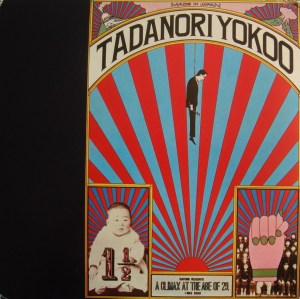
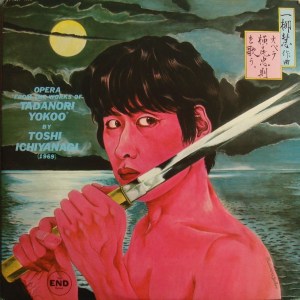
Drawing from Japanese modernism and Roy Liechtenstein’s brand of Pop Art, Tadanori Yokoo’s posters gained recognition for his proto-psychedelic mysticism.  Although not directly portraying the music scene, Yokoo’s striking visuals were to Japan’s rediscovery of fully bloodied color contrasts what Hapshash and the Coloured Hat were to London’s LSD scene (in fact, his work for rock artists dates only from the 1970s).  Since the mid-1960s, Yokoo had been obsessed with the traditional red sun ray motif, by then disgorged from Japanese symbolism and considered highly risqué internationally.  It could be that Yokoo was influenced by Mishima’s nationalistic stance prior to the latter’s suicide in 1970.


The “Opera” was a multi-media affair, well ahead of its time.  The importance attached to the visual side of the production was unprecedented – years before picture discs and multiple gatefold LPs became commonplace.  The attention to detail in both the sonic and visual side of the undertaking was as meticulous as only Japanese traditional arts and crafts can be.  This was also Ichiyanagi’s last large scale composition before his contributions to Expo’70 in Osaka. 


The “Opera” is a monument of 20th century avant-garde.  Ichiyanagi’s self-declared objective was to achieve multiplicity that is so characteristic of nature, rather than bequeath fruits of human concentration.  If there was ever one such record in the history of rock avant-garde, “Opera” fulfills this task. 


Side A:

1.Aria ichi. Aria: 1 – Japanese Ballad

An aura of melancholy emanates from the opening “aria”, which is little more than a traditional Japanese ballad performed by a subdued female voice.  This opening is highly misleading.  Such intimate nostalgia will return on this record, but never again in this form… 


2.Erektrikku chanto. Electric Chant.

Electric hiss, rather than chant, grows oppressive and passionately synthetic.  The second, echoplexed tone disrupts prominence ordering and almost instantly affects the dynamic variety.  With the accumulation of decibels, the electronic squall becomes strident, but when it recedes, the effect is spacious and planar.  From this abiotic slurry there emerges a figurative, yet barely recognizable form – a marching brass band of a bygone era.  Its chorus is patriotic, fanfaric, enraptured in its pre-war swagger.  The tragic hindsight corrodes our unconscious as soon as the magic words emerge – “Tenno Heika” (the Emperor)…  This documentary character of this chorus is treated with exemplary irreverence – snubbed by sadistic electro-glissandi…  Yet the overall effect remains confusingly nostalgic…


3.Otoko no junjô. Man’s Pure Heart.

A story of incompleteness begins with distant noises, sound of footsteps and archetypal girlish laughter.  Up front, a man sings to gauche piano intonation.  Despite encouragements, the singer appears troubled by the keys.  All along, children’s voices are still audible, as if the piano were placed within a short distance of a gymnastics hall.  Against such skeletal accompaniment, the singer’s quavering voice tries hard to continue: “the golden stars passing, shimmering…”.  We are perplexed.  Is it for real?  Is it an offtake?  Whenever we are beguiled into believing that the final version of the increasingly jarring song eventually materializes, it all collapses again.  The two insidious characters burst into suppressed laughter…  The singer stammers on the quasi-liturgical melody, stressing the syllabic quality of the nasal sound, à la japonaise.  They complain about the piano when they realize the environing silence.  “Everybody’s gone – nobody is watching, but should we continue when there is no one?”  Finally, devoid of any background noise, the song is delivered in full. 


Ichiyanagi once compared music to Japanese garden design – meticulous and painfully orderly, yet always interacting with indeterminate elements: moisture, light and wind.  Were the children’s voices an unplanned accident?  And more generally, how much of this “Opera” was captured, rather than pre-conceived? 


This side ends with demented screams, contrasted with a woman’s frightened whisper.  The fury of huffing and puffing is unnerving – as if someone was breaking through the barricades.  She is sobbing in fear.  Finally the ‘siege’ is over.  A low-flying aircraft passes above Haneda airport…    
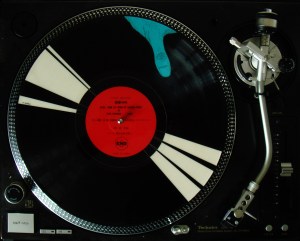


Side B:

4.Uchida Yûya to za furawaazu. The Flowers. 


Next to Le Stelle di Mario Schiffano (1967), Citizens for Interplanetary Activity (1967) and Red Crayola’s “The Parable of Arable Land” (1967), this 27-minute long track qualifies as one of the earliest psychedelic freak out forms.  It is performed by the Flowers, a predecessor of Flower Travellin’ Band – a solid hard rock act active in the early 1970s.  The Flowers here were Susumu Oku on guitar, Katsuhiko Kobayashi on pedal steel guitar, Ken Hashimoto on bass, Joji Wada on drums Hideki Ishima on guitar and leader Yuya Uchida.  The original plans to juxtapose the Flowers with a symphony orchestra were, fortunately, abandoned and Ichiyanagi gave them free hand.  Amazingly, the NHK studio engineers (Shigeyuki Okuyama?) let the recording tape run at half-speed.  The resulting shock wave of guitar-led dissonant turmoil was the official Big Bang for Japanese rock avant-garde. 


It all starts with an oversize riff berthed in perennial slap-echo.  Hashimoto’s bass bubbles with quasi-Turkic flips and a rapid-fire cymbal rattles (at double speed, as most of the band here).  This intro is stately, premonitory, narcissistic and wrenching.  The use of Hawaiian guitar is destabilizing, rather than purely decorative.  In these introductory chords the band remains purely abstract, way ahead of its time.  With its indolent, lateral moves, the bass makes the first pre-announcements of what is to come.  The accents from the Hawaiian guitar become garbled.  The cymbal and hi-hat work is highly tensile, taut and suspenseful.  Finally, the scalding fuzz guitar invites the drums, but the acoustic piano calls off the alarm and allows for some meter-planning by the drummer.  It lasts way longer than any drummer’s typical crowd-pleaser.  The drumsticks hit, and hit, and hit and nothing much happens.  This metronomic intro finally instantiates a French-style, tightly cropped wah-wah guitar (Mahjun, Komintern, Red Noise).  The full spaceship is now taking off – Ishima’s highly pitched, combustible guitar blasts at speed of light, later copied by Kimio Mizutani on Hiro  Yanagida’s second LP.  The bass remains very loyal, despite the freedom bestowed by Kobayashi’s rhythmic mantle (his Hawaiian guitar etches accents at every second beat).  There is nothing analytic in the instinctive interplay between the Hendrixy wah-fuzz, the piano and overload guitar injections.  The cooperation is certainly enflaming, vicious, bristling, stentorian, but never stereotyped. 


After a short lapse, the bass clutches on the colorful configurations planted by the Hawaiian guitar.  Then the second guitar (Oku?) crossdresses as a mining jackleg drill.  When it defects, the basic components are back – the bass, drums played with Nick Mason-ish mallets, a stately, hymn-building guitar, and ever-squirming Ishima with his scalpel-sharp axe incisions.  Uchida’s vocal interjections further coarsen the mayhem of guitars in total overdrive.  This manic superposition of grimy guitar walls leads to another climax, but piano arpeggios steer away (again) from any conclusion.  The beat is determined by quasi-looped wah-wah, with the pungent lead guitar meandering pointlessly.  Occasional voices make their holophrastic observations with the band in a supersonic flight, not unlike the electronic zooms crafted by maestro Ichiyanagi himself. 


The cut is so sudden, that it leaves us half-deaf.
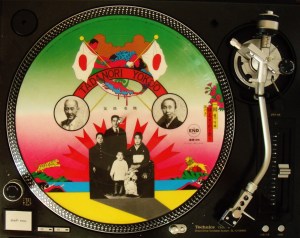


Side C:

5.Uchida Yûya to za furawaazu. The Flowers.


The cut was necessary.  In the 1960s, few vinyl record grooves extended beyond 25 minutes.  We are, therefore, back with the Flowers and their totalistic skullduggery.  Several cowbell clinks later the bass will again host the melodic development.  The band turns into a 12-handed percussion machine.  There is tapping, patting and clacking of anything with everything – spoons, sticks, pens.  The wah-wah guitar descends into obscurity, ever less distinct, in a long goodbye.  There will be one more return of the wild guitar drill sound, enveloped in acoustic piano, indifferent coughing and electronic twitch.  


These 27 minutes of absolute bedlam remain a grand classic of psychedelic avant-garde rock.  The legendary rock freak-out re-appeared later under the title “I’m Dead”, in reference to Tadanori Yokoo’s famous painting reproduced on the back of the gatefold LP sleeve. 


6.Nyûuyôku no uta. Song of New York.


A Chinese-sounding intonation introduces a poem recited in Edo-jidai Japanese.  But then, a very contemporary dialogue ensues.  An actor impersonates two roles – in a tantalizing exchange facing human destiny:

“ (…) will I recover?

         sure you will.

         But mother died of the same disease…

         No.  You are in good shape.  You are still young.

         Will I get better?

         Sure you will. 

         But why does a human need to die?  I want to live.  Even 1000 years.  Even 10’000 years.  (…)”

Even without the sinuous violin legato, I find this existentialist dialogue chilling, desperate in its message of protest. 


A short monogatari follows, couched in vernacular shamisen chords.  This is soon replaced by a frivolous dance as if calqued from some absurdist, drunken matsuri.  A crowded festival should be the right place to obliterate from memory that Kierkegaardian dialogue…


7.Kayo myuzhikare. Kayo Musicale


This absolutely hilarious medley of radio snippets, commercials, random commentaries, and not so random musique concrète reappraisals is one of the highlights of the “Opera”.  Although no sub-sections are indicated on the original, there are several distinctive parts here.


It begins with a nonsensical, goofy and farcical jingle halfway between popsike bubble bee sounds and advertising clips from “Tonmontagen”, collected by Peter Roehr barely two years earlier. 


Next comes what is audibly an excerpt from a film (I do not have the CD version of the “Opera”, where the exact sources are probably made explicit).  An adult scolds an initially recalcitrant, but ultimately pliant young woman for accepting something from a stranger.  The scene develops close to the beach, as we infer from the dialogue and from the sound of waves lapping against the shore. 


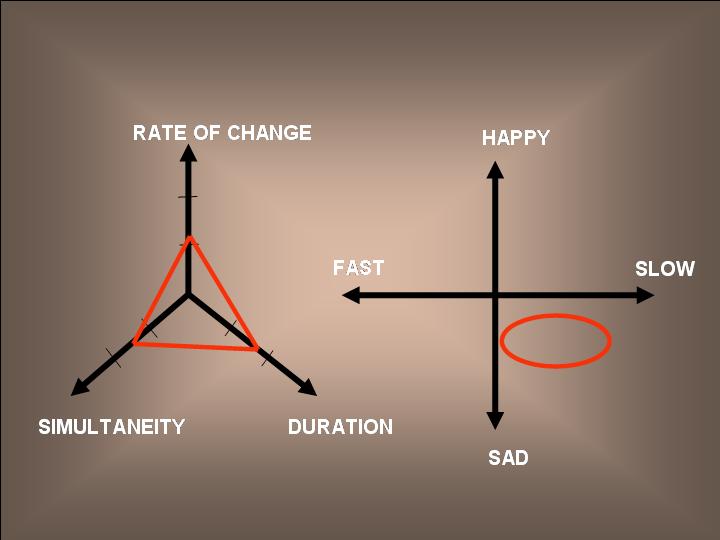
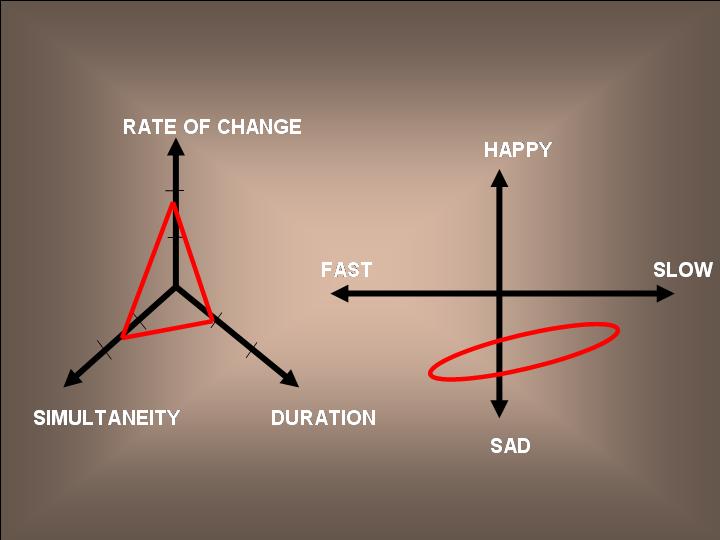
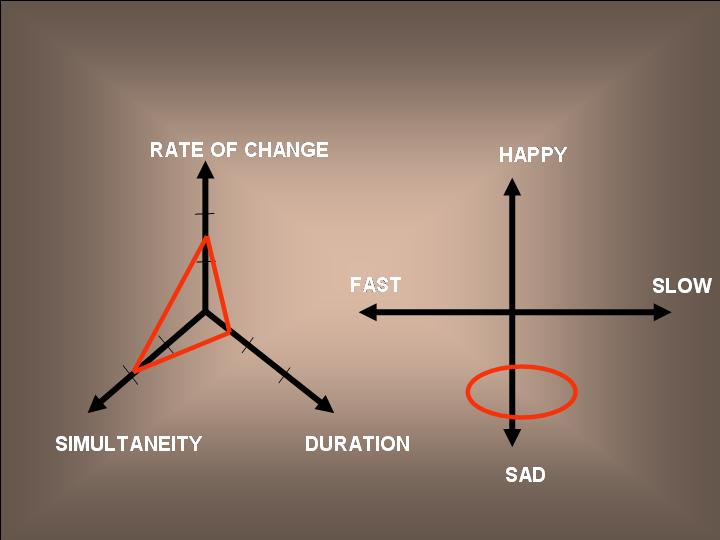
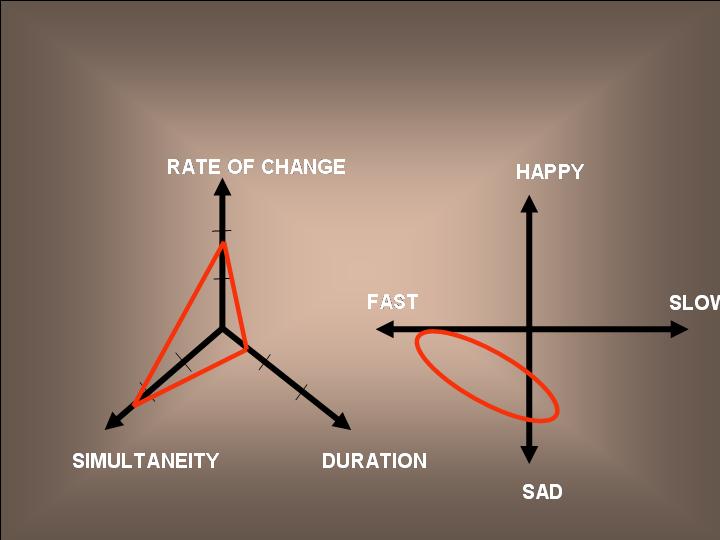
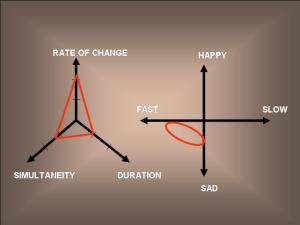
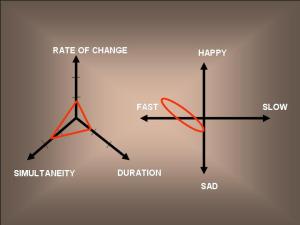
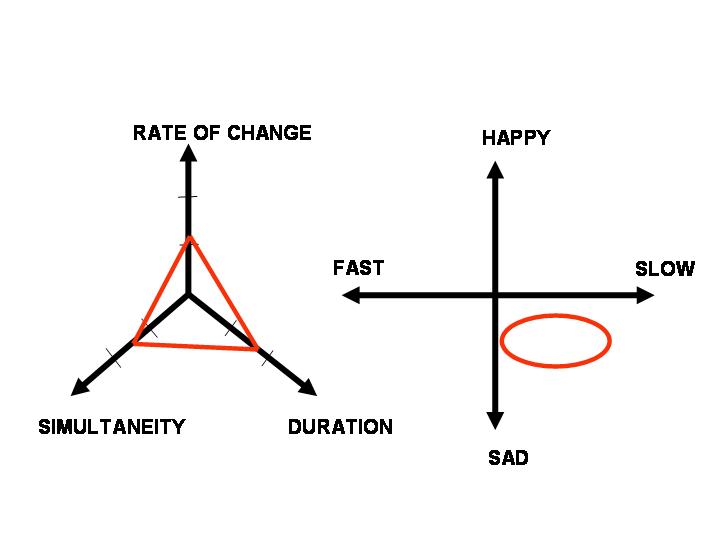
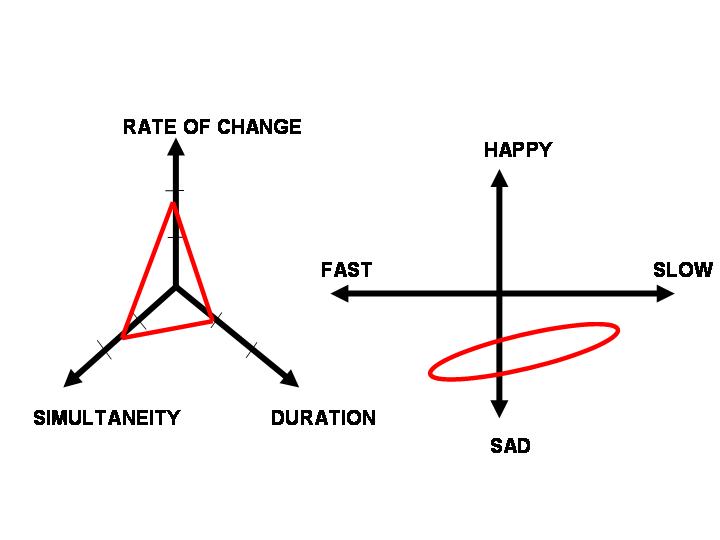
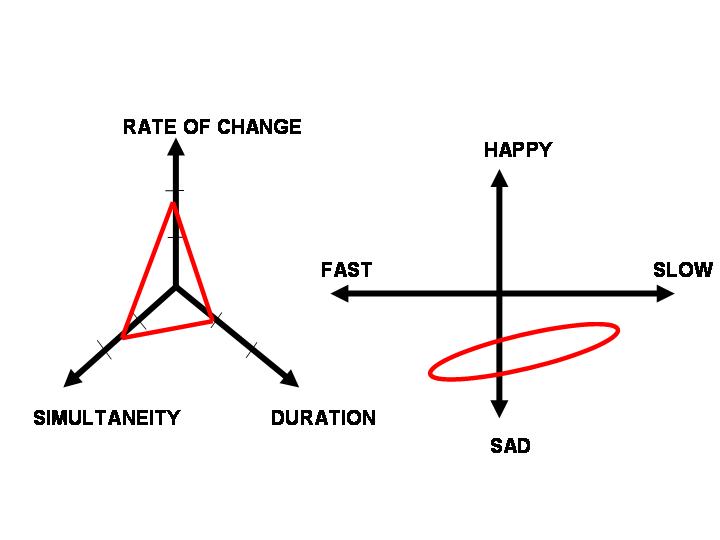
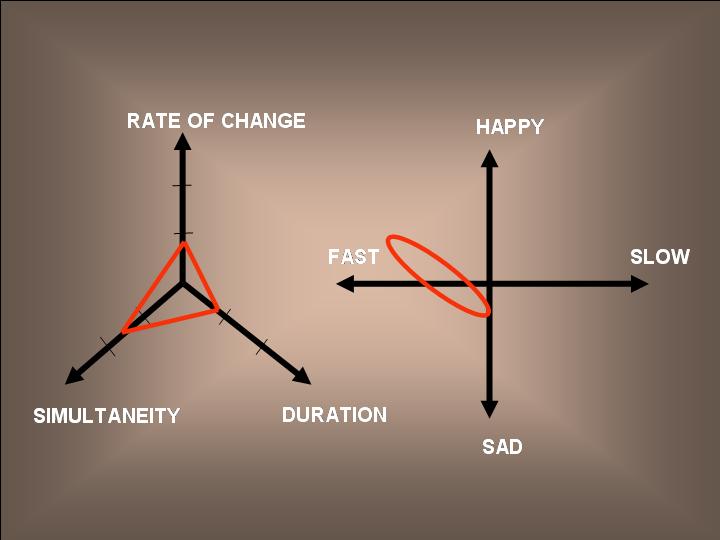
And then the notorious jingle: “chokoreeto – chokoreeto“ – a well known 1960s Group Sounds-era commercial, still remembered in Japan today.  Its cheesy organ colluding with piano, drum and bass were probably the product of Kyotoite band Tigers, led by androgynous Julie Sawada.  As illustrated on the diagram above, such juxtaposition of extremes – saccharine inanity next to brazen stress induction – leaves the listener emotionally drained.  Evidently, coexistence in diversity was Ichiyanagi’s recipe for unity.


This is followed by the halting regularity of church bells – slow, but double-time, ineluctable like cloudy skies.  When a stratum of subterranean bass blends in to compete with the increasingly inarticulate bell sequence, the section begins to recall Current 93, rather than Don Wherry’s church bell recordings. 


In the next section, we hear harpsichord in J.S.Bach’s repertoire, but deconstructed, scrubbed, overlaid, looped, echoed.  The sound quality shifts, suggesting unsuccessful tuning to a radio station.  Church bells then return, morose, somber and poorly additive.  The bass figure swells, oblivious to these European accents. 


For all his admittedly aleatoric proceedings, Ichiyanagi is also an accidental emotionalist.  In this last section of “Kayo Musicale”, he welcomes the listener with a smudged, sweeping drapery of electronic whirr.  Then we hear explosions; they are too close and too crisp to be merely (familiar) thunderstorms.  These explosions are manmade.  And the whirr, as we slowly and reluctantly begin to understand, is the sound of bombers turning Tokyo into a fireball of charred civilian bodies.  This realism is unbearable. 


The animality of xenocide is universal.  I do not recommend this record to anyone for whom war is a personal memory, rather than sofa entertainment.
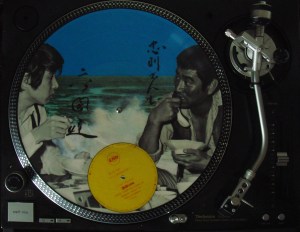


Side D:

8.Uta 1969. Love Blinded Ballad (Enka 1969).


The concluding side of “Opera” makes the transitions, co-occurrences, juxtapositions and articulations even denser than the sequential conveyor belt of inputs lumped together but permitted to breathe each with its own material. 


In the first section, we hear a Chinese-tinged melody, a mandolin, bluegrass, archival announcements, patriotic songs, marching fanfares, speeches, choruses, classical violin, Chinese erhu, and military songs.  All this appears and reappears intermixing in curvilinear fashion with neutering glissandos.  As a review of Japan’s tragic history 80 years ago it is at least as powerful as Georg Katzer’s testimony to 1930’s Germany. 


From the public space, we then step into the private sphere.  It is like walking away from Tokyo’s main thoroughfares into back alleys singularly resilient to the centuries of modernization, earthquakes, typhoons and bombings.  Early Showa-era songs compete here for auralscape with the sounds of a noisy market.  An insistent hawker tries to attract customers, distracting us from the leading ballad.  All of these elements are equally alluring and play an equal – and equally disorienting – role.  Their ebbing and flowing is, however, highly frustrating for their siren-like beauty beckons, only to push us away. 


Another of those marching songs romps through with accordion and trumpets.  Some fragments sound distinctly archival, others seem modern.  Orchestral tuning, operatic female voices, several choruses, comical elements – all bring back memories of the calamitous 1930s and 1940s, but the resurgent dynamic is too explosive to detect specifics. 


Frogs croak and waterfowl cackles amidst fluttering rivulets.  Echoes of patriotic choruses are eerily distant, pushed into the fading memory and only unearthed by misfits squatting around isolated bonfires.  Sepulchral crows crow.  Japan has long understood.  Will China ever do?


Within each of these subsections, the various layers seem to advance independently of each other.  If this is musique concrète, then we are light years ahead of “Variations pour la porte et le soupir”.  Light years, not four years. 


9.Uta 1969. Spite Song (Onka 1969)


Tchaikovsky’s “Swan Lake” is being subjected to discordant squeaking.  As it turns out – this is again the AM radio tuning, in and out of the romantic cliché…  At its most climactic, the hissing and burring is becoming indigestible.  The drama is augmented by the ear-bending chaos and distortion of the higher notes…  A siren – bomb alert! 


10.Takakura Ken, Tadanori Yokoo wo utau. Ken Takakura sings on Tadanori Yokoo.


In 1969, Ken Takakura was still virtually unknown outside Japan but had already attracted cult following among the shufu for his roles in multiple yakuza movies.  In this closing moment of the “Opera”, Takakura sings a traditional bossa nova uta, arranged by Masao Yagi, with lyrics by Juro Tô and Kazuro Mizugi.  The choice of Takakura – portrayed on the fourth side of the double LP – was not accidental.  Tadanori Yokoo had been employed to provide commercial posters for several of Takakura’s gangster movies.  The actor’s dry, virile style contrasts with Yagi’s sweet guitar, ‘chicken’ organ and an overtly polite 1960s vibe.  Not surprisingly, the idyllic pastels are trampled by the schizophrenic gloom of the verses:


“the dream burns in deep red,

I am watching myself

I will make this name dance through the world”


***


I usually do not dwell on the visual side of musical products.  Since the advent of CDs, cover art has been not only miniaturized, it has been marginalized.  The mp3 phenomenon has now made music simply intangible, a step too far in my opinion. 


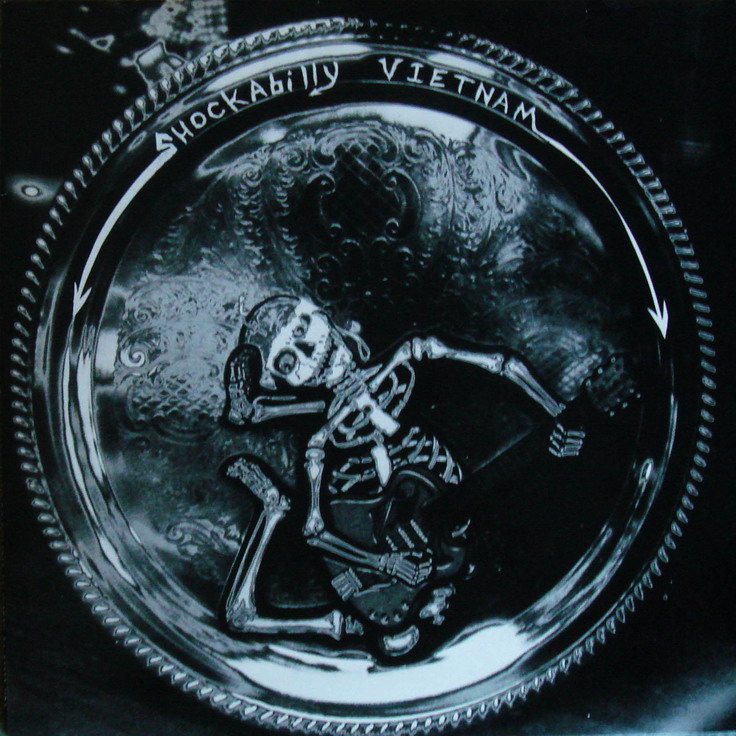
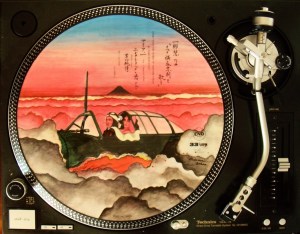
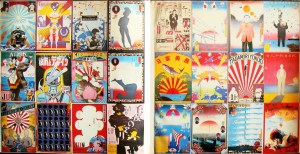
It was all different in the late 1960s.  After a decade of sterile LP cover productions in pop, jazz and contemporary music, the kaleidoscopic rendition of hallucinogenic illusions indelibly stamped the visual canon aimed at enhancing the appeal of adventurous, innovative music.  As last year’s exhibition at New York’s Whitney Museum testified in its celebration of 40 years since ‘the summer of love’, some of these artifacts have how grown to become the classics of 20th century visual art.  Tadanori Yokoo’s posters and Ichiyanagi’s “Opera” LP belong to this shortlist.  Without permission, I reproduce here the palpable beauty of this historical object. 


***


Ichiyanagi is a highly prolific composer and the list below is by no means exhaustive.  In addition to the sessions described here, I particularly recommend the lengthy “Improvisation” from September 1975 – an achievement on a par with the intense documents of Takehisa Kosugi’s Taj Mahal Travellers and Michael Ranta’s Wired.


Toshi ICHIYANAGI: “Music for Tinguely” (1963, 1967, 1969)

Toshi ICHIYANAGI: “Opera Yokoo Tadanori wo utau” 2LP (1968-69)

Toshi ICHIYANAGI / Maki ISHII: “Music for Living Process / Cho-etsu” (1973)

Toshi ICHIYANAGI-Michael RANTA-Takehisa KOSUGI: “Improvisation Sep 75” (1975)

Toshi ICHIYANAGI: “Cosmos” (1984)


Ichiyanagi’s early compositions from 1967-1969 can also be found on compilations “Extended Voices” and “Oto no hajimari wo motomete – Shigeru Sato Work”.  On this last CD, the composition entitled “Tokyo 1969” seems to have been recorded soon after the “Opera” sessions.  It exemplifies a very similar collage style and is a perfect companion to the classic album.


Flowers’ contribution on sides B and C was later made available on a separate LP which also featured a number of their (inferior) cover tracks from LP “Challenge”:


FLOWER TRAVELLIN’ BAND: “From Pussies to Death in 10’000 Years of Freak Out!” (1968)


WIZARD PRISON: “II” ****

Recorded 2005


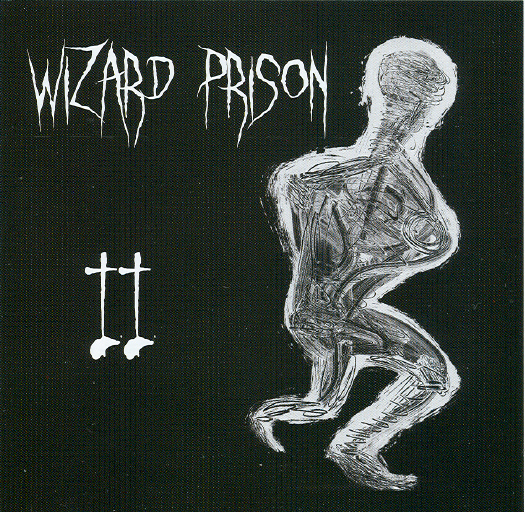
Wizard Prison is a Seattle-based multimedia duo consisting of recording experts Scott Colburn and Ben McAllister. A self-declared ‘audio-wizard’ Scott Colburn is a musical institution in Seattle, with much of his fame owed to the productions of Sun City Girls’ and Climax Golden Twins’ records. He finally gained well deserved recognition after recording what probably was Animal Collective’s best album.


Inventor Ben McAllister is a computer music graduate with a career divided into (and united by) ventures into film composition, sound design and audio engineering.


Although Colburn’s recording style has arguably been focused on capturing live aesthetic, Wizard Prison sounds uniquely refined, if not overdecorative. Whenever it falls into the clichés of electronic rock, it is instantly rescued by the authors’ highly developed sense of space and considerable experience with a wide variety of approaches to both electronic and acoustic (microphones) media.


A mystical fable accompanies this record. There seems to be a Daevid Allenish mischief to it – at least for those who bother to read the story. And it is pleasant to think of this record as a ‘concept album’.


Gogon’s Family Conference

This is studio wizardry at its most unhurried, liquid and glowing. Warm guitar tones, appeasing organ and looped bass all benefit from stylized electronic misplacement. The thematic focus comes from an unexpected source. A Chinese kid declaims affectively verses by Wang Anshi, a poet from Northern Song period. The qiyenjueju phrases celebrate the coming of Spring and the radiance of the sun. Wang was a political figure and a failed revolutionary, and somewhat of a political tone continues as a recording from Communist China’s radio spews some venom against the reforms of Taiwanese parliamentary system. This is followed by snippets in Cantonese. I am not entirely sure if Colburn and McAllister were aware of the semantic content of the excerpt. Western avant-garde musicians have been using tapes with Chinese speech since at least the times of Paul Boisselet’s “Symphonie rouge” (1947), but the proceeding usually reflected little more than the fascination with Mandarin’s quadritonal form. Colburn and McAllister overlay scratchy, processed voices, with the kid repeating the Chinese line. But it remains drowned deep inside the dense, nocturnal atmosphere, not unlike Jah Wobble’s “Bedroom Album”. Colburn once admitted that he despises fronting vocal parts in pop mix.


Sao Palo

Despite being more uptempo, this track is sill mudded with those ill-defined Czukay-esque bass and drums loops, punctured here and there by an extra guitar chord. Parading snare drums and woofy organ portend none of the heavy metal guitar blast, which riffs out confidently with its bass underbelly. The structure becomes heavily fractured – electronically rich, but interspersed with anthemic choruses (most likely Asian female voices, but I can’t identify the language, buried in the racket). Tight, dry drumwork distracts from the groove, but the sustained guitar chords usher in a quasi-mantric mood. The distressed female chorus gets re-sampled, re-mixed and re-mingled within the guitar riff and intensifying glitches that wean an entire miasma of bleeps in the style of Yoshihide Otomo’s solo works. As a final accent, acoustic piano takes over, surrounded by cymbals and distant scuttling guitars, all served in a soup of drones. It fades away through the guitar reverb into an echo of nothingness.


The Word of the Imaginary Vision

A 1980s indie rock guitar theme is tamed here by some amateur choral work (sports fans?). This sub-theme crosses the riff line, destabilizing the dominant meter.


Tea Dreams

The drum-and-hi-hat work is so metric that one could suspect a frayed metaphor of an old-time chug-chug locomotive, with a siren. Clinically insulated Fender Rhodes note is being repeated ad nauseam, but without the grace that the Necks have accustomed us to over the last decade. This repetition imparts an illusion of ascendance but only because the rock trio core breaks it every 8th note. If there is variety in this track, then it is provided by some wailing voices in the distance, and then by the return of China International Radio Station, which re-appears pompous as ever.


Gugon’s Visionary Plan

Cosmic keyboard pulses meet spectral guitar, padded bass and innocuous drumming that turn this to little more than stargazing from a nighttime beach. An unexpected trumpet call intones a wavering “shakuhachi” song. Acoustic guitars turn up in purely supportive, rhythmic role.


Sunn Kill Moon

This longer (21min) track opens with pulsating, blobbing electronics and a throbbing bass line. Wizard Prison shifts scales effortlessly, as the largely discredited 1970s’ sequencer music would do. But the sense of space is limited and so is the range – none of the tempting extremes of high and low register that sequencer-based classics accustomed us to. Only tiny bells accentuate the cleaner side of well-rounded, doughy ambience. The bass throb does not seem to be entirely in synch with the sequenced line of the higher register, but the asynchrony fails to generate any vertiginous sensations that, for example, Deuter’s first LP did. Then the throb is left alone to fend for itself, and is progressively demoted to the nether regions of an electric motor. The interactions between mid-range and lower pulses become quite abstract and never adopt explicitly melodious mantle. Admittedly, 40 years after Morton Subotnick’s seminal bubbly electronics, this passage does appear a mite too derivative. Finally, a dirty guitar fuzz is thrown in and reverberates with a long sustain. In an appendix, a Michael Karoli-styled second guitar washes in repeated frames, pushing away the electronic canvas into the deep background, out of the auditory reach. We are left with towering guitar sound, not unlike on Steven R. Smith’s or Steven R. Lobdell’s solo outings. A slow guitar theme emerges from inside the blizzard of electronic effects. It turns evidently illustrative, with chromatic effects, alien bubbles, mysterious ostinatos, and sharp fuzz incisions. A sense of foreboding prevails throughout. Bass outcrops will suffer injections of intrusive guitar until the end.


***


WIZARD PRISON: “The Early Years 1972-2005” (1974-2002)

WIZARD PRISON: “II” (2005)


The “Early Years” document Ben McAllister’s experiments and film soundtracks.


Published in: on August 18, 2008 at 9:23 pm  Comments (1)  
Tags: , , ,

BOGUS BLIMP: Men-Mic ****

Recorded 1997-98


A Norwegian sextet formed near Oslo in 1996 has pursued pointillistic experimental rock collages saturated with electronic illustrations uncomfortably perched between smeared abstraction and documentary realism. 


Over and above the dilution provided by the electro-dispersion of ubiquitous samples and glitches, the core instrumentalists typically engage in polynomial exercises ranging from weary pop tunes to black metallic backfill.  Remarkably, it is the electro-sampled glue that has successfully welded the band’s sound.  All their collections, each several years in the making, owe a lot to Ingar Hunskaar’s painstaking engineering work.  


Although their output has been housed on a label famous for post-black metal scaremongering, Bogus Blimp are as far away from this hyperformalism as Spitzbergen is from Weddell Sea.  Some of their electro-phantasmagorias stir a nostalgic vein, others finesse the disturbing side of 1980s’ geri reig, yet others stalk perilously close to futuristic ciné noir.  This story is not yet over.


Jazz/Speech

Against a toy motor burr, a very fast guitar tremolo intermingles with a seemingly prelapsarian, slightly out-of-tune piano recording.  As a mythomaniac politician delivers a public harangue, the piano flips up a carnavalesque groove.  In a grotesque twist, Hilmar Larsen crotchets on his mandolin with wicked abandon.  The initially clownish atmosphere undergoes grotesque, even macabresque mutations.  As the pulpit-thumping tirade harps on, a Zamla-style piano and guitar duo delights everyone, parading to Bjørn Larsen’s phatic signals of glitchy static.


Sweets & Love

It is unclear if Kyrre Bjørkås’s rhythmic thud adumbrates a heartbeat or a stomping leviathan.  Christian Mona’s half-whispered, hoarse voice interbreeds with organ, piano and drums.  Soon, the pregnant, vampiric menace explodes.  Mona’s vocal performance is funereal, unnerving and pathological.  Absence of fuzz guitar will forever alienate black metal fanatics, but when the theatrical, life-beaten protagonist spews the “Sugar Daddy” story, his anguish chills the spine.  The band reaches the climax of agonizing, creepy drama and then, unnecessarily, rehashes the entire stanza.  By then, Mona turns into a self-parodic crooner.


Hush Now

In windswept desolation, cymbals rummage through mellow guitar notes.  Hushed lyrics of this “lullaby” intensify along sustained ‘mellotron’ samples drawn out by Aslak Larsen, evoking latter-day Cassiber’s phantasms.  “The countdown has begun”, we hear, underlain by a leaden rumble milled by Kyrre Bjørkås’s bass.  Some guitar chords thrown in major scale brighten the entrained mood.  The “wind” sample turns synthetic and flies away, reduced to inconsequential hiss.


In/Exhale

A ‘cello’ riff and black metal vocal impersonate the ‘inhale-exhale’ sloganeering.  When the expected upwelling eventually comes, the riff becomes felsic, metallic, yearning for a missing fuzz component and comforted by the grueling, morbid, pathogenic vocal.  Many listeners of experimental music find the ‘black metal’ advances expletive, yet admittedly the cross-pollination of adventurous music and cadaveric sonic horror has taken root on both sides of the Atlantic.  While this misalliance has not quite yet given birth to any self-sustaining musical genre, the bastardly sub-genres have been aplenty – from Stolen Babies to Unexpect, from Dead Raven Choir to Special Defects, from Equimanthorn to Abruptum.  Interestingly enough, this debut was Bogus Blimp’s first and last flirtation with this questionable approach.  The vocal treatment on the later records preferably drew from public speech mockery to arch-drama familiar from STPO’s neo-futuristic ventures.  And “In/Exhale”?  The band’s endeavors to sustain the atmosphere with harmonium-like moan and sputter lead us squeaky Visigothic caravan axles – a theme atavistically familiar and previously exploited on such diverse recordings as Lindsay Cooper’s “Pictures at an Exhibition” and Boris Kovac’s “Ritual Nova”.  Finally, the merry-go-round returns, stuck in eternal rotation.


Brains

Right after a short intonation on tubas, an entire symphony orchestra is tuning in.  In a lovely moment, the strings impersonate Felliniesque ‘Prova d’orchestra’.  But whispers distract again.  This soon becomes a hymnal song, full of strained vocals, zooming on a swirling Hammond organ, but with a forged sensitivity of 1990s neo-pop.  Sudden key signature changes relativize these data and uneven meters complicate things further.  Henceforth, the track develops on several plans.  There is the mock-vampiric layer (Mona’s vocal), a nostalgic one (Larsen’s organ), an experimental one (Aslak Larsen’s samples), a rock one (Roger Jacobsen’s ever-shifting meters).  A sampled coda brings back the looped electro-haze and a posh accent from the British Isles about some futuristic science program. 


Even More

Bass-based figure, bass drum and ungainly lip smacking dominate the faltering organ and pliant hi-hats.  The placing of the bass growl is emotionally draining, and when it eventually explodes, it does so predictably.  The dusky, circus theme is also inconsequential, eventually lost in the samples collected from old English lessons on 33rpm vinyl: “you’re are listening to the record.  When I speak slowly you understand me”, reveals the narrator.  Spooky stuff. 


891

AM radio noise, static, Simen Grankel on the saw, distant rhythms, organ pop tunes, much distortion, or are these Soviets trying to buzz Radio Luxembourg out of the range?  The struggling pop tune survives, but barely.


Inside Here

Another manège moment, a carnival waltz, led by an apathetic, triste harmonium and a solemn, inconsolable melodica.  In between, the disconsolate voice whispers uncannily: “I don’t really know you”.  Subtextual cymbals finally give way to a more prominent rhythm, before it’s too late. 


***


BOGUS BLIMP: “Men-Mic” (1997-1998)

BOGUS BLIMP: “Cords. Wires” (1999-2000)

BOGUS BLIMP: “Rdtr” (2000-2004)


As stated above, the “metal” moments still present on the first recording did not resurface on the next two.  Between the follow-ups, “Rdtr” is probably the mellower of the two. 


Published in: on August 16, 2008 at 8:57 am  Leave a Comment  
Tags: , , , ,

CLIMAX GOLDEN TWINS: “Climax Golden Twins (Rock Album)” ****

Recorded 1993-2000


The Seattle-based duo of Robert Millis and Jeffery Taylor began to record their initially lo-fi avant-rock sketches around 1993.  They quickly developed penchant for studio improvisations, often produced by Scott Colburn and manned by several regular collaborators, among them drummer John Vallier, sonic explorer Jeph Jerman and visual artist Jesse Paul Miller.


Despite their post-hardcore sensitivity, several of their explorations ventured deep into sound documentary.  At its most esoteric, Climax Golden Twins celebrated the form pioneered by Luc Ferrari’s revolutionary field recordings.  On the other hand, the band’s studio avatar alternated between avant-rock collections and dreamy compendia of loops, drones and sinewaves.  It is the latter incarnation that has contributed auditory haze to countless art exhibitions, radio, theater, film and dance performances.


More recently, the duo reappeared under the Climax Golden Twins moniker in a more cohesive, orientalist rock format, officiating as a promising substitute the now defunct co-locals Sun City Girls.  This is more than a coincidence.  Robert Millis had for years collected field recordings in South East Asia, some of which have now appeared on Sublime Frequeuncies’ series. 


Climax Golden Twins are also behind Victriola Favorites – a highly enjoyable collection of deeply obscure 78rpm singles from first decades of the 20th century, a treasure imported from most exotic destinations including Japan, Turkey, Burma, China etc.  Charming acetate documents occasionally make an appearance in the band’s multi-layered textures. 


Does Your Mother Know I’m Here?

After a brief phonemic cluster of unknown origin, acoustic guitars begin to strum lazily, carrying us through a stagnant, slumbering environment, laced with glasslike chimes.  Aimless infant vocals vanish somewhere in the backyard.  The informal atmosphere is breezy, summerlike. 


German

The beguine accents turn this primitivist guitar piece into a quasi dance.  It is as if the guitars surreptitiously spied on something, lurking and poking around in a comical fashion.  A self-replicating piano chord obsesses deliriously with little effect.  Unenthusiastically, drums, bells and some non-resonant guitar plucking fill the space.  More abstract cymbal and piano missive finish this off.  It is the “dance” character of this piece that drew references to Fred Frith’s Ralph-label period.


Ballroom

This begins with heavy tympani pounding.  Animist Orchestra’s Jeph Jerman rolls around some round or spherical objects, placing us in the middle of the installation.  The skeletal melodic component is sourced from an ostentatiously purposeless, clacking guitar/bass/drum trio of Mills, Taylor and Vallier.  Despite the radicality of metallic scraping behind them, the sustained bass line makes the band’s outing almost spacey.  In turn, the fuzz guitar erupts violently in short, scalding bursts.  All along, the mysterious round objects keep rolling.  The track wanes when a more prudent guitar peels away gentle notes along with respectful clinking from little bells.


To Float

This (longer) track wastes about a minute before audible elements can be captured.  These “elements” unfold into a tardily progressing rock trio with simple tempo runs on bongos.  Rhythmically pedant, the beat is unmasked as purely accidental when a screeching guitar unfurls a dirty fuzz carpet, eventually spreading over the pounded drum, rather monothematic bass and some insulated piano keys.  This pattern of tortuous progress is reiterated after each fuzz relapse.  An acoustic guitar closes the piece.


Choked Up

Under a prominent bass ostinato and a trickle of cymbals, oval effects pile up, mutating into a rocking behemoth when the bass drum joins to pinpoint the offensive ostinato.  Almost instantly, a choking vocal deprives this “rock” number of any semblance of commercial potential.  The sound is processed through folding, faulting, caving effects. As usual, the piece ends with a contrasting accent – this time from skittery percussion.


Heavy Hippie Shit

Here the bass falls even lower – to a threatening register as perfected by Boris.  But the palette is more diverse: detuned acoustic guitar, grimy, coarse guitar fuzz hijacked from the densest of metals, organ’s vitreous resonance and marimba. 


My Peppy Loins

A strangely tuned “Asian” string instrument (cha’pei?) cackles, followed by a speed punk suprematism in search of something to loathe. 


Cough…  Sniff…

Satanic growl is being smothered by a heavy tornado of several electric guitars, and curiously inept drumming.  Harsh electro-core production places this excursion somewhere between the realms of Orthrelm and Psychic Paramount.  Overall, it is a sonically repulsive experience, unless you’re in the mood for discord.


Composed

Sticks, toy xylophone and acoustic guitar strum, pluck, click and crackle.  There is something Art Bears-ian in the ascendant, skeletal harmonies of this anti-professionally delivered track.


Microspace Patrol II

Non-metric drumming evades any responsibility for rhythmic structure, allowing the fuzz guitar to play with feedback.  The band wakes up into a solid avant-rock number.  Were it more rhythmically complex, it could be categorized alongside Canada’s Fat. 


Theme from Climax Golden Twins

Southwestern atmospheric heavy rock – melodically one of the most promising moments on this record, plunges into discordance and is cut off way too early.


Telephone Call from the 70s

Billy Cox-like bass could be considered an anachronism.  But Climax Golden Twins insists on jabbing the listener with colliding messages – a phoned “hello”, high-end feedback, annoying organ, itinerant, stop-go beats. 


Frankly

If you remember pre-industrial bass utilized by Joachim Stender in German band PD, then the Twins get pretty close.  It migrates through pre-recorded dance tunes, vocal tapes playing backwards, various voices, engine-prepping guitar.  Despite non-rational sawing and scratching, occasional piano tremolo and some dramatic vocal interjections, there are unfortunately not enough ideas to keep it continually interesting. 


You Drove Me, Nearly Drove Me

Groovy Hammond organ teletransported from 1950s small-town pre-rockandroll dance party could have remembered Vivien Leigh’s first steps.  Yet no saccharine allowed here.  Tweeting and twittering juts out from a tape run within a reading range recording head.  The effect is simple, but ingenious; it does chirp and occasionally sings.  And then, an eerie crooner at half-speed does, indeed, loop in a line from the title. 


Swan

Probably the strongest moment on the disc.  This Heat-like guitar symphony with rambunctious drums, simple electronics and tapes thrown into the sonic whirlwind.  It plods on ponderously, toxified further by stammering bray.  The lead guitar crafts a solo and a scream resonates inauspiciously.  The hoarse voice later returns, if only to incinerate the gates of hell. 


A Door A Fish Your Head

Clarinets and Gene Krupa-like archaic 12-bar drumming accompany a failed recitation of “Poems for a Dead Man”.  Amplified, jazzy guitar softly points to the verse ends, with the warm clarinet pouring in additional color.  Later, the clarinet pierces in Ornette Coleman’s style.


Pop

Here’s the basic trio falls into a groove.  Structurally, this is a dialogue between two simple themes: one tense and suspenseful, one joyful enough to resolve the suspense.  After some to-and-fro, a Jon Hassell-like windblown effect quells the dispute.


1, 2, 3, 4

Voice snippets are followed by a cut-up punk charge.  Black metal vocal hurls lethal syllables whenever the charge stops to take a breather. 


Lampshade Market

A relaxed tabla, field recordings and exoticist guitars à la Sir Richard Bishop, crowd in a market full of children’s voices. 


Drink Me

Back to the beginning.  A sizzle sneaks through a rather random mapping of acoustic guitar strumming, melodica blowing and crystalline intonation.  The guitar cradles slowly, effective and swinging, but relatively uneventful.  Then it attempts to impersonate poor-man’s Appalachia plucking style, despite the geographic and cultural gulf that separates the coal miners from Seattle’s coffee shops… Isn’t it closer to Thailand?


***


1. CLIMAX GOLDEN TWINS: “Climax Golden Twins” 2EP (1994)

2. CLIMAX GOLDEN TWINS: “Three Inch” MCD (1995)

3. CLIMAX GOLDEN TWINS: “Imperial Household Orchestra” (1996)

4. CLIMAX GOLDEN TWINS: “Lovely” (1997)

5. CLIMAX GOLDEN TWINS: “Climax Golden Twins (Locations)” (1998)

6. CLIMAX GOLDEN TWINS: “Dreams Cut Short in the Mysterious Clouds” (1999)

7. CLIMAX GOLDEN TWINS: “Climax Golden Twins (Rock Album)” (1993, 2000)

8. CLIMAX GOLDEN TWINS: “Session 9” (1995, 2000)

9. CLIMAX GOLDEN TWINS: “Highly Bred and Strictly Tempered” (2004)

10. CLIMAX GOLDEN TWINS: “Climax Golden Twins” (2006)

11. CLIMAX GOLDEN TWINS: “Five Cents a Piece” (2007) 


The band has also issued plenty of cassettes and I am yet to hear several of their early recordings.  Position 8 is a soundtrack using some material from 2 and 6 and I do not recommend it.  5, 7, 10 and 11 would offer a range wide enough for anyone willing to explore the band’s variegated approaches.

Published in: on August 13, 2008 at 8:47 pm  Comments (2)  
Tags: , , ,

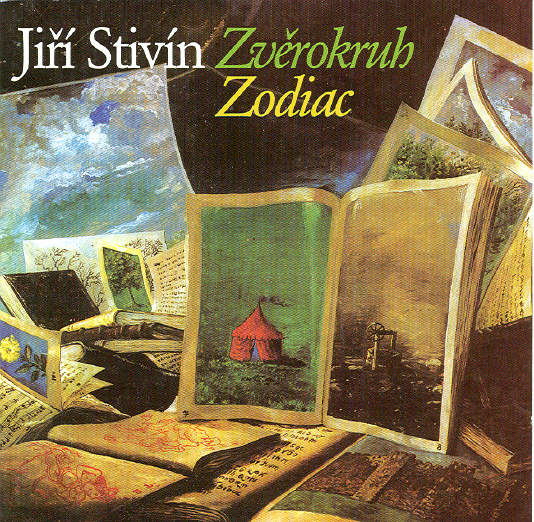
Jiří STIVÍN: “Zvěrokruh” ******

Recorded 1976


The decade of 1970s was replete with various fusion styles.  Jazz was illegally married with rock.  Rock flirted with symphonies and suites.  And analog electronics pervaded all styles of music.  Much of the surge in creativity actually reflected the ferment of the 1960s, and by 1974 the thrill was gone.


But there are exceptions.  Prague flutist Jiří Stivín made rare inroads into syncretic forms virtually untested elsewhere.  His cogent approach to classical, experimental and free jazz music facilitated his exposure to London’s improvised scene, including Scratch Orchestra and Cornelius Cardew. 


In an era when many Czech and Slovak jazz musicians faced significant obstruction by the Communist regime, Stivín’s cross-border activity may be surprising, but the results were nonetheless spectacular.  His Jazz Q quartet recorded a trailblazing session with Radim Hladik’s Blue Effect.  Later collaboration with guitarist Rudolf Dašek also gained notoriety on the continent.


By mid-1970s, Stivín achieved a remarkable level of synthesis between electric jazz and baroque music.  He used his versatility to create a poetic idiom of the highest standard.  For many, such shameful heterodoxy would amount to little more than an artistic cul de sac.  Yet Stivín’s luxurious arrangements are not only cosmopolitan and multifarious, but often entirely counterintuitive.  It is therefore not surprising that in later years Stivín specialized in Vivaldi’s and Telemann’s repertoire. 


Oheň

The first four sections are iconophonic illustrations of the four elements.  Beginning with “Fire”, after a brief anaphora from the chorus (Kühnův Smíšený Sbor), the saxophone flirts with a swift upward run.  The mixed gender chorus part is enunciatory and lofty.  Against this non-formulaic, befuddling introduction, Slovakian pianist Gabriel Jonàš’s entry is comfortably jazzy – recurrent bass figure serving right hand improvisation.  Stivín occupies himself with cymbals and delivers elegant, discrete drumwork.  Then he picks up his alto sax, turning the concept into a virtual trio of modal, very European (Namysłowski?) character.  The tonal organization of the chorus owes a lot to George Russell’s achievements, with a strong emphasis on modern chromatic harmonies placed in a quasi-medieval context.  The tenors keep repeating the original phrase, while the sopranos enjoy more freedom.  A gong overtone and sopranos stringendo close this first eavesdrop into Stivín’s vision.


Voda

Water – “acqua, fluves, fluvia”, or so echoes the sprightly dialogue between male and female members of the Kühn chorus.  Gabriel Jonàš’s piano emerges from this celebratory atmosphere in a more Jarrettian mode (in particular his pedal work).  The chorus vanishes slowly, leaving the pianist to twirl solo, but soon resuming its haunting, watery line.  The multifunctionality of the pianistic contribution is remarkable.  Jonàš provides a repetitive figure for Stivín’s flute, and then, brighter and blither, his keyboard prances around, occasionally inviting the chorus to return with its acquatic message.  The flute’s solo is smooth, classical, well-rounded and never overly florid.  Whenever the chorus’s call and response reappears, Jonàš confines himself to courteously hand out a reliable bass line.  Stivín’s circular blowing ends on a high note, not unlike in Corea’s Andalusian themes.


Vzduch

“Air” commences with breathy, melismatic vocal.  Cosmic panpipes (actually a syrinx) and mixed male/female Sprechgesang unfold in a multi-layered, jaunty argument.  The panpipes are used here in a neo-classic, rather than folksy (Andean or Carpathian) mode, but the overall mood is bacchanal, even zestful.  Stivín exploits velvety, mushy melismas to warble and tweet on his piccolo.  The simple two-chord configuration suffices to make the composition swing like a school break see-saw on a windy day.  It imparts a sense of mirth, despite, or rather because of the meticulous scoring for strained voices, guttural and plosive effects, scat, clicks and water bottles.  Some of these effects express relief, others – ecstasy.  The looped syrinx recurs with the regularity of a suburban maneige.  We leave the composer, his piccolo soloing and his gasping on alto flute.


Země

“Earth” deceives.  From a madrigal-like polyphonic carol exuding declamatory pathos there snakes out Stivín’s alto flute.  Unexpectedly, hand drums and a very mechanical sounding drum crop up (one could almost believe it is a rhythm machine, but is this possible in Czechoslovakia barely 4 years after Kingdom Come’s LP “Journey”?).  The piano part is conservatively syncopated, with the accents perfectly positioned for the rushing flute solo.  By now the chorus is long gone – and “Earth” becomes a mere ‘fusion’ trio of flute, piano and fast motion (Stivín is actually quite impressive on the bongos).  An enigmatic piano window shuts all too soon and “Earth” wins hands down as the most mundane of the four elements.  The final choral rentrée does not alter this impression.


Flegmatici

The second quadruple set of compositions features a String quartet (Talichovo Kvarteto).  The cellist intones a romantic line, only sparsely actualized by the partners.  Jonàš’s electric piano is a living testimony to the most commonly usurped sound of the decade.  The strings’ phrasing is beguiling, but entirely predictable, allowing Jonàš to fill in all the available space.  Deservedly or not, an avant-garde jazz rock combo set against a neo-classical string quartet will forever bring back the memories of Quoatuor Margand on Yochk’o Seffer’s trilogy ‘Neffesh Music’. 


Sanvinici

This is a busier, nervy track staged for a duet between jolly piano and nonchalant piccolo, piqued against a stately (albeit brief) string quartet intro.  Its plucked meter suggests a ragtime substructure, but one with inbuilt classical commentaries by the Talich Quartet.  Stivín’s piccolo frolics with apelike agility, even though it sends us back 60 years in the history of jazz. 


Melancholici

Imagine a deeply melancholic flute, misanthropic electric piano and pastoral strings – bundled together, all this sounds, looks, tastes and smells like a 1970s’ soundtrack.  The key ingredients are all present: the track is downtempo, decorated with an interminable legato and a lonely, mellow melodic line hung loosely above it.  To be fair, there are actually two flute lines multitracked by Stivín, but this is only made apparent when the prolonged complaint forlornly laid out by the romantic strings eventually perishes.  How come Lelouch or Chabrol never made use of such highly lachrymatory commercial potential?


Cholerici

In a stunning aboutface, the Talich Quartet sprouts like Soldier String Quartet in Elliott Sharp’s strident hands.  Realism descends only when Stivín’s reeds and Jonàš’s arpeggiated cembalo begin to coruscate like Pierrot Lunaire’s classic masterpiece.  Undisturbed, the quartet keeps sawing as if obeying marching orders.  This groundbreaking experiment would be entirely satisfactory even without the multilayered saxophone finish.


Zvěrokruh

This longer track crowns the proceedings.  This is also the only occasion to hear simultaneously the chorus and the string quartet.  The ever lyrical violins rise, immediately doubled up by the chorus.  Once again, Stivín exposes his predilection for seeking out unique tone colors – here on marimba juxtaposed with cembalo tremolos.  The chromospheric flute governs the melodic content; the harmony emanates from the acoustic piano.  With tense string backdrop, tenors and sopranos alternate, pronouncing the Latin names of the zodiac.  This is much more effective than the spoken word on Cosmic Sounds’ LP “Zodiac” (1967) and it is doubtful whether Stivín was familiar with that record.  A rather domesticated saxophone returns in a solo, dragging back the piano from obscurity.   The obsessive tremolo on clavicembalo, in and out of auralscape, never tires.  If there is anything remotely ‘jazzy’ on this unclassifiable piece, then it stems from the piano part and will still fall short of purists’ expectations.  The two players swap roles whenever Stivín’s marimba infuses just enough harmonic support for a pianistic solo.  When the watershed moment finally comes, the entire “band” is at the ready – the flutes, the saxophone, vocal snippets, piano, cembalo, marimba and the strings – peaking in ecstasy redolent of Keith Tippett’s large ensembles.  For a moment, Stivín’s saxophone turns torrid, his phrasing gets shorter.  The apotheosis ends when the Andean piccolo flutters away in complete solitude.  Spectacular. 


***


BLUE EFFECT & JAZZ Q: “Coniunctio” (1970)

STIVÍN-DAŠEK-PHILLIPS-SEIFERT-VITOCH-VEJVODA: “5 ran do cepice” (1972)

Jiří STIVÍN – Rudolf DAŠEK: “Our System Tandem” (1974)

Jiří STIVÍN – Rudolf DAŠEK: “System Tandem” (1975)

SYSTEM TANDEM: “Koncert v Lublani” (1976)

Jiří STIVÍN: “Zvěrokruh” (1976)


Jiri Stivín’s discography is much more extensive.  Note, however, that he does not feature on any of the Jazz Q records that followed the revolutionary “Coniunctio”.  Although “Coniunctio” and “Zvěrokruh” are in a class of their own, the remaining recordings listed above are also of interest for those who have developed a taste for European borderline avant-jazz of the 1970s.  His later sessions with Pierre Favre were reputedly of equally high quality.


Published in: on August 11, 2008 at 9:50 pm  Leave a Comment  
Tags: , ,

Mat MANERI: “Pentagon” ******

Recorded 2004


New York-born, but Boston-raised violinist will forever be introduced as “the son of jazz sax player Joe Maneri”.  Classically-trained, he opted to explore multi-string variations of electric violin and electric viola.  His first recordings date from the mid-1990s and the plethora of labels that housed his early output – from ECM to Leo Records to Hat Hut – illustrate as much early-stage eclecticism as genuine artistic hesitation.


Jazz violin had been for years dominated by European musicians and American players, if they opted for the instrument at all, tended to pretend that nothing much had happened in music over the last 50 years.  Maneri’s formula proved revolutionary – his preference for low registers invited timbric juxtaposition of unusual tunings in non-traditional orchestral contexts. 


If some of his early recordings maneuvered somewhat languorously, by the time Maneri sat down to record “Pentagon”, his introspective style had transcended all stylistic limitations.  Often in duo with trombonist Ben Gerstein, a multi-faceted Maneri careers swiftly, surrounded by a plurality of contributions from triadic keyboards and punctiform percussion.


Ava

The record is enframed in two painful etudes for multitracked acoustic and electric violins.  Slowly expanding waves of glissandos wash romantically, subverted only by subcognitive laptop gurgling.  Without a shade of supercilious pathos, the track is undone with a quasi-Mahlerian finish.


WWP

Freeze frame and we are up against an ultra-modern combo progressing at a most slothful of paces.  The palette is impressive – an “electric Miles” piano, organ panels, unglazed trombone and skittery drumming.  Ben Gerstein on sullied trombone dominates here, keeping the ensemble in an unhurried, tepid mode.  This inviolable, insoluble order rewards with incredibly rich textures.  Keyboards and electric violin occupy parts that in other formations would be scored for guitar.  The track is perennially expansive – always broadening the spectrum and disappointing those who could expect a melodic or rhythmic conclusion.  It remains conceptual, rather than inferential, and advances amoebically, if it “advances” at all.  Jamie Saft’s organ interacts with muted cymbals and splices of other keyboards occasionally step into the fray.  Saft’s and Gerstein’s soloing achieve an unlikely intensity, oblivious to the free form structure nurtured by the rest of the band. 


Inslut

A determined funky rhythm greets us with that ultra-modern, cybernotched derivative matrix familiar from Date Course Pentagon Royal Garden’s recordings (something about 5-angled forms here?).  Craig Taborn spews from his laptop a nice ‘vinyl’ crackle and a pre-recorded, Larry Young-ish organ is being continually reprocessed – slowed up and sped down throughout the solo exposé.  This unexpected impromptu is urbane and astute, but a tad too short.


Irena

Muted trombone explores various orifices in the multi-percussive, non-metric soundscape.  There are two drummers here – John McLellan and Tom Rainey, both engaged in highly chromatic, delicate, almost furtive research.  Electric piano parts are suggestive of a distant stylistic kinship with Miles’s cohort Cedric Lawson.  Meanwhile, Maneri’s bizarrely amplified electric viola swaddles nicely in a spaced-out dialogue with the trombone.  Astonishingly, the trombone is perched higher than the viola, which makes these dialogues so unique.  Gerstein’s lyrical tone quality would indicate that he plays an alto trombone here (?).  And throughout, very discrete harmonics is being masticated by Taborn’s laptop. 


Third Hand- the Fallen

T.K. Ramakrishnan’s mridangam awakens, contrasted here with a multi-violin passage as mournful as Terje Rypdal’s early orchestral works.  Nuances abound, as string processing slows things up like in Gavin Bryars’ classic “Sinking of the Titanic”.  Mridangam scuttles around and between channels like inebriated dragonfly.  The close proximity of the fatalistic, sorrowful string portamentos and the snakehipped, agitated Indian barrel drum is highly successful in its destruction of context sensitivity. 


Witches Woo

The two drummers appear here in a more directly rhythmic role, but their playing remains very lateral and textural, with more stress on cymbal work than on previous tracks.  Craig Taborn’s Fender Rhodes tilts towards solos, and so does the trombone.  John Herbert’s bass is pitched thunderously low but acts almost surreptitiously.  It does proffer a semblance of structure, though, for an attentive ear at least.  Otherwise, one can’t really tell where the overall coherence comes from as the frontloaded solos extend spectrally and fail to provide a reliable sense of direction.  Maneri’s role is more limited – short commentaries, purely polemic, as if triggered by the trombone. 


Wound

A circumspect, brooding forest of percussive substrates engulfs Joe Maneri’s acoustic piano.  Papa Joe brings here an aura of mystery, sometimes underpinned with the trombone in a quasi-harmonic mode.  Then Maneri’s violin injects some Seifert-an moments and Saft’s organ spews a barbarous hiss.  The drummers crowd in false interjections and we are plunged deeply into the mystic world of violinistic lament, fast drumstick hatching, and eerie, hiccupped bisbigliandos on the piano.  Somewhere far away another source of harmonics (pre-recorded violin?) resonates, magnifying the illusion of depth.  Surprisingly, just as we expect the formless mass to muddle through with an ease of Escherichia coli, there is a sudden, dramatic climax.  The violin weeps gently, comforted by a friendly trombone.  Joe Maneri’s piano is now reduced to an almost idiophonic role.  Feder Rhodes re-appears, in a knot with the continued percussive frottage and Mat Maneri returns on electric viola.  The production is extraordinarily mellifluous and well-defined.  The fluency of Jamie Saft’s engineering must be applauded. 


Howl in My Head / Motherless Child

Heavy avant-funk piece led by Joe Maneri’s saxophone, acid-leached with turntable scratches, woopy bass and superspeed Jon Rose-like violin squeaks.  All this stockpile of riches is suddenly abducted to serve a songform.  Although Sonja Maneri’s nasal vocal is firmly anchored in jazz tradition, it operates here against the atonal subtexts of prepared piano spurts, booming funk bass, sparse, dampened cymbals and regular hi-hats.  An excellent edition to your library of avant-songs. 


An Angel Passes By

Muted trombone, percussion and Feder Rhodes prepare the ground for the now familiar electric viola’s lowland soundscape, with Gerstein’s trombone usually more agile than the Maneri’s amplified instrument.  Between the two drummers, one is rooted in the tradition of impressionistic mosaics, the other epitomizes neo-harmolodic idiom.  The interspace between them is plastered with the organ and synthetic frizzle.  The whole construction generates an illusion of false indeterminacy.  One of the keyboards even re-creates a mellotron-like chorus.


Pentagon

Short intermezzo populated with an unlikely trio of old male vocal, sampled mellotron and mridangam.  The lisping voice is heavily argumentative and emotes in a tragicomical fashion.


The War Room

This is an organ-based symphony of altered chords and ornaments from the full orchestra of sampled mellotron, rich rhythm section, and distinctly guitar-sounding fuzz violin.  In other words, a bizarre heavy-metal jazz moment for avant-garde ears.  Craig Taborn’s electric piano sounds impulsive and gritty.  Soon enough, the impetus collapses into a mesmerizing inquadratura painted by the trombone, electric violin and skittish drums.  Intentionally or not, the ‘mellotron’ part begins to evoke King Crimson’s LP “Lizard”.  The full ensemble is now anti-melodic and recombined mayhem rules.  Self-styled fuzz violin makes a comeback, but the way Maneri sustains the notes makes you believe that the instrument is plucked and processed, rather than bowed. 


America

The record turns the full circle now, back to the romantic opening.  Despite the hissing keyboard, this is a romanticizing, tranquil violin soliloquy: temperate and affective, but also multi-form and undecidable.  Electronic sizzles intrude upon the lyrical bliss, but do not durably distract. 


***


I was charmed by “Pentagon”, but my knowledge of Mat Maneri’s other recordings is spotty at best, and I am aware that many other positions exist.  Should you be aware of anything remotely similar to the chef d’oeuvre described above, Sonic Asymmetry would follow-up with glee.


Mat MANERI: “Accident” (1998)

Mat MANERI: “Pentagon” (2004)


Published in: on August 10, 2008 at 10:00 am  Comments (1)  
Tags: , , ,

ARANIS: “Aranis II” ******

Recorded 2007


Over the last three decades, Belgian musicians have filled an impressive library of frequently engrossing attempts to decontextualize chamber music from its canonical constraints.  Two generations of composers and classically trained instrumentalists have crafted a cornucopia of par excellence ‘Euro-centric’ recordings covering the whole spectrum of syncretic endeavors.  Those who forged a groundbreaking neoclassic tenebrism have been more likely to gaine international fame (Univers Zéro, Présent, Julverne).  Others opted for a genre-bending fusion of humoristic, jazz and neo-classical elements (X-Legged Sally, Cro-Magnon, DAAU).  Occasionally, Belgian neo-classicism drew on systemic vocabulary of American and British predecessors (Soft Verdict, Maximalist).


Since the 1990s, Belgium has literally flooded the market with Kammermusik for rock audience.  Still, the productions of Joris Vanvickenroye’s septet Aranis have soared above any expectations.  His compositions are tense and dramatic, exuberantly orchestrated for violins, flute, accordion, acoustic guitar, piano and bass.  The harmonically and contrapuntally sophisticated fantasias are cogently structured, alternating fast and slow sections and indulging in urgent shifts in dynamic (sometimes even too urgent). 


Even though some of themes are catchy, the band eschews the simplicity of the groove; either the keys are modulated or the motif is soon juxtaposed with unexpected nuances, ornaments or transitions that often force the hitherto leading instrument to play the proverbial “second fiddle”.


For a drum-less, acoustic band, Aranis exudes an astonishing sensation of power, without ever compromising its stylistic trajectory.  The band has now assumed a prominent rank in the premier league of chamber rock.


Kitano

The record commences with an intrepid acoustic bass ostinato, platonified by bird-like strings.  We are instantly thrown into an atmosphere of breathless drama.  Frenetic flute, sharp piano chords and hooked bowing on violins are interlocked in premature variations on the still-evolving theme.  All too soon, a trio of juicy bass, lyrical accordion and domesticated piano offers yet another twist in this complex capriccio.  After several seconds in the limelight, the accordion cedes to a reprise of the intro on flutes and a more rhythmic piano.  The accumulation of ornaments brings a rich potpourri of reminiscences.  An energetic staccato, courtesy violins of Linde de Groof and Liesbeth Lambrecht, brings back the memories of Chick Corea’s orchestrations in “the Mad Hatter”.  Then Marjolein Cools follows on her wistful accordion – never too far away from Astor Piazzolla’s Tango Nuevo style.  The violin duo becomes virtuosic, in turn subsumed by piano and flute interventions and by accordion-dominated refrains.  Throughout, the dynamic swells and ebbs, clearly conducted by the bassist.  The septet delivers this complex piece with extraordinary panache.


Vala

An introspective violin theme develops slowly through systemic blankets woven by surging strings and a repetitive piano figure.  Jana Arns’ flute glides romantically in search of violin fermatas.  In an aura of classicizing melodiousness, the string legatos conquer the ideal of sonic purity with agile legatos, but the quest is abandoned in the higher register, leaving us with a semi-arid détaché.  The second round belongs to the accordion, mimicked by the flute.  Joris Vanvickenroye on bass and Axelle Kennis on piano conjugate a fluent rhythmic artery.  The intensity of the thematic tail captures the entire ensemble, with the violins dramatizing over and above the holistic tutti. 


Looking Glass

Acoustic bass and acoustic guitar (Steyn Denys) intone a congenial malagueña.  The accordion enriches further the joyful, dancelike tune.  Violins repeat the theme, taking it barely one verse further.  A very fruity piano and effervescent flute invite the entire band to a transition and loudly reprise the motif.  One by one, the instruments fall off the cliff – leaving only the piano to pick up the scattered notes in an offbeat solo, adroitly inlaid by the metronomic bass.  The composer defaults to pizzicato and col legno, which, unexpectedly makes the piece rock.  In a sweep, the violins and flute scoop up short licks con brio, making other chamber rock competitors blush. 


Gona

Bass arcato introduces the piano and the flute.  This is not the first time that these instruments are scored in an emphatic, yet consonant interplay.  Eventually, the violins follow, and their ostentatious portatos suit the herringbone structure of these fantasias.  In the second part of the composition, one of the violinists paints a lyrical aquarelle with harmonic easel set up by accordion and a dazzling light cone shed by the arpeggiated piano.  The tonal pilgrimage finally reaches its destination, augmented by the second violin and rustling flute.  


Walk in One’s Sleep

This time the grainy arcato on bass is malevolent, obsessive and ominous.  Repelled, the slices of violin and tangential flute seek their own pathway.  Cools’s accordion is less academic and more streetwise here, keen to shake the bellows.  After a miniclimax, violins take the lead descrescendo until the dynamic craters.  Then like the Pied Piper, the strings will guide the ensemble onto the Olympian summit.  The guitar crowns some quieter passages, and the idyllic flute reveals its bipolar tendencies.  The texture becomes increasingly polyphonic – the violins return, an uncredited oboe (?) makes an appearance next to a flute vibrato, and a very determined left hand strides on the piano. 


Moja

A songlike track is introduced by the piano and acoustic guitar, with some brief commentaries from the accordion.  As usual, the band wastes no time to densify the structure – a duo or a solo are instantly followed by a richer, more condensed (yet still legible) orchestration.  On “Moja”, the plaintive swells evoke an old Art Zoyd motif from its classic period.  Tone color patterning operates pairwise – violin and flute to convey drama; guitar and piano to strike an Iberian nuance and accordion substratum laying the veneer of bolero-like accumulation of successive tonal strata.  Although the repetitive tendency does owe its pedigree to Steve Reich, the reiterations never last longer than several seconds.  The turns are too fast and too potent for Aranis to be labeled “minimalist”.


Waris

An acoustic bass figure, in harmonic consonance with the accordion and violins takes longer than in the other compositions to develop a recognizable motif.  But what sets this track apart is trumpet, courtesy Bart Maris.  His instrument, sometimes muted, has a warm, intimate, almost fluegelhorn-like surface.  In more misty, subdued moments, Maris’s playing brings back the memories of Butch Morris’s ‘breathing’, nasal style, which the American composer perfected in small formats.  Here, tense, alarmist piano part prepares the ground for another threatening swell in decibels.  Eventually, violins quiet things down. 


Turbulentie

A South-Eastern European dance (a gopak? A furiant?) lashes out pizzicato with vertiginous swings and a Bartokian piano.  But Aranis does not dwell on this hugely fertile ground, previously exploited by Iva Bittova, Boris Kovac or Martya Sebestien.  This is the septet at its most “rock”, with the heavy beat on piano and bass that is as sweeping and awe-inspiring as Daniel Denis’s legendary thrusts.  After a strident interlude from the violins and the flute, a different mood appears.  A slow bass walk and, two radical signature changes later, a voluble melody follows on accordion and flute, adorned with putatively Ukrainian stylisms. 


Trog

The only piece composed by Peter Verdonck commences with a facetious, burping vibrato on bowed bass, guitar and accordion.  After some vacillating alternance from the violins and accordion, the piano and guitar duo chisels away an unusual intro and unfolds into a jocular dance, swirling like the unforgettable Cro Magnon’s tunes in the 1990s.  Occasionally, the guitar digresses away from the piano and the bass-based ostinato.  With verve, bowed bass instigates a polymetric motif full of hilarious, uplifiting twists and jigs. 


Lovey-Dovey

A piano-based theme, followed by strings and a painfully lonesome accordion.  The composition is more stationary, its structure is more fractured and it develops more hesitantly than the other tracks.  In the second half, the guitar makes an attempt to resume the theme, followed by the piano. 


Mythra

A leisurely-paced morceau for acoustic guitar and eerily familiar violin phrasings of the Nyman-Mertens-Glass heritage.  Although the repetitive component reasserts itself, additional variety is apportioned with violin duels – dirty shreds versus pristine loftiness.  Along with piano, the strings build (unintentional?) Nymanian quotes.  Still, the track never aspires to minimalist unity and towards the end assumes the rocking potency from bass and piano, capturing the effect achieved by Far Corner not so long ago. 


***


Aranis: “Aranis” (2005)

Aranis: “Aranis II” (2006)

Published in: on August 6, 2008 at 10:21 pm  Leave a Comment  
Tags: , , ,

MALACHY PAPERS: “Malachy Papers with Earl Harvin” ****

Recorded 2004


Some time in the mid-1990s, Kansas City-based saxophone player and horn sculptor Mark Southerland began to collaborate with percussionist extraordinaire Mike Dillon.  They shared taste for jazz and blues classics as well as contemporary groove revivalism.  Fascination with Art Ensemble of Chicago correlated with their predilection for striking costumes, masks and props. 


Several bass players performed and recorded with the band, notably Bill McKemy.  In more recent recordings, they were joined by Johnny Hamil. 


Southerland operates a whole storeroom of unique horns of his own making, generating highly original, idiosyncratic textures.  His Kirk-ian salvos are interspersed with lateral effects from Dillon’s extensive weaponry of idiophones.  Cognizant of half a century of American musical tradition, they lay out dense grids of largely representational and yet path-breaking ceremonials.  It is therefore not surprising that they forged an occasional collaboration with Eugene Chadbourne.


Their output is not easily available and it is unclear if Malachy Papers are currently in existence. 


What’s Wrong with Butt Fungus

A lattice of saxophones, magnetic samples and nonlocal drumming greets visitors with lunatic abandon.  The horns, endowed with heterotropic tone colors, fall into a dance mode before the vitriolic, repressive onslaught resumes.  Blown-out squeal, squawk, blare and peal crowd out other contributors with dogmatic precision.  A resolutely bewildering entrée.


Four Titted Puppet

True to its title, this track opens in a more playful manner.  Dillon’s vibraphone playing has this je ne sais quoi quality, as if lifted from a Jacques Tati movie.  The accents and theme progression are left to the horns, and they do smolder with nerve.  Hamil steps forward with a secular ‘modern jazz’ run on his acoustic bass.  Throughout the CD, Texan Earl Harvin will enrich the rhythmic palette of the band, showcasing a highly intuitive, yet thematic style.  His non-resonant cymbals engage here in an equiprimordial conversation with the vibraphone and tenor saxophone.  Harvin’s sense of space is impressive – his iterable rolls are carefully placed to allow for more pronounced vibraphone projection.  His non-metric accents are so complex that he abdicates the main tempo role, leaving Hamil’s bass to carve comfortable ostinato for Southerland’s fluent sax divagations. 


Brilliant Corners

A connotative take on Thelonious Monk’s immortal magnum opus from December 1956.  Harvin’s drumming appears here a lot tighter than the original, not because Max Roach was not fast and muscular (he was, both ballistic and virile).  Rather, Harvin’s playing is being underwritten by Dillon’s tabla, a very frontal presence once the initial theme has been laid out.  Hamil’s viscous, convex bass lines are to Oscar Pettiford’s walks what a modern treadmill is to rusty bicycle.  Southerland strays from the original, burrowing deeply in mid-size phrases.  The return of the main theme is surprisingly staccato, almost percussive, but Dillon’s tabla work is never excessive and reticulates perfectly.


Gimpy Ho

A downtempo opening with intrametric fill-ins from both Harvin and Dillon (on shakers) It leads to a stop-go dialogue between the two percussionists.  Southerland appears on discordant, plasmatic horn – or rather multistrata of horns.  The rotten, wrenching sound of his ‘bastard’ inventions is softened somewhat by Dillon’s marimba.  But soon the overdrive bass and drums go punk, with the horns frontloading a cavalry charge.  After a short lapse, Dillon does a little Ruth Underwood jig on marimba, but less for a colorful interjection that defined early- to mid-1970s Zappa sound, and more for prosaic beat-keeping.  The final cadence brings back the gnashing horns, muddling through with the illuminative accompaniment from the drums and overdrive bass. 


Solitude of Kim

Light percussion intro on dampened cymbals appears synchronous with left-hand tabla drum which abducts the entire low-end register of the percussive spectrum.  A quasi dub-bass grunts with low velocity and the ensemble is in full swing before Southerland’s horn zooms in.  The poetic theme will hinge on ambidextrous vibraphone, while the saxophone remains initially confined to surges and short repetitions.  With each sequence, its barks are becoming more articulate, cheerleading bolt-on swells.  It is as if the structure of the composition were to unveil the thematic component only gradually, until some final climax.  Throughout this iterative mobilization of sonic resources, the production remains very clear and the instrumental simultaneity easily legible.  The vibraphone returns, perfectly localized by Harvin’s selective, melodious drumming.  If Embryo were a jazz band, then this is probably how they could sound. 


Moon Germs

Joe Farrell’s 1972 classic is brought by sullied, overadjusted notes on vibes, followed by lavish percussive textures – metallic, brassy, scribbled, ombré.  Multi-tracked horns gulp and unleash a fury of pinched, shrill tones.  The vibraphone or glockenspiel cast long-lasting traces, leaving it up to the bass to maintain a thematic order.  But it is Dillon with his mallets who impersonates Hancock’s role on the original.  He sways perfectly between the improvised and scored sequences; his tremolos are purposeful and appropriately measured.  The bass-drums section is loquacious, but self-limiting.  The amazing horns are otherworldly – diverging into an unsightly asylum full of synthesized slates. 


Pagan Residue

This 9-minute composition penned by Hamil begins with a wooden-sounding sul tasto on G-string, setting off an eerie déjà entendu of an African drum call.  Harvin offers a radical re-reading of his skill on skins, initially eschewing any contact with metal.  Elsewhere, tubular bells, shakers, graters and sampled bleeps underscore the progression, distracting us from Southerland’s plaintive blowing.  When the bass engraves a pounding ostinato, the theme finally originates from the horns – like an industrial siren carried by the plodding, percussive engine.  Dillon extracts from his vibraphone muted reverb, almost swamped by the horn’s aggressive phrases.  Against the increasingly expansive, invasive drumming, the horn blowout calls for a final clean-up and the assembly line takes a breather.   Harvin’s drumsticks get more selective, and Hamil’s bass slumps into a monologue.  An electronically processed reed tone ends up skidding, rescued only by a clash with the percussive arsenal. 


Uncredited track

An unexpected ‘bonus’ offers a spectacle of environmental sounds, footsteps, and random clanging.  Nothing musical and even little non-musical material surfaces for about a minute.  Finally, a ‘lost in translation’ reed and vibraphone theme, interwoven by a delicate cymbal work reiterate a self-looping phrase.  The despairing bass is bowed and the melodic component seems to be based on a familiar theme, but I can’t recall what it is.  Context dependence?


***


The availability of Malachy Papers’ recordings is poor and I am yet to hear several of these:


MALACHY PAPERS: “Bone and Horn” (1998)

MALACHY PAPERS: “Adult xxx” (1999)

MALACHY PAPERS: “Demons” (2000)

MALACHY PAPERS: “Burning Parasols” (2001)

MALACHY PAPERS: “Blackbelly” (2002)

Eugene CHADBOURNE with MALACHY PAPERS: “And the Wind Cries Malachy” (2002)

MALACHY PAPERS: “Malachy Papers with Earl Harvin” (2004)


Mike Dillon has appeared in many other bands, notably Frog Brigade and Critters Buggin, but I have not heard any of them.


The band’s name is apparently a direct tribute to the bassist from Art Ensemble of Chicago.  Needless to add, Malachy Papers’ output should not be confounded with Malachi Favors Maghostus’ recordings.  Nor has the band anything to do with the acid raga folk act Malachi, which left one recording in 1966.

SHOCKABILLY: “Vietnam” ******

Recorded 1984


By the time Shockabilly embarked on its first lengthy tour, guitarist Eugene Chadbourne had already traversed at least two distinct musical phases – one as a member of improvised jazz nebulae and one as a champion of mock-heroic country and western revalorizations.  His own guitar style matured, incorporating the elements of blues, bluegrass, lo-fi and (mostly acoustic) noise. 


Monumentally irreverent and scurrilous, the Shockabilly trio evolved out of the larger ensemble known as the Chadbournes.  Together with Lower East Side dwelling Mark Kramer and David Licht, Chadbourne was now ready to set his “free improvised C&W bebop” into a pastiche-bound, noisy power-trio.  Kramer was on the cusp of reaching temporary celebrity as a musician, producer and owner Shimmy Disc label.  David Licht accompanied him in some of the later adventures, not least in Ball. 


Surprisingly for a short-lived band famously doomed by personality clashes, the documents dish out astute, hyperreal covers, improvised snippets and seductively manipulated tapes.  Their brusque, pelean inroads into American song classics were often redemptive for syrupy, generic originals.  They remain excitatory and fresh a quarter of a century later. 


Pile Up All Architecture

A taped voice is telling us that this is – surprise – “a new Shockabilly record”.  Meaty electric guitar and hysterical falsetto crop up soaked in closed-space echo.  No sooner do we establish a set of expectations about the heavy rockin’ band when a pop parody intervenes with the piano, surrendering again to a grimy guitar assault and David Licht’s accents on small xylophone. 


Born on the Bayou

Californian John Fogerty wrote some awful pseudo-southern songs in the early 1970s and Chadbourne dissected one of them here, producing a simulacrum far worthier than the “original”.  It starts innocently with moronic story-telling (“when I was just a little boy”) turned into slapstick by the infantilized howl.  The ambiguously mixed-down trio trawls on, upstaging the yowing-zowing, elvis-ing, rockn’n’rolling vocal effects.  The archaic treatment ricochets against a freaking guitar and bludgeoned drums.  Before the track eventually disintegrates, Kramer throws in some muddy, looped tapes.


Your USA and My Face

This is most probably Chadbourne’s self-made electric rake – an instrument sounding like a cross between a tenor guitar and a taut A-string in a cello.  Ever scary sounds of neighing horses (remember Steve Moore’s “The Threshold of Liberty”?) play but an auxiliary role.  The song rocks despite its acoustic context, set against musique concrète canvassing.  The tapes are but an ornament, and fail to melt the structure of the song to follow the steps of John Fahey’s “Requia” nearly 20 years before.  But despite being merely a decorative element, these industrial sirens and animal whinnying do affect our capacity to discern the instrumental tone quality of the band. 


Iran into Tulsa

Oh, how topical.  From Persepolis to Oklahoma?  Dystopian, rumbling rhythm drowns out fatuously carefree beach vocal harmonizing.  Underlain, a metamorphic voice growls over a classic (pre-speed) punk ostinato and a single-channel guitar scream.  There is always an expectation of an actual melody line.  Instead only scraps fall. 


Vietnam

John Lee Hooker’s blues – slow, head-banging, delivered with clean drum work from  Licht, abrasive guitar screech and a multifaceted organ responsible for both bass line and harmonics.  Several voices bathe in angst-swamped proto-singing, illuminating regular guitar builds-ups redolent of Randy Holden’s anachronistic stylisms. 


Flying

What used to be a passable organ vignette in Lennon-McCartney’s original, flares up here on off-pastoral acoustic guitar, guiro and woodblocks.  An appropriately wavy electric guitar washes up 5 ascending chords.  Nonsensical tapes intersperse this alleged bliss with male voices and passing single engine planes.  Finally Chadbourne enters his trademark, hyper-active improvisation mode, abusing his acoustic guitar until the end. 


Paris

Kramer’s ratatouille begins with a call from an elderly dad.  It is closely followed by a largely inarticulate psych rock jam: a clangy “I don’t care if it fits” guitar, overdrive bass assorted rumble, plus sloughing organ.  All participants seem to just get a kick out of these non-sequiturs. 


Georgia in a Jug

After an irrelevant excerpt from a gig, Chadbourne intones a standardly country and western ballad: “I am going down to Mexico in a glass of tequila and then to Puerto Rico in a bottle of rum”.  The subtext could be considered comical – Chadbourne sings of travels as wide as a Georgian bloke could possibly fancy.  Kramer’s tapes speed up, all over up to an eruption of hysterical yell and heavy, booming rock.  Soon we are back to the country-rock territory and the drunken confession.  Chadbourne’s predilection for C&W themes always seemed tongue-in-cheek, but his syncretic, half-improvised style did attract following in the US South.  This song was penned by one Bobby Braddock, who is apparently considered as a Nashville institution. 


Lucifer Sam

This begins with a call from an aphasiac fan (?) who has trouble describing Shockabilly’s songs.  The instantly recognizable, vintage Syd Barrett’s guitar riff intro leads to sliding signifiers, light years away from the original.  The trace of Swinging London recurs only in a verse-ending whistle.  David Licht’s drumming sounds wonderfully ramshackle.  Shockabilly is here more of a futuristic jug band that a young Barrett could have ever imagined.  It gets perilously close to the edge of chaos.


Signed D.C.

An old ballad from Arthur Lee’s repertoire, reconfigured by Chadbourne into a wrestling acoustic guitar, plucked within the fringes of tonality.  Hand drums and wooden tapping on guitar body reverberate.  The production of this escapist, spacious folk pastiche is superb.  Were it not for the rather predictable chord progression, the echoes of worn-out squawk and guitar strings would presage some of Keiji Haino’s acoustic experiments in the following decade. 


Nicaragua

After a well-intentioned rant against “Jonathan and his cruise missile launchpad”, ex-Fugs legend Ed Sanders spills his ‘anti-American’ venom with all the pet obsessions of the era: “CIA surrounds Nicaragua and Reagan says yes to the death squads of El Salvador”.  It is amazing to hear Sanders’ doggerel on a record entitled “Vietnam”, with each verse accentuated by the frayed guitar.  Sanders remains a living monument of underground manifestos.  As much as I could never share the pro-Ortega naiveté of the mid-1980s, many years later I found myself chanting with Sanders “Impeach George Bush” in New York’s Knitting Factory when the Fugs returned with gusto at the beginning of the Iraqi War.  Times they are a-changin’. 

Shockabilly’s music survives.


***


SHOCKABILLY: “Dawn of Shockabilly” EP (1982)

SHOCKABILLY: “Earth vs Shockabilly” (1982)

SHOCKABILLY: “Colosseum” (1983)

SHOCKABILLY: “Greatest Hits” EP (1983)

SHOCKABILLY: “Vietnam” (1984)

SHOCKABILLY: “Heaven” (1985)

SHOCKABILLY: “Just Beautiful.  Live” (1982, 1984-85)


The last record contains the entire debut EP plus live recordings.  “Vietnam” and “Heaven” are my favorites.


Unless there is something entombed on elusive cassettes, the earliest Shockabilly can probably be found on Eugene Chadbourne’s double LP “LSD C&W”. 


The band’s recordings also appeared on several compilations.  Unique tracks were contained on “That’s the Way I Feel Now – Tribute to Thelonious Monk” and “Passed Normal vol.1”.

Published in: on August 1, 2008 at 8:14 pm  Comments (2)  
Tags: , , , ,