PRP GROUP: “Today Was the Happiest Day of Your Life” ***

Recorded 2004


Prp Group are (were?) a British trio of Ashley Clarke (drums), Richard Riz Errington (guitar, electronics) and Michael Clough (bass).  In the 1980s, all three were active in another formation known as Rancid Poultry. 


Prp Group’s sound is based on a smooth, interactive flow between the three, fully enfranchised musicians.  Often yielding to the lure of rock jamming, the band has been on a continuous quest for definitive sound.  Each recording seemed to tap into different deposits of experimental rock – from tropospheric space jams, through post-punk’s self-regulating ostinatos, to smelting guitar trio feedbacks. 


It is not clear if the band is still in existence.  Their output from earlier in this decade documents well various phases of their stylistic research.  At the same time, their intriguing CDRs carried a promise that they would eventually go beyond the rehearsal stage.


Ptarmigans

The track begins with a subterrestrial bass vibrato and rim shots from Ashley Clarke.  The succulent bass morphs into a regular ostinato, underlying the contrast with the dissicated drumstick work – in an (unintended?) resemblance to good old A Certain Ratio.  After about 20 turns, cymbals check in, cushioning a cleanly combed electric guitar which reverberates in the distance.  The guitar’s tickle and giggle iterations become brassy, gaining an almost timbales-like resonance, but the high-pitched notes’ call for the timbales answer will remain aperiodic.  A drum’n’bass dialogue walks in spryly, despite Jah Wobble-like bass tuning.  One just can’t dispel the memory of PIL’s “Fodderstompf” from 30 years ago (ouch !).  This is definitely not a space rock jam as we have known it from many talented US bands over the last decade.  Rather, Prp Group stays quite restrained and almost reluctant to engage in disorienting crotchets.  Although the extended, slow moving structure allows the guitar to improvise freely, Richard Errington appears surprisingly constrained, incorporating fairly minimal variance.  Finally, the drumming becomes more forceful and some additional treatments rear their buzzing heads.  This is when additional wooden percussive effects appear – sounding like angklung or a small bamboo xylophone. 


Shatner’s Bassoon

This piece starts with cyclonic electro-fluctuations and an extra-metric drumming hiccup – regular enough to sound like a sample.  The hi-hat is quite lonely in its chore, groping for understanding bass figure.  Some droning cylinders pivot incessantly – now you hear’em, now you don’t.  The repetition is slowly earning a loop-sounding, systemic character and the accent shifts offbeat.  Soon afterwards, it is reduced to pure, sputtering electronics.


Cow

Michael Clough’s relaxing bass exposes an obsessively simplistic, 9-note songlike phrase.  Languid drums and dry guitar clang do little to distract us from this self-defeating idea.  Echoing drum rims, acoustic guitar, purring electronic surge, crash cymbals and ratchet will all apportion some non-linearity, but the lack of convincing development is problematic.  Dub treatment selectively tackles drum reverb, but Adrian Sherwood this is not.  Some of the echoplex treatments are even a little childish, and those that do work are overfamiliar – a metallic pipe effect, alternatively extended reverb and damping of cymbals.  This amounts to little more than explorations into sustain and muting.  The listener’s attention is finally rewarded by “chopsticking” on a hard surface – light and multiplied many times over until smeared out into a buzz – a moment worthy of François Bayle or Bernard Parmegiani.  Unfortunately, a marching version of the elementary theme ruins the tail end.  A rocket lift-off noise will lead us directly into the next piece.


Dub Version of the Previous Track

This misleading title picks up where the “Cow” left off, but throws “dub” out of the window.  Yes, we do have reverb and even much of that, but it turns the aural environment into flywheels of electromagnetic buzz, fraught with sizzle, frizzle and feedback.  The pitch control is fairly slow; the amplitude control a little more varied.  The oscillations fingerpoint some blackbird tweets, panning between the right and left channel.  There is some intentional feedback from a speaker that sounds as if it had caught the waveforms from a fluorescent bulb nearby.  With the top range teeming with swarms of insects and the lower end hammering resoundingly, the days of contemporary studio luminaries (Milton Babbitt or Richard Maxfield) seem to be back.  Just the (very acoustic) drumming occasionally adds a non-academic twist to the concoction.  Again, this track will seamlessly sublimate into the next one. 


The Elephant Charmer

The carry-over drumming intensifies, increasingly emphatic and bruising.  Ashley Clarke pounds with abandon to the limit of our Faustian imagination.  It could almost segue into “it’s a rainy day, sunshine baby” as in the recent live recordings of the Diermeier-Peron version of the legendary kraut-band.  Prp Group will instead keep socking, with a riffless fuzz guitar sustaining its chords.


***


The discography of prpGroup is limited to relatively short CDRs.  Positions 1 and 2 were later collected on one CDR entitled “Penfruit/Babylard”.  Likewise, 3 and 4 can be found on one CDR.  Unfortunately, I have not heard position 5. 


1. PRP GROUP: “Penfruit” (2001)

2. PRP GROUP: “Babylard” (2002)

3. PRP GROUP: “Snib” (2003)

4. PRP GROUP: “Sun Pie in a Custard Pie” (2003)

5. PRP GROUP: “Soil Pipe” (?)

6. PRP GROUP: “Today Was the Happiest Day of Your Life” (2004)


Aside from Rancid Poultry, Clough had also played in duo with Errington (as Clothearz) and with Clarke (as AMA).  At the moment, Sonic Asymmetry is not aware of any other recordings by PrpGroup.  Are you?


Published in: on July 8, 2008 at 6:06 am  Comments (1)  
Tags: , , , , ,

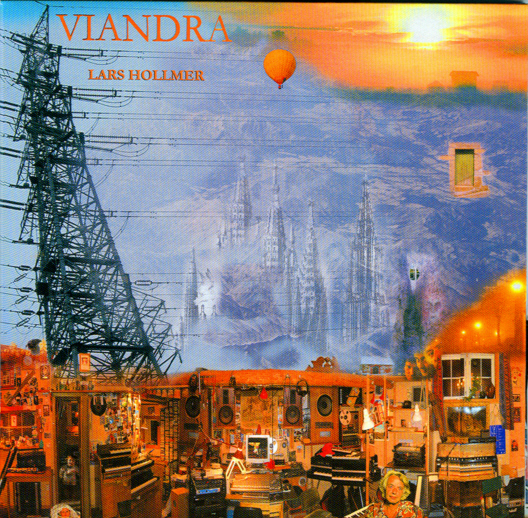
Lars HOLLMER: “Viandra” *****


Recorded 2001-2007


The world would be much gloomier a place without Lars Hollmer.  The Swedish composer, accordionist and keyboard player was the key force behind the legendary Samla Mammas Manna and has over the last quarter of the century developed a unique melodist vocabulary, drawing inspiration from both European folk music and baroque.


Holed up in his “Chickenhouse” home studio in Uppsala, Hollmer has regularly brought to Nordic light series of highly successful accordion miniatures.  Whether in stately fugues and cantatas, jolting polkas and farandoles, rapid scherzos and capriccios or pensive lullabies and bagatelles, Hollmer’s final synthesis remained highly original and instantly appealing.  Despite his frequent references to the traditional dances of the European north, the relative paucity of direct quotations has kept him apart from the Scandinavian folk renaissance of the last 15 years. 


Some of Zamla’s fans reproach Hollmer for not replicating the band’s sound more faithfully.  But Zamla was always more than just Lars Hollmer.  His solo records lack the band’s contorted time signatures, contrary motions, Coste Apetrea’s guitar twitches or extended, mirthful extemporations.  Still, Hollmer’s recordings more than compensate for that with cliché-free emotional content and open minded attitude to a variety of musical traditions. 


Viandra

This is not the first time that Hollmer opens his record witch such an unassuming, feathery tune.  His accordion knits slow, reedy gables.  Harmonic mellotronics materializes, setting the stage for middle register, consonant melodic line.  But the gracefulness of the piece distracts from the otherwise unstable periodicity of the epicycles carrying not one, but several charming sub-themes. 


Mirror Objects

This time mellotronics invites us to a poignant waltz.  Hollmer’s accordion merely serves harmonics.  The piece stays afloat, eerily tinged with 1940s’ tenebrism. 


Sök

The track begins with a low-key glockenspiel, then moving on to a full quartet sound.  Michel Berckmans enters on stately, silicate English horn, joined by Santiago Jimenez on violin and Andreas Tengberg on cello.  The isostatic character of the piece first smacks of distant memories of a music school, save for the seasoned pizzicato.  The band burgeons in an atmosphere of serenity, later carmelizing into decorative baroque quatrefoils. 


Snabb

In a radical change of pace, “Snabb” introduces high volume, bass-laden digital drum setting for a melodica and accordion line.  In turn, the subsequent transition will draw on Miriodor-like, keyboard-led neo-classicism.  The rest of the piece is be filled by the contrasting alteration between the drum episode (courtesy none other than Morgan Agren of Mats & Morgan fame) and the classicizing keyboard answer.  Towards the end, the robust pummeling will be enriched by tinny, hollow kalimba touches. 


Moldaviska

This track was apparently inspired by a Moldavian girl who appeared in a movie to which Hollmer wrote a score.  A short divertimento for accordion, melodica and acoustic piano proves Hollmer’s willingness to constantly refresh his format with new sources of folk inspiration. 


Påztema

A wistful, songlike cavatina of highest caliber.  It is delivered camminando with the basic bass line from the keyboard bass, and the melody spinning through melodica.  Ulf Wallander on tenor saxophone adds some agility to lower registers, enhancing the bass line.  This is one of the most romantic moments on this record.


Prozesscirk

The full quartet returns with strings and accordion interplay – a format that can scarcely escape comparisons to Astor Piazzolla’s legendary dramaturgy.  Glockenspiel and keyboards are in clear lead, hosting a concordant, ashy veil of bassoon, cello and violin.  A double of violin and accordion paint a theme that hangs over like cirrocumulus.  This could easily qualify for Hollmer’s another film score. 


Merged with Friends

Piano and melodica open in a gentle, tender, optimistic tone.  This is Hollmer’s well-trodden format – first the exposition without the bass line and then the primary theme repeats it with the support – this time performed by Berckmans’ organic bassoon.  The piano will provide some variation before fizzling out.


Konstig

A trio with bassoon and violin.  The track’s rhythmic mobility converges on melodica’s excesses – well supported here by the bassoon.  Then, a surprise transition leads to an eerily familiar, ecstatic melodic adventure.  On the way down, the more prominent violin provides a welcome textural enrichment.  The non-linear seams that tie together the hummable refrain will probably exclude “Konstig” from the radio, but otherwise its bold and swinging panache would beat commercial melodists hands down.


Baladeis

A stately, contrapuntal fughetta with Berckmans on bumblebee bassoon.  Its glyptic polyphony is appropriately artful and elegant.


Strutt

A polka written for accordion and melodica.  It throws us back to Hollmer’s hard-driven folk dances from his early LPs.  Even if the intention is a little facetious, the resulting jumpy repetition is ludic and frivolous.


Lilla Bye

This delicate berceuse cradles us with mandolin and random cuckoo vocals from Hollmer’s three granddaughters.  The multi-focal arrangement of vocalizations and the choice of flocculent instrumentation bring to mind some of Albert Marcoeur’s more lyrical moments. 


Första 05

Violin and cello slog along chained in some doomed pilgrimage.  This is another baroque piece, quiet and solemn.  The initial ricercar sets the key for the bleak string development – somewhat reminiscent of Univers Zero’s metaphysical dirges. 


Alice

We wake up from the nightmare into a happy sunrise serenade.  Hollmer’s granddaughter officiates here in a “singing” part, thanks to the author’s innocuous nepotism.  Luckily, Zamla’s Coste Apetrea provides some assistance on mandolin.  It is full of sparkling, youthful optimism. 


Överdagö

Michel Berckmans’ autumnal oboe sobs slowly.  When glockenspiel and violin rejoin, Berckmans switches to harmonic bassoon.  Santiago Jimenez steps to the fore, and engages in a downcast, rueful duet with Hollmer’s accordion.  This brings back inescapable memories of long evenings en el barrio de Boca


Foldron Menad

Hollmer’s introspective string samples set up Jimenez to perform a love call which sounds like a Hungarian gypsy whine.  Somber, cheerless shadows are cast against an unobtrusive sampled chorus and a poignant cello line.  This quiet composition is marvelously evocative but at the same time pleasantly restrained.


Folkvandringslåt

This much earlier track has been added to round off the entire set on a more optimistic note.  A simple dance played by Lars on accordion and keyboards possesses parameters of a polka – the quintessential accordion dance.  Yet some of the keyboard developments are unmistakably Hollmerian and when he begins to spin around, it could just as well be Colombian cumbia.  The artist is such an emporium of themes that this array of influences turns each dance into a highly idiosyncratic proposition.  There is only one Lars Hollmer.


*** 


Until the very recent appearance of the supreme “Viandra”, it was position 4 that was most often drawn from the shelf.  However, 2, 3 and 5 are equally recommended.  Positions 1 and 8 are live performances of two different bands – extremely lively and brimming with cheerfulness to clear up any gloomy day.  Both 1 and 9 make extensive use of traditional themes.  From position 7 onwards, Hollmer spent a lot of time digging into his considerable inventory and inevitably some peripheral sketches crept into the public domain.  Positions 14 and 15 are artistic résumés transposed onto a micro-Japanese and macro-Canadian context, respectively. 


1. RAMLÖSA KVÂLLAR: Ramlösa Kvâllar (1977-78)

2. Lars HOLLMER: “XII Sybirska Cyklar“ (1975, 1980-81)

3. Lars HOLLMER: “Vill du hora mer“ (1981-82)

4. Lars HOLLMER: “Fråu natt idag“ (1983)

5. Lars HOLLMER: “Tonöga“ (1984-85)

6. Lars HOLLMER & the LOOPING HOME ORCHESTRA: “Vendeltid“ (1987)

7. Lars HOLLMER: “Vandelmässa“ (1972, 1983-93)

8. LOOPING HOME ORCHESTRA: “Live 1992-1993” (1992-93)

9. FEM SÖKER EM SKATT: “Fem söker em skatt“ (1987-1994)

10. Lars HOLLMER: “Andetag“ (1993-97)

11. Lars HOLLMER: “Autokomp A(nd) More“ (1982-1991, 1998)

12. Lars HOLLMER: “Utsikter“ (2000)

13. Lars HOLLMER’s GLOBAL HOME PROJECT: “Sola“ (2001)

14. Lars HOLLMER & Yukiko MOKOUJIMA DUO: “Live And More” (2003)

15. FANFARE POURPOUR & Lars HOLMMER: “Karusell Musik” (2006)

16. Lars HOLLMER: “Viandra“ (2001-2007)


Other recordings labeled by Hollmer or his LHO can be found on various compilations from the 1980s and 1990s: “Ré Records Quarterly Vol.1 No.1”, “Festival MIMI 89”, “Hardi brut”, “Angelica’92”, “Angelica’93”, “Haikus urbains”.  He also appeared on numerous recordings of other musicians – Fred Frith, Wolfgang Salomon, Volapük, Miriodor, Guigou Chenevier among them.  Naturally, there are also various other recordings of Samla Mammas Manna, Zamla Mammaz Manna and Von Zamla.  Sonic Asymmetry will return to these one day with great pleasure.


Hollmer is also a member of the international combo Accordion Tribe.  His classic compositions belong to the band’s repertoire, showcasing slightly different arrangements.  The last of the three CDs is more Hollmer-heavy.


ACCORDION TRIBE: “Accordion Tribe” (1996)

ACCORDION TRIBE: “Sea of Reeds” (2001-02)

ACCORDION TRIBE: “Lunghorn Twist” (2005)

Published in: on July 6, 2008 at 4:37 pm  Comments (3)  
Tags: , , , , ,

CURRENT 93: “Nature Unveiled” ******

Recorded 1984


In the early 1980s, Current 93 and its founder David Tibet were a pillar of England’s esoteric underground.  But while most bands continued to explore the debris of industrialism, David Tibet entered a then uncharted territory populated with mystic obsessions – the occult, Aleister Crowley’s hermetism, Comte de Lautreamont’s nihilism, monotheistic and Buddhist spiritualism, near-death experiences.


At its best, Current 93 was neither hierophanic nor iconoclastic.  Tibet, supported by the studio talents of Steven Stapleton never attempted to express the ineffable.  Rather, the focus of the early recordings was on the tortured, medieval scenery juxtaposing the angelic and the demoniac, the Gnostic mysteries and the Gothic splendor.  This is not to exclude that David Tibet was, indeed, prodded in this direction by genuine afflatus. 


The multilayered productions of 1984-1986, heavy on echoing Judeo-Christian chanting, tape manipulation and abrasive recitations became lasting classics.  During these years, Tibet and Stapleton were frequently supported by John Fothergill, John Murphy, Nick Rogers, Annie Anxiety, Roger Smith, Tathata Wallis, Steven Ignorant, John Balance and Rose McDowall.  Most of these artists appeared in many other formations at that time.


The real mystery is why after 1986 David Tibet lapsed into an artistic coma and launched an interminable string of records riddled with supposedly apocalyptic, but mostly puerile rhymes.


Ach Golgota (Maldoror Is Dead)

The side-long composition initiates us into an atmosphere of petrifying horror.  A malevolent beast inhales and exhales with painstaking precision – claustrophobically close to our ears.  This abominable, monstrous sonic motif will recur throughout the composition.  But the focus of the recording is on the emotional power of ancient Christian chants.  Although much has been made of David Tibet’s interest in Gregorian monophonies, the character of the vocal drone that buttresses the choir makes it more likely to be of Byzantine or Coptic tradition, singing to the glory of Pantocrator.  The contrast between the horrifying proximity of the beast and the exalting drones emanating from Temenos is almost unbearable.


The mighty choir proceeds slowly, undisturbed an electronic burr that Steven Stapleton extracts from his repertory.  A third seam is being added – a repulsive, dantesque, porous male voice lurches out, overreliant on open vowels.  When the voices multiply, the carnivorous, guttural breathing returns.  All this bathes in a dark stew of deep echo and reverberation which drown out pathologically insomniac piano chords.  An alcove occludes reeds and percussive shingles; a bassoon hides in the baptisery…  From the demoniac voice germinates a smeared out, abrasive recitation.  The echo, sustain and slow release make it impossible to capture the sense of the prayer.  The dejected piano chords thrust as if from a different dimension, arousing the catacomb-dwelling beast again. 


The hummed damnation is exposed to some spuriously sub-rhythmic repetition while the agonizing, condemned voices remain the focus.  This last part of the composition is more openly electronic.  Crippling electromagnetic beads mutate into a sizzle and then smelt into slabs, cross-mutating with the demon’s voice.  Colloidal, radio-magnetic clouds appear in an excellent display of shock-awe electronics from John Murphy, John Fothergill and Nick Rogers.  The vocal reaches an expressive climax, subsuming the sprawling infra-growl.  This all clears the apse for the final howl of anguish and pain.  Stapleton allows his internal combustion engine to move in slow motion.  Like a stream of felsic lava, it all slowly cools down, rarefying the ambience.


The Mystical Body of Christ in Chorazaim (The Great in the Small)

Like a clerestory that lets in a beam of light, this composition’s evanescent beauty relies on the recurrent choir of nuns, immersed in a faded echo.  Afar, sampled strings hand over a dolorous refrain.  Meanwhile, a deeper, thermospheric layer overcasts the sampled rhythm.  Two more sonic mappings will blend into the imagery of malaise: a male Gregorian choir, extensile, twisted and disfigured; and Romanic declamation pleading the Lord for absolution. 


The correlation between the two choirs does not seem to be aleatoric.  The female waves rhythmically lash in and out, in torment and lamentation.  The Gregorian choir endeavors to find the inner sanctum.  A didjeridoo buzzes with its elliptic, see-saw abandon.  Tragic mellotron strings join the thick, tessellated lattice.  Disorienting cut-ups close this section, leaving the listener to marvel at the colonnades resonating with the song of solitude that still emanates from the female choir.  Quite unnecessarily, some sequenced synthesizer bleeps percolate through the Gothic walls.  Angelic voices soar, instantly infected by tape speed changes, direction reversals and trajectory vacillations.  Only the “nun” choir perseveres, oozing in and out inexorably. 


In the last section, a skronk of a wooden cart parades behind our ears, leaving a sfumato rut in the loam for the female choir.  The buzz returns, jarring and increasingly prominent.  Initially a minutia, it ferments into a pervasive sonic canopy, haunted by Annie Anxiety’s howling apotheosis of final damnation. 


***


Between 1984 and 1986, Current 93 could do no wrong.  It is difficult to choose between these remarkable recordings, which married successfully Tibet’s hermetic visions with Stapleton’s undeniably novel studio creativity.  Then came “Imperium” and the spell was gone.  Tibet somehow decided to pioneer a very different style – a particularly loquacious form of apocalyptic folk.  It stomped and it strutted with menace, but despite Steven Stapleton continued involvement it never appealed to Sonic Asymmetry.  A long list of these recordings would be out of place here.


CURRENT 93: “Lashtal“ EP (1983)

CURRENT 93: “Nature Unveiled“ (1984)

CURRENT 93: “Dog Blood Rising“ (1984)

CURRENT 93/ NURSE WITH WOUND: “Ballad of a Pale Girl / Swamp Rat“ SP (1984)

CURRENT 93: “Live at Bar Maldoror“ (1985)

VARIOUS ARTISTS: Gyllensköld, Geijerstam and Friends.  Live at Bar Maldoror (1985)

CURRENT 93 / SICKNESS OF SNAKES: “Nightmare Culture“ MLP (1985)

CURRENT 93: “In Menstrual Night“ (1986)

CURRENT 93: “Dawn“ (1983, 1986)

CURRENT 93: “Imperium“ (1986)


This is not to say that David Tibet’s talent simply evaporated.  In the late 1990s, he recreated some of the old magic on several records.  These are heavily studio-manipulated affairs, with “Faust” probably the most engaging of all.  “The Great in the Small” is an interesting concept, squeezing into one LP the multilayered themes from previous records.  “In a Foreign Town” is an electronic fresco created for Thomas Ligotti’s writings. 


CURRENT 93: “The Starres Are Marching Sadly Home“ ½ LP (1996)

CURRENT 93: “In a Foreign Town.  In a Foreign Land“ (1997)

CURRENT 93: “Faust“ (2000)

CURRENT 93: “The Great in the Small“ (2000)


Regrettably, the last three are the exceptions to the otherwise dominating folksy mannerism in which the most recent output has been mired. 


Current 93’s older tracks from the early period can be found numerous compilations:  “Myths 4”, “The Fight Is On”, “Devastate to Liberate”.  More recently, the band also participated on “Hot Buttered Xhol” – a tribute to the legendary German band.

Published in: on July 5, 2008 at 8:57 am  Comments (1)  
Tags: , , , ,

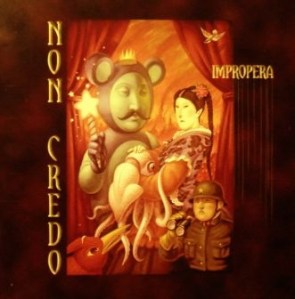
NON CREDO: “Impropera” ******


Recorded 2006


The duo of LA-based drummer Joseph Berardi and singer and multi-instrumentalist Kira Vollman first surfaced in the late 1980s.  After early experiments for vocal and percussion, they began to explore a richer palette of sounds, incorporating accordion, cello, clarinets, keyboards, viola, marimba, bass and radio.  Such was their thirst for chromatic wealth that the duo apparently tried to broaden the format by co-opting other musicians, an attempt that eventually failed. 


Their strength lies in Kyra Vollman’s capricious vocalizations rooted in the heritage of musical theater and the traditions pre-dating 19th century bel canto.  But her classically trained vocal ability strays often onto operatic arias, haunting siren songs, menacing lectures – all delivered at a clip elusive even for an attentive ear.  The sound perfectionism is achieved through ample access to the duo’s Zauberklang studio.  The textural wealth of their material belies the predominantly improvisation-based musical creativity.


This is musica di camara moderna of the highest order.  It was, therefore, with great pleasure that the globally dispersed audience welcomed the long delayed update on Non Credo’s oeuvre.


NUDO E CRUDO

Prima Punta

Carried by an orderly harpsichord continuo, Kyra Vollman commences her recitativo secco.  Her classically trained voice, laid against the spiky keyboard strokes, inevitably brings comparisons to Opus Avantra.  But when her clean, lyric soprano goes arioso, she is more dramatic and serious than Donella del Monaco ever was.  The aria decelerates exhibiting her light, flexible tone.


8 Bit Whore

This is the first time Joseph Berardi unleashes his flaring matrix of samples and percussion.  Entering with a snare drum he will refocus our attention like a magician.  This is a blindfold test that even the most attentive listener will struggle with.  First an old, edgy jazz trumpet emerges from Berardi’s keyboard-induced samples.  When exotica congas begin their jabber we are transported to the cigar-filled dens of early 1950s Cuba.  Dark piano arpeggios do not disrupt the quick runs of a damned, wild rumba.  An atmosphere of Santeria jazz is further bolstered by sampled tenor saxophone.  Over this plethora of references, only a live bass clarinet makes some brief, free commentaries.  Do not expect it to sing in Spanish…


Hubris and Greed

An engaging contrast sets in between wild, obsessive woodpecking and indifferent humming.  Vollman whispers a text about a miser bum – formerly a failed stand-up comic.  She conveys this rather sad story with no compassion, on the contrary – there are shades of spite.  The doorway cracks, opening the way to traumatic giallo of groovy Italian films.  These samples approach the innocuous suspension of a vintage Ennio Morricone or Piero Piccioni.  Vollman’s recites the text with a low-pitched, critical, almost perverse voice which contrasts with her trained, clear vocalizations. 


Bella Donna

Dull, deadpan thuds and backwardated buzz reach us from Berardi’s sample bank.  In a display of melismatic virtuosity, Vollman the Witch meets here her operatic persona. 


Trouser Role

For a fraction of a moment, a Philip Jeck-like old record scratching suffocates us with ample color of the bygone era – lupine, vermillion, chamois, ochre.  Vollman’s exuberant vocal show ranges from contralto rapping scat and non-descript coloratura to extortionate theatrical firecrackers.  Her range is so extreme and the transitions appear so latex-smooth that Shelley Hirsch’s early experiments come to mind.


Faux Afro

Vollman’s bass clarinet is left here alone, struggling with sampled, mechanic, piston and cylinder cum bass sample, known from Marie Goyette’s exquisite recordings.  Given the slightly minimalist background, the bass clarinet soundpainting evokes John Surman’s electronic period, even though the sound palette is very different here.  The track ends up on a pyre.


Deep, Deep Down

Again the affected, exorbitantly accentuated story-telling reminds us of Shelly Hirsch.  Kyra Vollman goes guttural, jumps over to fricatives, nearly chokes on ingressives, excels in oval vocalizations, then gargles and regurgitates duck-like semi-diphthongs.  All along an organ sympathizes with the vocal boneless wonder. 


Via Nino

This time Berardi offers us sampled strings.  In itself, such a trite proceeding could almost lull us into somnolence, but there is a novelty here – a    m e l o d y.  The suspense is (again) redolent of Italian film style of 1960s and 1970s.  Even though the rhythmic buoyancy tends to fingerpoint mirth, the actual vocal effect is haunting and intimidating.  Vollman’s vocal strings rise so effortlessly that the texture pleads for some friction.  Graters and metal gongs are au service, bringing back a more terrestrial atmosphere. 


Heaven Help Us

A tight, nervous, mysterious cry for help with Vollman officiating in two roles – a naïve one and an experienced one.  Some metallic clang and a refined basso underpin this modern cantata.


Interval One

A babble arises from a crowd.  A crankshaft volunteers a clank: “Clank”. 


SONO CONFUSO

Sicka Siam

This second movement of “Impropera” begins simplistically, with a rhythm machine and a melodica.  Clobbered, marching music depicts a nightmarish vision of person locked up in Bangkok “on trumped up charges”.  A guitar, crawling ad libitum, responds with jangles while the bass clarinet performs over a sampled piano form.  The melodica swishes back.  Despite a very contemporary production, it is here that we recognize Kyra Vollman from her prudish-sounding debuts some 20 years before.  A string-like sample eventually takes over, cut up to pieces by the melodica’s flat-footed, pathetically constrained, plastic improvisation. 


Stock and Trade

Another diplay of vocal Fireworks from Vollman.  Bubbly, gaseous electronics is overpowered by a thorny effect – as if someone let a metal bar hit running wheel spokes.  Jaded warnings echo “nothing new”.  Samples glue distant drumming and a barely perceptible groans.


Sleeping Beauty

This is a depressing story of abandon – with a devastatingly simple, horrifying electronic pulse that occasionally triggers log drumming.  Vollman’s impudent recitativo seamlessly yields to soprano arias.  Her demoniac whisper spits out some macabre lines.  It seems that the bass clarinet parts are little more than an extension of her considerable vocal techniques.  In any case, her staccato tonguings appear to indicate it. 


Odor of Sanctity

More inertial, expansive bass clarinet lays out its dusty souvenirs without urge.  Vollman’s treatment is first breathy, then moves to a fuller tone, particularly impressive in the mid-range.  The samples showcase furtive strumming, augmented by Bernardi on long drums.  The clarinet’s tremolo rides epicycles around sampled Byzantine touches.  This is Non Credo at its most atmospheric and ill-bient. 


Interval Two

In a dreary, industrialized repetition metallic wrenches hit some object regularly, while backward tapes collect distorted voices. 


FACCIA BRUTA

Faux Cazzo

“Impropera’s” third movement begins with dilated, kimberlite prepared piano chords, ladle-full of Cageian nostalgia (“Sonatas and Interludes”).  Manifold keyboard sheets are overlaid, some muted, some metallic, accompanied by shell-shocked percussive blasts.  Meanwhile, Vollman impersonates a seductive siren from an aquatic, Greek myth.  Detonating rhythms distract her into a baritone-like phrasing, even though her voice cannot reach that pitch. 


Laptop Dance

A tabla sample was clearly picked for the dud resonance rather than intricate Indian meters.  Rotary patterns let the music flow slowly, despite all the fluttering, honking or factory sirens.  Sirens?  Well, not really.  When the sample is allowed to fan out fully, it proves to be a jazz big band.  It is an eerily familiar sequence, but I cannot recognize the source (if you can – please leave a comment below – I am not going to venture a guess that this is Count Basie).  Vollman’s bass clarinet improvises all along, which is formally captivating; bass clarinets usually bend easily and do not have a projection that allows them to come to the fore from a full big band backing.  The prepared piano returns, in an emotional, malleable moment.  So does the washboard. 


Vienna Fingers

The track opens with a marching snare drum.  But the jolt comes from the castanets’ sticky kiss.  Vollman’s detached vocalizations turn into angry complaints about “a lie”.  Then a trio of harpsichord, castanets and snares prepares the ground for operatic soprano aria.  Glockenspiel’s transparent tinge seeps through it all.  In her insolence-inspiring martial whispers Vollman tends to sound Germanic – her consonants are devoiced and stilted, vowels angular and glottal.  Is it a pastiche?  Not more than American actors’ performance in some of the older “Second World War” movies.


Epilogue

This epilogue takes us back to harpsichord continuo and recitativo secco from the opening.  Upon reflection, Vollman’s dramatic mannerism probably brings her reaches an octave higher than the Italian counterpart, referred to at the beginning.  The harpsichord is too busy to be just a classic obbligato.  Rather, its arpeggiated ad-lib facets evoke the instrument’s rebirth parented by modern virtuosi and their partners – the 20th century composers. 


***


For a ‘band’ whose productions have been appearing for 20 years, the total output has been relatively thin.  Of the three official CD, I consider their last one as the most accomplished. 


NON CREDO: “Reluctant Host” (1988)

NON CREDO: “Happy Wretched Family” (1992-1994)

NON CREDO: “Impropera” (2006)


Non Credo’s tracks can also be found on several compilations, such as “Bad Alchemy Nr 11” and “Poetic Silhouettes”. 


Prior to forming Non Credo, Berardi played in a quirky art-pop combo Fibonaccis.  They have left behind several recordings, the most prominent of which bears some resemblance to Non Credo’s early format:


FIBONACCIS: “Civilization and its Discotheques” (1987)


Both Vollman and Berardi have been appearing in numerous other formations – Fat and Fucked Up, Kraig Grady, Punishment Cookies (she), Double Naught Spy Car, Obliteration Quartet, Eastside Sinfonietta (he).  Although the duo has apparently contributed music to many films and performances, none of this material is currently publicly available. 


Published in: on July 4, 2008 at 6:07 am  Leave a Comment  
Tags: , , , ,

ONLY A MOTHER: “Romantic Warped” *****

Recorded 1989


Only a Mother were something very, very different.  Theirs was a most revolutionary combination of ear-bending musical satires with highly unusual arrangements incorporating instruments from marching bands, rural backyards and the philharmonic halls.  Although many bands claimed to be cognizant of small town America’s musical traditions, Only a Mother were the wittiest, sharpest and most iconoclastic of them all.  Back in the 1980s, only Eugene Chadbourne attempted to provide a similarly detached social commentary by rewriting the history of America’s non-academic, white music. 


Frank Pahl from Michigan began to perform under the OAM moniker in the mid-1980s.  Despite a nebulous character of the formation, whose line-up overlapped with several other Midwestern bands, the basic core coalesced around Pahl with exceptionally talented multi-instrumentalist Marco Novachcoff, violinist Mary Richards, bassist Bobbi Benson and percussionist Doug Gourlay. 


The quintet was ahead of the game in their pleasing syncretism.  From medieval troubadour themes, through atonal improvisations for percussion to short folk sketches for toy instruments, Only a Mother never failed to generate a sense of fun – which is remarkable given the frequently morbid lyrics in their quixotic “songs”.


Elephants

A spontaneous assortment of shawms, ocarinas and whistles produces a multi-reed, inconsequentially tossed-up microcosm.  Frank Pahl appears as a super rapid singer, agonizing over bizarre misadventures of a young hitch-hiker.  It is unclear if autobiographical reminiscences mix freely with fantasy, or vice-versa…  For a relatively simply structured song, the acoustic orchestration is sumptuous – replete with flutes, clarinets, harmonium and a chorus.  When Mary Richards fiddles adroitly her descending notes we discover with some surprise that the tune is actually a waltz…  There is some affinity here with small choral works of Marek Grechuta, but given the light years that separate these artists, this could be little more here than accidental convergence, not a quotation. 


Mysterioso

The instrumental track opens with a bellowing violin à la Art Bears and crumpled percussion (is this the “sheet metal wakka” from the liner notes?).  Pumped up by Bobbi Benson’s comical double bass, this miniature is bluegrassy in all but its name and unusual instrumentation – complete with two organs and mandolin.  The high-pitch violin, placed here in unison with Marko Novachcoff’s harmonica has something of a hirsute, rural quality fondly remembered from Bob Dylan’s “Desire” (1975).  Although the acoustic bass keeps the band in pace, it all sounds wonderfully makeshift and ramshackle. 


Pardon mon Faux Pas

This could be a train song, were it not for its ironic grit and the notation that makes it “anti-country”.  This ode to provincial boredom is all the more truculent and trenchant thanks to cello’s raspy sul tasto.  The acerbic, biting irony (“ain’t a question of what you know, It is who you know that counts”) is almost tragicomic. 


Spinning

In a complete change of emotional spectrum, the band invites us to a medieval dance.  Irish recorder and Mary Richards’ astral vocals bring back the memories of Pentangle, Trees or Trader Horne.  This is medievalism at its most profane, a Carolingian feast within an earshot from the nearest campanile.  The timbres are appropriately selected – flute, bass viola, mandolin, melodica and a simple triangle.  In between, a more virtuosic, frictionless violin fast forwards the atmosphere by a couple of hundred years. 


Rack # 1

The entire band appears on percussion instruments in what apparently is an ‘ancient track of unknown origin’, assembled by Doug Gourley.  The topsy-turvy tuning approaches Harry Partch’s idiosyncratic experiments, although Frank Pahl & Co remain far more unassuming in their endeavor.  The racket is further augmented by horns brought from a sports arena and a toy xylophone. 


Rubbydubs, Mugwamps, and Wobblies

This could be a country-and-western ballad, nonsensical, iconoclastic and fed with the staple of acoustic guitars, mandolin and violin.  This last instrument evokes again the aforementioned “Desire” – in articulation rather than intention.  The band maintains a distance to the codified Nashville formula, not least thanks to the second-dimension lyrics.  Pahl does not try to force a Southern twang and operates in unashamedly nasal Midwestern accent.  Bass clarinet, out of its philharmonic element, overlays a woody chalumeau tone. The final vocal roar and a guitar clink chop off this welcome musical heresy.


Warp # 17

A valse macabre scored for accordion and violin with some assistance from a cumbersome bass saxophone and crystalline electric organ.  It is a doomed, eternally delinquent track of merciless damnation.  An accoustic guitar dances forlornly in the middle.  Nightmarish, deviant “oompapa, oompapa” oversees the swiveling theme, repeatedly displayed on reedy accordion and organ.  There are other “Warps” in Only a Mother’s catalogue, but “# 17” certainly belongs to the classics of American instrumental music of 1980s… 


Bucket of Brains

Marko Novacchoff’s farting bassoon harmonizes dryly for the rest of the band.  Soon Mary Richards lurches out and hysterically yelps out some necrophiliac story.  Her convulsive drama reaches out for the upper registers, but some stabilizing decency emanates from the lower range occupied by woodwinds.  The “song” advances by fits and starts with basso ‘humungo’ and bassoon picking up the pieces here and there.  Haunted vocalizing and the brassy “percussion” workshop accompany the messily strummed guitars and mandolins. 


Trigger Happy

This is another of those anarchic pseudo-country numbers.  Nervous guffaws and whistling introduce Ken Stanley’s text ridiculing advice fossilized in old proverbs.  Like a Pandora’s Box of giggling dwarfs that got out of control, the clownish song hops and pops…   Pahl wields his mandolin, strumming along with abandon.  There is probably more chortling per square foot here than on Frank Zappa’s momentous “Lumpy Gravy”.


Fingers of a Pumpkin

Another “medieval” track, but this time with a multi-storied tapestry of rococo arrangements (string trio, harmonium and cymbal).  The idea is alluringly simple – the melody flows, bursts out with the cymbal and bass drum, and then returns to the violin line.  Only the vacuum-filling mandolin is reminding us that these are Midwestern cornfields, not than a French conservatory. 


Doodley Squat

This simple, working class ballad is initiated with predictably Spartan instrumentation – over-reliant on Novachcoff’s harmonica.  It sports a typical structure – two stanzas, a round-off-it-all refrain with intensifying dynamic and a smoother instrumental bridge to another stanza.  The music is so overly conservative that only the socially critical text (referring to the 1980 attempt on Reagan’s life) prevents listeners’ gullibility.


Rack # 2

This is the second of those ‘Harry Partch’ moments on the record.  Although Only a Mother lack Partch’s ‘spoils of war’ or his ‘chromelodeon’, they the click, clack, tick-tac and occasionally scrunge awright (don’t get a wrong impression.  Sonic Asymmetry is fanatically fond of Harry Partch’s music).


Simple Song

At the outset, Doug Gourlay treats us to the rainy shimmer from a palo de agua (now, that must have been at least as simple as the title, we presume).  The rest of the band will combine the inputs from harmonium, cello, violin and acoustic bass into a tuneful song with vocal parts jackknifed octaves apart (Pahl and Richards).  Critical of middle America’s self-satisfied solipsism, the song has a wonderfully anti-professional, or at least-anti-academic feel, despite the seductive melody line.  The long coda descends the scale with determination. 


The Romantic Side of Ken’s Cat

A richly percussive moment of atonality, covered with animal-like calls from valved eccentricity of euphonium and extendaphone.  Climactic shouting precludes any development.


A Song for Mud

Here’s a longer chug-a-chug.  Pahl’s quavering voice delivers a morbid narrative about a disappointed first love.  Woodblocks and half-muted alloys barely catch up with the song’s progress.  The rapid scrubbing relies mostly on violin and acoustic bass.  When the bowed, burly bass retrenches the line-up, balalaika erupts, unapologetic for its belated hyperactivity.  The chorus eventually bids farewell to the bewildered audience…


***


The band’s first two LPs are the classics of the genre – “Romantic Warped” being probably the more folky of the two.  “Naked Songs for Contortionists” reworked some of the earlier material.  I have not heard the last two positions listed here. 


ONLY A MOTHER: “Riding White Alligators” (1987)

ONLY A MOTHER: “Romantic Warped” (1989)

ONLY A MOTHER: “Naked Songs for Contortionists” (1991)

ONLY A MOTHER: “Feral Chicken” (1994)

ONLY A MOTHER: “Dusty Nuggets” (1988-1998)

ONLY A MOTHER: “Damned Pretty Snout” (1998)


Before donning the hat of a one-man-orchestra, Frank Pahl began his solo career frequently supported by his companions from Only a Mother.  Certainly the early efforts, as well as “The Back of Beyond” are highly recommended.  I have never heard “Loose Threads”.


Frank PAHL: “The Cowboy Disciple” (1991)

Frank PAHL: “The Romantic Side of Schizophrenia” (1992-1993)

Frank PAHL: “Loose Threads” (1995)

Frank PAHL: “In Cahoots” (1997)

Frank PAHL: “Remove the Cork” (1998)

Frank PAHL & KLIMPEREI: “Music for Desserts” (2001)

Frank PAHL: “The Back of Beyond” (2003)

Frank PAHL: “Euphoniums Solo” (2004)

Frank PAHL: “Songs of War and Peace” (2005)


Pahl also appears in Scavenger Quartet, a more sedate and developed affair with little relationship to the sophisticated enthusiasm of the early days.  Little Bang Theory is a new and promising adventure for toy instruments.


SCAVENGER QUARTET: “Whistling for Leftovers” (2001)

SCAVENGER QUARTET: “We Who Live on Land” (2004)

LITTLE BANG THEORY: “Elementary” (2007)


In the early days, the musicians from Only a Mother participated in number of formations à géometrie variable.  Plug Uglies, Major Dents and Sublime Wedge were the most important of these, but unfortunately cassette recordings and samplers remain the only documents:


SUBLIME WEDGE: “Sublime Wedge” (1987)

SQUIDBELLY PHLEGMFOOT & the PLUG UGLIES: “Mass Murder 101” (1989)


Only a Mother can also be found on “Studio Animals” and “Bad Alchemy Nr.11”.  Frank Pahl’s compositions appeared on “Passed Normal, vol.5”, “Haikus urbains”, and “Musique du jouet”.


Published in: on July 2, 2008 at 6:55 pm  Leave a Comment  
Tags: , ,

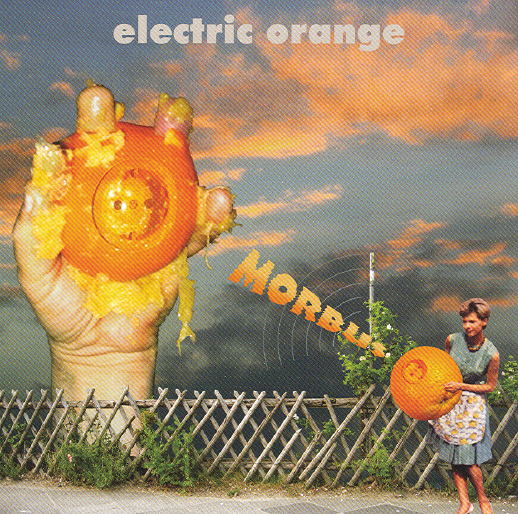
ELECTRIC ORANGE: “Morbus” ****


Recorded 2006, 2007


The juicy name and squelchy logo hide the considerable talent of keyboard player Dirk Jan Müller who since the early 1990s has been recording increasingly inspired jams in volatile constellations.  But mid-1990s he was joined by guitarist Dirk Bittner, but it took several more years before the core of the currently active band took shape.


Electric Orange seeks inspiration in the long tradition of rock jamming, but often straying from the well-trodden format into unexpectedly hooked arrangements and exploratory parentheses.  For all those who miss the extraordinary inventiveness of German music over a generation ago, Electric Orange brings a whiff of fresh air, albeit with an aura of healthy déjà vu.


Unfortunately, the musicians insist on filling the available CD space with some marginal material, which somewhat mars the coherence of the sets.


Einwahn

We are transported into the unconscious world of childhood memories filled with amusement park hubbub – merry-go-rounds, Ferris wheels, cheesy itinerant businesses.  Regrettably, this evocative anaphora leads nowhere…  Sudden assault comes from a tribal drumming circle that flails its way indefatigably with the hoof-like precision.  Jagging guitar sound and a Hammond-soundalike localize the ghosts of their stylistic patrons.  An extraordinary power emanates from the band – unwavering, tight and compressed.  When the organ begins to chuckle on its own bobsled ride, the Second Hand’s supreme “Death May Be Your Santa Claus” comes to mind.  The potent chug-along is vibrant and jubilant, quite unlike the title (“delusion”). 


Rote Flocken

Electronic hairpin serpentines open with pre-recorded, tinny voices in heraus-pronounced German.  The organ cradles us in a comfy rut allowing the guitars to explore various registers.  Snippets of distorted recitation probe the über-conventional organ & guitar riffing.  Impotent trumpet, piano strings, unidentifiable samples and percussive glimmer penetrate the herringbone structure of this track. 


Span 5

In a natural segue, a more resonant guitar grit punctures the trippy organ – bass – drumset perfection.  The crystal clear mix allows our senses to tune into the various guitar pitches simultaneously.  On top of the range, distant wah-wah scrambles for attention in a patchy cooperation with eerily evocative organ (Dirk Jan Müller must have grown up on young Richard Wright’s fastidious harmonizing).  Silvo Franolic’s cymbal splashes pile up layers of dense cloud formations.  The rest of the band needs to soar above these vigorous explosions.  And soar it does.


Morbus

The title track sounds like a tribute to Brainticket’s organ-led vortex, spinning tenaciously with the ease of “Cottonwoodhill” and taking us for a whirring steamroller ride.  Deposits of annunciatory voices are laid behind these gyrations, while a strained, pentatonic recorder bores holes in this cylindrical domain.  A full-scale guitar cum organ convulsion bursts in flames, only to reveal the unstoppable magmatic flow.  Screechy recorders will have the last word.


Errorman

Initially, the organ, guitar, bass and drums quartet adopts a more leisurely, trotting pace.  In a monumental entrée, the rhythm section veers off towards the ecstasy of vertigo-inducing passages.  Tom Rückwald appears on bowed acoustic bass, doubled on choir-emulating mellotron.  Silvio Franolic treats his plump drums and tinkling cymbals with measured, downy mallets.  Bittner’s voice is full of painful agony, but despite its menacing quality, the uncanny, tubular vocal carries also crosstextual messages from a long-lost pedigree (e.g. Silberbart, 2066 & Then).  Mellotron’s fake celestial strings close this pleasant déjà entendu


Flohfunknest

Acoustic guitar succumbs to a sound forest of hand drums, cortales, and thrown coins.  A funky interaction arises from the thumping electric bass and teasing soft rolls harvested with brushes by the drummer.  The band unleashes sonic debris – stereotyped ‘Bahnhof’ announcements, flippant effects from someone’s oral cavity, persuasive girls, manual tooth brushing, an old-time alarm clock, an electric shaver.  But underneath, this is but a circular funky rondo – a fairly conventional musical joke.


Traumama

We are now almost on a midsummer, Latin party terrain.  When the initial frenzy clears, a female voice adapts to the reigning climactic condition.  The hyperactive, but harmless, blithe beach guitars are reminiscent of latter-day Can’s dubious explorations into oases of rhythmic optimism.  Several isolated notes on a Spanish guitar shut this chapter.


Kratschock

After this 2-track parenthesis, the mood turns again, courtesy a threatening harmonium.  This catatonic instrument, rescued from oblivion 30 years ago by Univers Zero, is accompanied here by an intimate guitar, organ, drums and flute.  Electric Orange brings yet other memories of their nation’s formative Blütezeit.  The way the dispassionate recitation has been mixed in brings to mind the declamations by Walter Wegmüller or Sergius Golowin.  Acoustic bass and breathy flute frame the structure, supported by molten organ, much like early Gila – both in gesture and in form. 


Wald

First, vitreous sound of unknown provenience.  Next, a very international sound of a noisy schoolyard.  Then, sustained bass notes and mysterious harmonium gear the band to inchoate harmonic trajectory.  All these attempts are instantly spoiled by monorhythmic swelling and an angular organ chord.  This is a disappointing moment – the band creates anticipation that it does not live up to for several long minutes.  The prominence of the organ layer does not allow the muscular rhythm section to generate a punch worthy of Neu’s “Negativland” or Glenn Branca’s “Ascension”.  And even then, the idea would have been epigonic.  When Bittner’s singing breaks in, one is seriously puzzled – not sure if this is a parody, a dance number or a piece of failed space rock trapped in the troposphere and unable to overcome earthly gravity.  The harmonium and synthesizer fail to save the day, as the formulaic, isometric pounding is never too far behind. 


Reaching

This is a ballad for acoustic guitar and bass, delivered with a slightly distorted, rippling voice.  The apparent ingredients are there (mellotron, and flute), but the tune correlates poorly with the stronger moments on this CD. 


Schöhl

Crippling electronic intro yields to an official pre-announcement worthy of West Coast Pop Art Experimental Band.  Fast bongo runs and a pulsating bass leave much space – enough for the organ and guitar to accentuate the beat.  Each time the guitar repeats its two-chord routine, the bongo woodpecker wakes up.  Additional distortion is provided by simmering synthesizer effects. 


Sarau

Waves of low amplitude electronics wash on a sailboat fitted with organ and bass.  A toned down organ coupled with Josef Ahns’ ascending flute legato has many precedents: Ove Volquartz of Annexus Quam (“Beziehungen”), Herb Geller of Brave New World (“Impressions on Reading Aldous Huxley”) or Rainer Büchel of Ibliss (“Supernova”).  This engaging opening gives way to sub-Saharan hand drum and echoplexed guitar, with the organ ensuring further continuity.  In the final bars, a highly pitched guitar improvises until the final cut. 


***


ELECTRIC ORANGE: “Electric Orange” (1992-1993)

ELECTRIC ORANGE: “Orange Commutation” (1993-1994)

ELECTRIC ORANGE: “Cyberdelic” (1995)

ELECTRIC ORANGE: “Abgelaufen” (2001)

ELECTRIC ORANGE: “Platte” (2003)

ELECTRIC ORANGE: “Fleischwerk” (2004-2005)

ELECTRIC ORANGE: “Morbus” (2006-2007)


I have not heard the first three positions.  The general impression is that the band’s inventiveness has progressed on the most recent CDs.  “Morbus” was mastered by Eroc, krautrock’s ultimate studio joker.

Published in: on June 30, 2008 at 8:04 pm  Leave a Comment  
Tags: , , ,

ONE STARVING DAY: “Broken Wings Lead Arms to the Sun” ***


Recorded 2002


One Starving Day stand out among the new league of Italian bands which struggle to find their own musical idiolect in the intense urban traffic of contemporary avant-rock influences. 


The quintet, founded by Pasquale Foresti (vocals, samples and bass), includes Marco Milucci (guitar), Francesco Gregoretti (drums), Andrea Bocchetti (guitar) and Dario Foresti (synthesizer, samples and vocals). 


Critics usually shower One Starving Day with any number of labels affixed by such nifty terms as “post-“, “sludge-“, “doom-“ and such like.  None of these help to analyze the sound achieved on the band’s first full-length CD.  Whatever category One Starving Day falls into, the band reaches the high water mark.  Through the mutually dependent forces of attraction and repulsion, the musicians achieved a rare equilibrium between the aesthetics of abysmal ugliness and intumescent restraint. 


Black Star Aeon

Dario Foresti unleashes sequenced electronic stitches that loom and vanish repeatedly like slowing rotors of an unidentifiable flying device.  Sustained organ coatings and low-range buzz almost transport us to long oxidized Teutonic shores of Sand, Code III and Cosmic Couriers.  Bowed guitar and splashy cymbal overtones eventually hit the road.  An infernal machine awakens slowly from its catacomb, steadily lurching forward with delicate acoustic guitar cupids fluttering around.  Crunching guitars under its paws, the beast sniffs around before advancing further, oiled by sampled strings and achromatic synthesizer.  A repugnant, noctilucent growl penetrates this gruesome, outlandish imagery.  The drummer thumps out liquefied life forms from the monstrous apparition.  Along with deep, intimidating bass rumbles and sustained cybernotes, Francesco Gregoretti is solely responsible for solidifying the stationary bridges between the anguished stanzas. 


Secret Heart

Cello-like scale passages provide a suspenseful invitation into this dusky, pictorial piece.  Phlegmatically and unenthusiastically, a rich inventory of tones is stockpiled by the guitars, the synthesizer and the samples, all dipped into the solution of buzzing molasses.  From the didactic electric static, there emerges a guitar line and a menacing mid-tempo rhythm section.  Mushy surface swivels from the self-serving synthesizer.  Finally, the stately guitars strut forward like larger-than-life totems.


Fate Drainer

Unobtrusive electric guitar plants linear seeds in a frail, vulnerable groove.  The painstaking sowing is observed by sampled strings, and a rising crescendo from the other instruments.  Pasquale Foresti’s recitation is barely audible, but it does add a creepy sense of foreboding.  The band then changes direction, throttling back and eventually locking in the twin guitars in a comforting melodiousness.  Mutated, dissonant shouting and vocal altercations quickly subvert this open-sky ambience until a cosmic pause sets in with abrasive, plasmatic keyboard work and sustained organ notes.  The full band then offers a reprise of the initial theme.  Anguished, paranoid vocal turns this into an unexpectedly traumatic experience. 


Leave

Hand percussion and strummed bass tug each other hesitantly, spied on by a synthesized swirl.  The languorous pace and the dulled mix of the sluggish rhythm section here may be responsible for the inexorable comparisons with Godspeed You Black Emperor.  But in stark contrast to the Canadian formation, the Italian band juxtaposes a piano sound and sample strings with the leader’s unnerving, calamitous vocal nihilism.  As usual, the structure of the track is broken and a more introspective section relies on skin caning and birching, with some ruffled synthi sound interwoven into the infrastructure.  Back on stage, Marco Milucci’s and Andrea Borchetti’s guitars slog their way in a more eloquent and less pedantic fashion. 


Silver Star Domain

A frigid, apathetic piano solo struggles with its own parapraxes.  It does not attempt to correct them and for a moment the circular repetition brings to mind Corrupted’s most Pharaonic labyrinths.  Instead, Dario Foresti allows for the theme to evolve naturally, in a liturgic, elegiac fashion.  Raw, uninspired synthesizer peers somewhere from above…


***


This is so far the band’s only full-length recording.  Other compositions appeared also on samplers – “Emo Diaries 7” and “The Silent Ballet Compilation Series”, neither of which I have heard.  Apparently a new CD has been in gestation for a while. 


ONE STARVING DAY: “Broken Wings Lead Arms to the Sun” (2002)


Published in: on June 29, 2008 at 8:41 pm  Leave a Comment  
Tags: , , ,

Iva BITTOVÁ & Vladimir VÁCLAVEK: “Bílé inferno” ******

Recorded 1997


Iva Bittová stormed into the European avant-garde musical scene in the mid-1980s.  Born into a musical family with mixed Gypsy and Slavic roots, she incorporated elements of central and eastern European cultures into her repertoire without ever falling into the clichés of the so-called world music.  Trained in Brno as a violinist and singer, she developed a unique, conversational style that somehow appealed to the international improvisational scene on the eve of the political changes in Czechoslovakia. 


Armed with an arsenal of various vocal, violin and viola techniques, Bittová often betrays her theatrical tendencies.  Her music achieved an artistic peak during the period of collaboration with Vladimir Václavek, a gifted musical narrator whose sensual guitar-based songbooks only recently have attracted acclaim for their earthy authenticity. 


In this memorable duet, Bittová and Václavek often draw on influences from folkloristic dances and bucolic balladry.  They achieve astounding, complex textures and organic unity despite a narrowly scoped orchestration.  It is in the simplicity of “Bílé inferno” that lies its immortality. 


Vzpomínka

At the very outset, a disconsolate, Euclidean viola strikes us with its plaintive weeping until acoustic guitar dashes to its succor.  Soon after, Iva Bittová’s muscular vocalizing invites us to a jig lifted from Breughel’s village paintings.  The carnevalesque ambiance is further enhanced by jocular violin pizzicato and Václavek’s wordless accompaniment.  He then begins a lilting recitation, supported by a guitar stripped down to its harmonic and rhythmic role.  Even his congenial vocal, always in key register, carries only scraps of melody.  The refrain relies entirely on Bittová’s intrepid violin playing and her agile voice.  When the duo picks up pace, Ida Kelarová joins the increasingly bold chorus and tambourine.  In a more musing, calmer setting of pizzicato and unadulterated guitar, Václavek recites the final stanza of this “Souvenir”. 


Uspávanka

After several guitar chords one can recognize Václavek’s signature style.  Iva Bittová vocalizes here, accompanied by contextual shakers.  A five member-girls’ chorus produces a silvery, luminous echo.  Bittová sings and the girls reciprocate with youthful sparkle.  With its minimal instrumentation, this song evokes European students’ monochord bonfire incantations.  The percussion is restrained to the body of acoustic guitar and shakers, and yet, the isometric progression is vibrant and jumpy.  Some of the stanzas are acknowledged by Bittová and the pre-puberty chorus.  Then Jaromir Honzak appears on acoustic bass and the late Tom Cora on cello.  Their bowless duo will support the acoustic guitar chords till the end.


Sirka v louži

The ceramic, humble filigree begins with Bittová on tinkling kalimba and Václavek on bony guitar.  This time her singing reminds us of an apparition from a fairy tale.  Although she eschews Gilli Smyth’s vocal equilibristic, Bittová’s cornucopia of fanciful, theatrical effects is impressive.  Chromatic violin and sparse percussion accompany the torrent of her excited, breathy polysyllabism. 


Sto let

To an 8-bar figure on acoustic guitar, Iva Bittová whispers, clicks, and betrays her talents of variegated interpretation.  Her fiddle imitates blackbird calls and her onomatopoeic vocal covers a wider range than in previous songs.  When So Pakju’s text is finished, a frenetic village jitterbug emerges from a crafty, cliché-free interplay of guitar, percussion, fiddle, kazoo, bugle (Frantisek Kucera) and acoustic bass (Jaromir Honzak). 


Kdoule

Instead of a chord intro, the highest string plucked delicately.  The pattern is kinetically repetitive, minimalistic, almost autistic.  Frantisek Kucera accentuates the hollow walking line on Indian ghatam and Bittová’s delivers her extensive narrative with hushed, abstemious voice.  This burgeoning structure is overlaid with beige strokes from Turkish saz, but Václavek dodges any temptation to engage in simplistic Anatolian references.  His saz graces the listener with jangly, clipped resonance.  As in most compositions on the record, an eventual turn has to come.  Here it happens courtesy intrusive cello trills from Tom Cora. 


Zelený víneček

An exquisite vignette for piano and vocal from Ida Kelarová.  The heartfelt, exuberant melody line is based on a traditional folk song from Slovakia or Western Ukraine.  Kelarová and Bittová sing in unison with some assistance from girls’ chorus.  When Honzak’s joins on oily, metamorphic bass, the airy song is instantly brought down to jazzy (under)ground.  Although Bittová’s vocalizing will append it with a more familiar, vanguard element, the piano and a male vocalist (is it Honzak?) add an unexpectedly Karnatic hue to this oddity.  In the end, Kelarová and Bittová will repeat the entire folk song, solving the transitory puzzle in the process.


Moucha

The lyrics of this song (“the Fly”) lent the title to the entire CD.  It begins with obsessive mandolin tremolos and a viola mistreated by some terrorist who decided to saw the miserable instrument, instead of bowing it.  Still, the mandolin relentlessly advances, unaffected by the grim vocal and viola tortures in the background.  This out-of-tune intro will be closed by a scat worthy of an old Urszula Dudziak record.  Having changed the decorum, Bittová’s excellent diction will deliver the stanzas.  Her pitch ratio is well controlled and her voice is occasionally multitracked, with some polyphonic humming buttressed by the viola.  Her story-telling sanguine and elegant, supported by Václavek’s guitar which provides a reliable, comfortable backbone. 


Moře

After a short, classical sounding violin, the ambiance is warmed by westerlies from a slide guitar.  Tom Cora’s ascetic cello is dramatic, almost redemptive.  So is Bittová’s vocal manner, punctuated by frightening whiplashes from castanets.  Frantisek Kucera sustains some lines with an eerie conch shell before the band collapses into a sonic exploration of tone colorings, using deep echo, and tiny percussive effects.  When the theme returns, Bittová’s vocal again plunges into pain and agony.  Castanets fly around an aura of tragedy which contrasts with the metaphoric text.  “The sea is a beautiful face”, we hear.  It all ends with conch shell.


Starý mlýn

One of Václavek’s solo classics with instantly recognizable acoustic guitar phrasing.  His sober, approachable baritone tells us a story of an old windmill.  It is striking how much emotion he can extract from an unsophisticated chord progression and such minimal instrumental code.  Contrite shakers and cryptic finger rattling on the guitar are the only sources of diversification here. 


Je tma

In a more exotic setting, Iva Bittová’s magical whispers are met by sonorous tingling from listless African bow harp.  The tar-shaded, wooden atmosphere is mysterious and occult.  Impenetrable doors crackle nightmarishly.  This is not world music.  It is spine-chilling underworld music.


Churý churúj

The longest composition on this record begins as duo of acoustic guitar and viola.  The novelty here is in Bittová’s spiccato – allowing for the bow to bounce naturally of the strings.  But the effect is muted and void as if this was a ping pong ball bouncing (a technique known from flat guitar explorations).  Either way, this fragment is masterfully arranged – rustling, breezy, good-humored.  Václavek murmurs as Bittová hesitates between wordless singing and whispering.  After this lengthy introduction, Václavek’s warm guitar finally intones the song proper.  “Get Up Johanka” alerts Bittová.  Kucera joins with his flugelhorn watercolors, softening somewhat the violin’s edge.  When the text ends, the “spiccato” strokes recur… 


Zvon

“The Bell” begins slowly as if to illustrate ponderous movements of the clapper.  The guitar’s notes emulate the sequence of a handbell group, with individual sounds allowed to die out, rather than damped.  Bittová appears with her sour viola and her opening vowels evoke again Indian, nasal singing style.  As she recounts the bell’s daily chore, Václavek and the choir girls echo back a heart-warming “bim-bam”.  When Kucera’s granulated trumpet joins, the texture becomes more condensed in a fascinating show of mutually stimulating harmonies.


Hujlet

Mordechaj Gebirtig’s classic text is reproduced here by Bittová in original Yiddish.  The unsettling text reminds the young to enjoy the youth as the winter will soon set in…  Although Bittová and Václavek’s music evades klezmer touches, it fits perfectly the long lost world of crowded central European streets.  A thunderous drum and assorted percussion provide a pivotal build up for unstable violin and predatory vocalizing. 


***


“Bile inferno” has remained a one-off.  No other position in either artist’s discography has quite lived up to the intensity achieved there.  Still, Václavek’s poetic canticles should not be missed.  In particular RALE’s “Twilight/Soumrak” is an absolute must for those who enjoyed “Bílé inferno”. 


RICHARD-FUKUSHIMA-VÁCLAVEK-BIELER WENDT: “Arminius“ (1993)

RALE: “Ah zahrmi“ (1997)

RALE: “Twilight/Soumrak“ (2000)

Vladimir VÁCLAVEK: “Pisne nepisne“ (2003)

Vladimir VÁCLAVEK: “Jsem hlina, jsem strom, jsem stroj“ (1991, 1993, 2005)

Vladimir VÁCLAVEK: “Ingwe“ (2005)

Vladimir VÁCLAVEK & Milos DVORACEK: “Zivot je pulsujice pisen“ (2007)


Iva Bittová’s unquestionable talent did not always find the appropriate format.  Her first duet with Pavel Fajt was a revelation, but the harsh remix of most of the same songs on the second LP lost some of the charm of the debut.  From her later output, I particularly recommend “Ne nehledej” – a more lyrical chronicle performed in a style often bordering on Indian vocalizing.  In the recent years, she returned to film acting and her recording career in the US has been less prolific.


The discography below is limited to the records I know. 


Iva BITTOVÁ & Pavel FAJT: “Bittová & Fajt” (1987)

Iva BITTOVÁ & Pavel FAJT: “Svatba” (1987)

Iva BITTOVÁ & DUNAJ: “Dunaj” (1988)

Iva BITTOVÁ: “Iva Bittová” (1990, 1994)

Iva BITTOVÁ: “Ne nehledej” (1994)

Iva BITTOVÁ – DUNAJ – Pavel FAJT: “Pustit musis” (1995)

Iva BITTOVÁ & Vladimir VÁCLAVEK: “Bílé inferno” (1997)

Iva BITTOVÁ: “Classic” (1998)

Iva BITTOVÁ & NEDERLANDS BLAZERS ENSEMBLE: “Ples upiru” (2000)

Iva BITTOVÁ: “Cikori” (2001)

Iva BITTOVÁ & BANG ON ALL CAN STARS: “Elida” (2005)


Bittová appeared on many other compilations, not least on Fred FRITH’s famed “Step Across the Border” LP and the documentary film under the same title.  Some other performances have been captured on “Haikus urbains”, with Pavel FAJT on “Ré Records Quarterly Vol.2 No.1” and “Festival MIMI 88”, with Tom CORA on “Hallelujah Anyway”, with TARAF DE HAIDOUKS on “The Man Who Cried”.  In 1989, Frith dedicated his first String Quartet (entitled “Lelekovice”) to Iva Bittová.  It can be found on his “Quartets” (1992). 


Vladimir Václavek’s DUNAJ mostly performed and recorded without Bittová.  These documents, often supported by Pavel Fajt, are taut, aggressive affairs for post-punk ears.  The bands E and KLAR propose an update on this format.


DUNAJ: “Rosol” (1990)

E: “Live” (1990)

DUNAJ: “Dudlay”  (1993)

DUNAJ: “IV” (1994)

E: “I Adore Nothing” (1994)

KLAR: “Motten” (1995)

DUNAJ: “La La Lai” (1996)

KLAR: “Live CZ 97” (1997)

KLAR: “Between Coma and Consciousness” (2002)

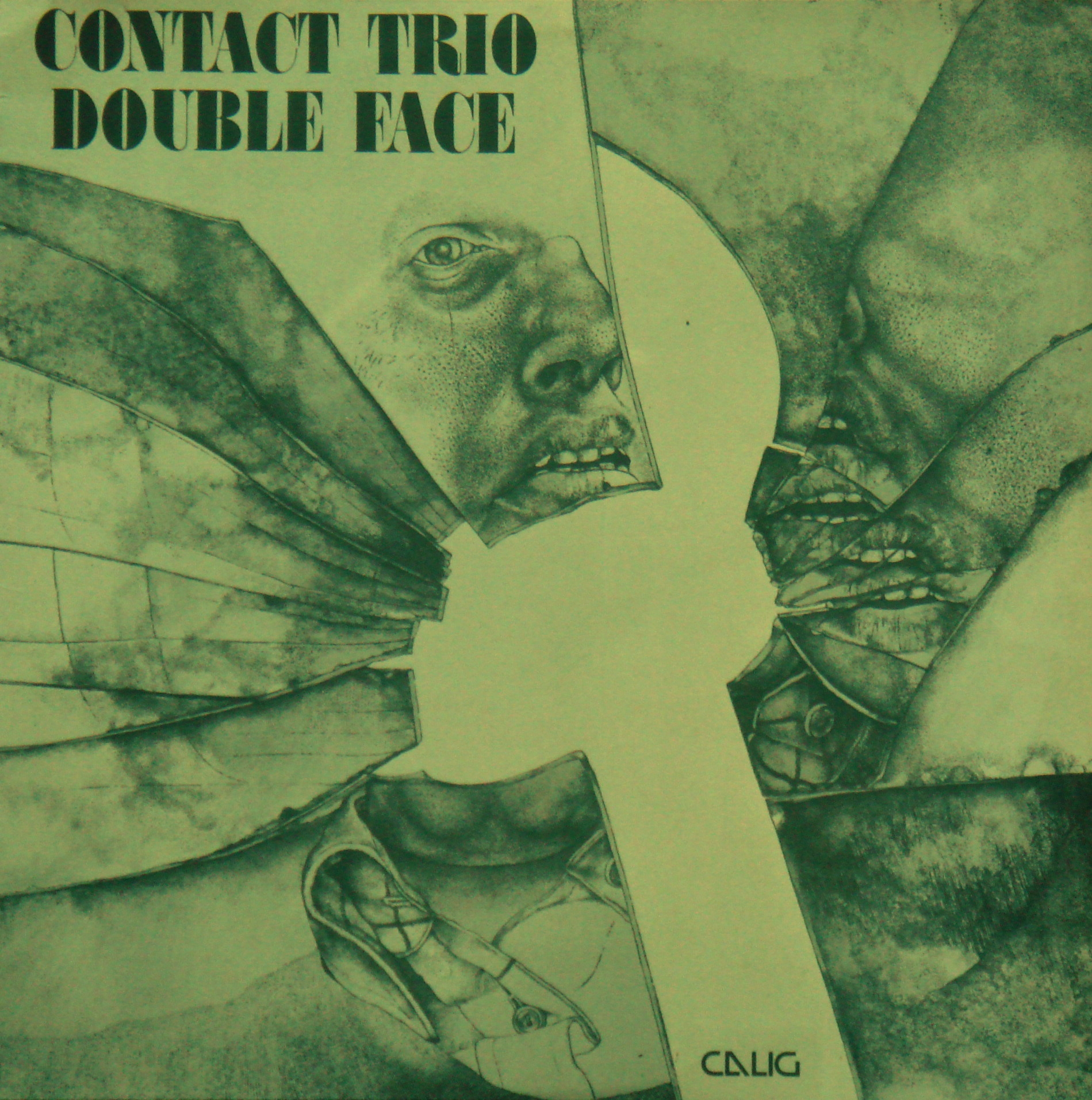
CONTACT TRIO: “Double Face” *****

Recorded 1974-1975


In late 1960s, drummer Michael Jüllich and bassist Alois Kott launched the concept of a trio straddling the “border” erected by the media between the rock and jazz scenes.  Continental Europe had none of the race divisions that were still determinant for the development of separate musical trends on the other side of the Atlantic.  The openly avant-gardish evolution of German rock music in the following years allowed Contact Trio to develop into a tight unit incorporating explorations into jazz improvisation, contemporary composition and ethnic percussion.  Contact Trio really took off when Evert Brettschneider joined on guitar in 1973.  


The band’s parsimonious tapestries were an antidote to over-orchestrated pedantry and calculated, aseptic guitar races that began to dominate derivative jazz-rock by that time.  Rather, the members of Contact Trio opted to nourish a mutual intrigue, but always foiling a full-blown arousal.  Their reed-less style, sometimes compared to Giger-Lenz-Marron or to Electric Circus, remained diagrammatic and introspective.  Despite the unquestionable quality of their music, their records never accrued the type of cult following that did many of their contemporaries. 


Rumpelstielzchen

The first sound of Contact Trio is that of a marimba, adroitly handled by Michael Jüllich.  It breaks the ice for a fast ostinato courtesy Alois Kott on acoustic bass.  Kott tees up for Evert Brettschneider on acoustic guitar, but the marimba appears to question this.  The full configuration offers an initial response, but both string instruments will now proceed more cautiously.  As the marimba and acoustic bass tiptoe along, an electric guitar introduces shreds of suspense; first intimate and delicate, then sharp and anguished, leaving us on tenterhooks.  The bass indulges in thorny, crumpled vibrato and the guitar leaches improvisations laid out perfectly within the tonal range of the marimba.  Brettschneider scatters some rugged flashes, but never races ahead.  Even though his guitar does occasionally bring to mind Dzyan’s Eddy Marron, Contact Trio’s arrangements are more transparent and permeable.


Double Face

The title track unfolds slowly with strings scraped along the body of the guitar.  Porous, bowed bass adds another pole of wiry attraction.  The strumming of the guitar could be a sign that the atonal intro is over.  Instead, the guitar sets an irregular time signature, still scraping the end of the notes, chucking them into a deep echo.  From that abyss emerges the flute (Jüllich), organically endearing itself to the bow.  The wind instrument seems to be instantly magnetized by the guitar-stressed bars.  Whereupon, the theme ceases…  In an ambiguous moment of self-doubt, the guitar and bowed bass refuse to meet on the scale, even though they seem to be aware of each other’s meter.  Jüllich’s tabla wakes them up, issuing an invitation to multivector explorations.  This improvised trio is hermetic, but legible, scraggly but sprightly.  Instead of a monsoon, the guitar calls on a whiff of Brazilian breeze.  To the ostinato of acoustic bass ostinato and tabla, Brettschneider spreads his wings, cruising above the multi-metric transom with ease.  His selection of pace, loudness and proportion is impeccable.  After a short melodic interlude from the bass, the tabla is left alone.  Most probably frowned upon by subcontinental purists, this parched, solo meditation bolts forward and perfectly sews into the fabric.


Englestanz

Brettschneider struts in, on a mystical electric guitar, with immanent delay and micro-distortion.  This daring, graphic ode is also our first introduction to electric bass and drums.  When the guitarist switches over to Toto Blanke-like fusion runs, the band is literally wrapped in glimmering cymbal ribbons.  Wah-wah bass blabbers something behind as the guitar mesmerizes us with its vitality.  Back to the illuminative march of the opening seconds, the trio crafts a forgotten classic of tri-modal jazz-rock avant-garde.


Sonate

A very presto entrée reminds us of some of Association P.C.’s memorable moments.  When the guitar loses its way, the exuberantly sparkling cymbals encourage Brettschneider to pick up speed.  Which he does, but fails to schlep along the rest of the band.  Contrary to naïve expectations, this now appears to be a prehensile improvisation for bipolar guitar and cymbal shimmer.  The second movement is played largo with mallets gently laid on the drums.  A neurotic, psyched-out guitar glides over the dreamlike bass steps.  This highly addictive guitar play is rather unusual in the jazz format (if it is jazz at all, a big ‘IF’).  With a slight echo thrown into the mix, the guitar self-observation gains plenty of transcendental freedom.  The third movement of the Sonata is devoted to repeated striking guitar salvos, always abandoned on a higher note.  The cross-chord technique would several years later be adopted by Henry Kaiser during his flagship atonal period.  Here, Alois Kott’s bubbly bass germinates goofily.  A molar drum solo purports to perform a rondo, but none of this is allowed to linger for too long.  Sharp, incisive cuts from the guitar catalyze the Sonata’s ending. 


***


Several years later, the trio returned with an equally exciting statement.  On their last LP Michael Jüllich was replaced by Peter Eisold.  The group continued to perform for several years without leaving any recorded traces.  All the three albums are recommended for the lovers of continental jazz-rock (?) avant-garde. 


CONTACT TRIO: “Double Face” (1974-1975)

CONTACT TRIO: “New Marks” (1978)

CONTACT TRIO: “Musik” (1980)


One later track can be found on festival LP entitled “Umsonst und Draussen – Papenburg”. 

Published in: on June 25, 2008 at 7:50 pm  Comments (2)  
Tags: , , ,

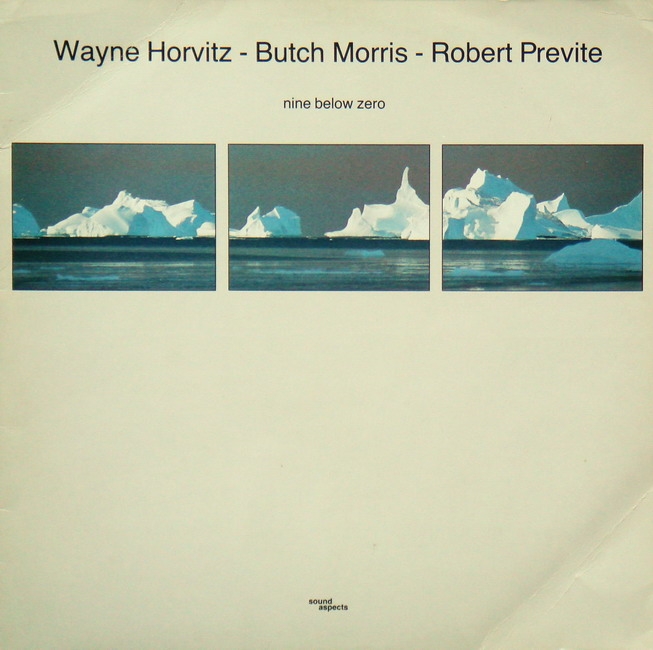
Wayne HORVITZ – Butch MORRIS – Robert PREVITE: “Nine Below Zero” *****


Recorded 1986


By the mid-1980s, Wayne Horvitz (keyboards), Butch Morris (cornet) and Robert Previte (drums) were household names on the downtown NY scene.  Morris had recently explored the trio format with two other musicians, combining his astral, satiny cornet pitch with the electronic soundscapes generated by traditional instruments.  Together with Horvitz and Previte, he decided to juxtapose his glacially restrained style with polycentric contributions on piano, keyboards, marimba and drums.  The results were unusual.  The lethargic pace of the recordings induced critics to seek polar metaphors, which could have been induced by the cover art that adorned the LP.  But if the arctic vocabulary applies, then it is in the unexpected reflections, twinkles and glows that catch up with an attentive listener with lagged irregularity.


The results of the encounter between the three musicians barely carried any similarities to their contemporaneous activity.  Horvitz had spent most of his time perfecting saccharine keyboard vignettes and leading unassertive pop-jazz combos.  Morris’s records were dominated by ambitious but disorienting scores for large-scale timbral ensembles.  Previte uncharacteristically hesitated between baroque jazz and industrial soundscapes.  Since the 1980s, all the three musicians have enjoyed illustrious careers, bifurcating from the no man’s land of “Nine Below Zero” into more easily defined pop rock jazz (Horvitz), orchestral scores (Morris) and eclectic jazz formats (Previte). 


3 Places in Suburban California

Muted cornet’s nasal sound opens the record, soon retooled into bright, full tone accompanied by acoustic piano.  Percussive contribution languishes, never too eager to catch up, while spiraling electronics flourishes diffusely.  The aggregation of loud acoustic piano chords and electronic spiderweb calls to mind some of Heiner Goebbels’s sonic canvases from that era.  Butch Morris extracts duck-like squawks from the cornet – just enough to bite through electronic hissing and shuffling headwinds.  Bobby Previte’s accents on drums follow close upon the piano’s rare, but decisive chords.  He focuses alternatively on a buzzy snare drum or on hollow, dark skins treated with mallets.  Then a marimba begins its clockwise regularity, bringing order to this smattering of electronic sizzles and swizzles.  The piano and the drumset are then snuffed out and DX-7 appears.  This was one of the most popular digital synthesizers in the 1980s – here endowed with timbales “voice”.  The DX-7 has a much shorter resonance than “real” timbales and allows Horvitz to improvise over the marimba’s gamelanic ornaments. 


Nine Below Zero

A wake-up call from the cornet and ringing electronic stridence, braying like an antique doll.  The DX-7 dominates here again in terms of both tone projection and velocity.  The veiled, muted cornet squabbles with this synthesized double helix and Wayne Horvitz re-emerges confidently on amplified piano.  A circular rhythm surfaces briefly, but is shut out by the bubbly, squeakly, disconcerting bush of microtones.  The low range is protected by Previte’s tympani, while Morris spends most of his time on sustained notes that are so muted that his instrument nearly achieves a trombone-like, corky tonality.  In less dynamic moments, his cornet sounds more like a round, mellower fluegelhorn, soaring above a dissolving, melting, amplified piano. 


Glory

This is the first of Robin Holcomb’s compositions in this collection.  It opens with acoustic piano (how else?) and a glass-like note that after a brief pause proves to be a shade of cornet.  This time, the electronic sweep is very discrete, limited to a sparse, dotted, bass line.  Henceforth, we are mostly served with a duo for a hesitant cornet and a vacillating piano.  Horvitz and Morris do not really play with each other, but rather listen (…) and then respond (…), aided occasionally by the near-infrasound of some electronic discretion.  Scraps of melody are fidgety until a childlike piano figure ushers in the full-tone, bright cornet.  They strut along, distinguished and monumental, before we realize that this is but a coda of a formally unbalanced composition.


If Only

A Gerswhinesque piano theme looms up inconsolable, only to be crowded by other, more talkative partners – a garrulous piano and a loquacious synthesizer.  Then a repetitive, syncopated theme appears from the entire trio, with dry skin rattle and some marimba patter.  It is an unhurried affair, always ready to stop over on a brownstone’s porch and look idly across a sun-drenched alley.  So much for the Arctic imagery?


Remind Me of You

A processional cornet and tambourine intro has something of a church lament – ceremonial and majestic.  An electric organ sound surges from behind, propping up the cornet’s notes to exaltation.  When it dies down, lonely tambourine will carry the torch for a little longer…


The Duchess

Roland drum machine, coupled with real drums throw the lost cornet and piano into a torrent of hyper-rapid progressions worth of David Van Tiegham’s early videos.  From today’s perspective it is hard to comprehend that fascination with in-human rhythms that left scars on many 1980s’ recordings.  Interestingly however, the interplay between the man and the machine on this track actually pays off.  Morris spins around without suffering vertigoes and Previte’s cymbals add an anthropogenic slant to the otherwise predictable setting. 


After All These Years

This is DX-7 at its most lyrical and romantic.  The synthesizer’s duo with marimba sketches a beautiful song as if lifted from a music box discovered in the dusty attic.  Perched against microscopic marimba rolls, Morris’s improvisation is like a modal update on 1950’s cool jazz.  Tantalizingly idyllic and evanescent, the trio abandons us in our longing for the melancholic, defining top seven notes from any of the three main actors: marimba, DX-7 or the cornet.  The belatedly recurrent motif is the strongest moment on the record.


Three Strickes

Martial drumming changes the setting.  Cavernous electronics croons eerily while a taped, disfigured, amplified piano slows down in mid-tempo.  Contorted cornet and prepared piano strings occasionally ooze through the ghastly croon.  Finally a high-voltage crack from the rhythm machine extinguishes this turbulent fragment.


Reno

Another of Robin Holcomb’s non-linear compositions.  Her manner of writing melodic piano tunes with shifting tempos is in full evidence here, prefiguring her monumental “Larks They Crazy” LP, two years later.  Robert Previte adds some shades of grey with his brushwork touches on the otherwise nocturnal, inert, almost amnesiac theme.  We are never certain if the main axis will recur and this frustrated expectation of the familiar chord progression forces us to focus on the irregularity of silences and pauses.  Like a mouse in a labyrinth, the track always finds a way out and proceeds with more vigor, making it a variegated, rather than simply anemic exploration.  Holcomb’s writing is so strong that it is not surprising that the trio soon decided to pursue the adventure using her compositions.


***


The trio appeared only on two recordings, replicating the formula on “Todos Santos”, entirely devoted to Robin Holcomb’s compositions.  Butch Morris had previously appeared in a similarly restrained collection of aural sculptures with electric guitar and trombone. 


Wayne HORVITZ – Butch MORRIS – William PARKER: “Some Order Long Understood” (1983)

Bill HORVITZ – Butch MORRIS – J.A. DEANE: “Trios” (1985)

Wayne HORVITZ – Butch MORRIS – Robert PREVITE: “Nine Below Zero” (1986)

Wayne HORVITZ – Butch MORRIS – Robert PREVITE: “Todos Santos” (1988)


Those who would like to explore these artists’ other recordings should keep in mind that they bear no relation to the music described here.  


Robin Holcomb’s piano songbooks of the era were collected on two LPs.  Wayne Horvitz (Holcomb’s husband) once admitted that he would sacrifice his little finger to become as accomplished a composer as his wife.


Robin HOLCOMB: “Larks They Crazy” (1988)

Robin HOLCOMB: “Robin Holcomb” (1990)

Published in: on June 23, 2008 at 9:32 pm  Leave a Comment  
Tags: , , , , ,